
Clinical supply
Capsules for clinical trials. Placebo, over-encapsulation, blinding sizes, and the paperwork
Compare placebo and over-encapsulation requirements, blinding sizes, capsule fit, and the documentation needed for clinical supply.
Written by A. Sanderson, CEO, Capsules.com
On this page
A protocol lands on your desk. It calls for a matching placebo, or it calls for the comparator to be hidden inside a capsule so that nobody in the study can tell the two arms apart. Either way, an empty capsule has just become a starting material in an investigational medicinal product, and the questions that follow are not the ones a supplement buyer asks. Which size swallows a 9 mm tablet. What the placebo is filled with. What the capsule does to the comparator's dissolution, and what the FDA or the MHRA will want to see about it. Whether the capsule has a drug master file, whether that matters, and who signs the letter. Whether your own pharmacy is allowed to do the filling at all.
This page answers those questions in the order they tend to arrive. It is written for the people who source and release trial materials, the clinical trials pharmacist, the production manager at a hospital manufacturing unit, the Qualified Person, the Investigational Drug Services pharmacist, the formulation scientist at a CDMO, and the clinical supply manager who sets the requirement and buys the service. It also covers the early-stage formulation scientist choosing a capsule for a first-in-human study, because that choice travels with the molecule and is cheap now and expensive later.
One position up front. Capsules.com sells empty hard capsules in gelatin and HPMC as an excipient, with the maker's specification, the lot certificate of analysis, and the maker's regulatory documents passed through unchanged. We will sell a single box with the same paperwork as a container. What we don't do is fill, blind, or release anything, and nothing here is advice about what a capsule's contents do for anyone. The capsule is an object, and this page treats it as one.
- What's the difference between a placebo capsule and over-encapsulation? Three jobs a capsule does in a trial, and which one the protocol is asking for.
- Which capsule size fits my tablet for over-encapsulation? The dimension sheet for the double-blind range, the sizing bands, and the standard sizes alongside. One table, one rule, one tool.
- Do I need a double-blind capsule, or will a standard opaque one do? What the extended cap buys you, what a 00 costs you in backfill, and when each is the right call.
- What goes in a matching placebo capsule? Microcrystalline cellulose, lactose, or both. Weight matching, rattle, and the specification a UK mock dossier used.
- What does over-encapsulation do to dissolution, and what do the regulators want to see? A 2 minute lag in the published studies. Three media, twelve units, f2, and the sentence in the FDA guidance that decides whether you need an in vivo study.
- Which capsule color hides a tablet? Opaque, darker than the tablet, and the iron limit that caps how many a day.
- Gelatin or HPMC for a clinical capsule? Cross-linking, moisture, the gelling agent question, and the TSE file that gelatin carries and HPMC doesn't.
- Does the capsule need a drug master file, and how do I get a letter of authorization? Type IV, optional for an IND, no fee, and the letter comes from the holder.
- What does the UK or EU file need for the capsule shell? There is no excipient DMF in Europe. What the IMPD asks for instead, and why a UK CEP still works.
- What does "Ph. Eur." or "USP" mean on a capsule? Less than people assume, and it's changing.
- What TSE paperwork does a gelatin capsule need? Species, tissue, country category, process, and the certificate number.
- Can my pharmacy fill placebo or over-encapsulate tablets itself? In the UK, only with an MIA(IMP) that lists capsule manufacture. In the US, under the IND. In the EU, under Article 61(5).
- Can I buy a few thousand capsules with full paperwork? One box, the same documents as a container, and what the large makers don't publish.
- What happens if the capsule changes mid-trial? Change notification, what counts as significant, and why the shell is locked in early.
- Which capsule for powder-in-capsule first-in-human studies? Dose range, the micro-dosing equipment, the size limits regulators cite, and why HPMC is usually the answer.
- The documentation index. Every document a capsule needs before a QP or an IND reviewer sees it, and which ones Capsules.com supplies.
- Over-encapsulation fit selector. Enter the tablet's dimensions and get the double-blind size, the standard-size alternatives, and the backfill estimate.
- The free AI prompt pack. Load it into ChatGPT, Claude, or Gemini and it builds the fit plan, the placebo specification, the documentation checklist for your market, and the supplier questionnaire with you.
One note before the numbers. The figures on this page come from maker dimension sheets, regulator guidance and regulations, and peer-reviewed dissolution studies, and each is labeled where it appears. We don't yet have our own fit trials across the standard sizes, and when we do the tables will say so. Regulatory positions are stated as of September 2026 with the source named, and your regulatory contact or your Qualified Person has the final word on every one of them.
What's the difference between a placebo capsule and over-encapsulation?
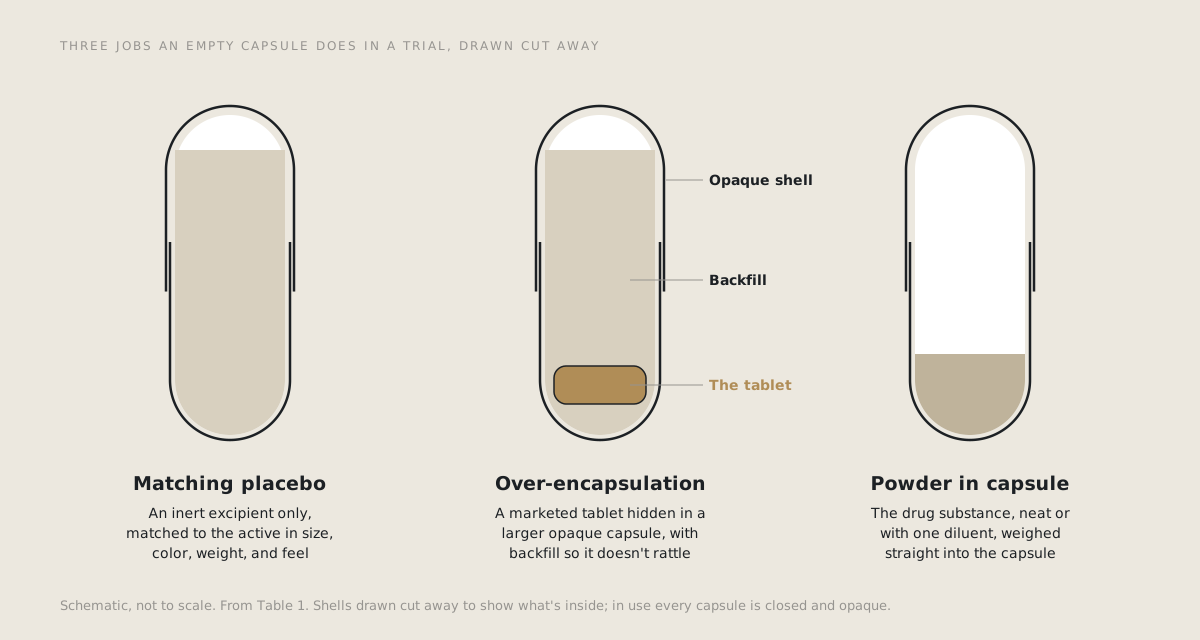
A placebo capsule contains no active substance and is built to look like the active. Over-encapsulation hides an existing tablet or capsule inside a larger opaque capsule so that two products look the same. They are different jobs with different paperwork, and most blinded trials with an oral solid dose use one of three approaches, sometimes two at once.
Table 1. The three jobs an empty capsule does in a trial. Vocabulary from the CDMOs and regulators cited on this page.
| Job | What it is | When it's used | What the capsule has to do |
|---|---|---|---|
| Matching placebo | An opaque capsule filled with an inert excipient, made to match the active capsule in size, color, weight, and feel | Placebo-controlled trials where the active is already a capsule, or where both arms are over-encapsulated | Match the active's shell exactly. Same size, color, opacity, print, and lot-to-lot appearance |
| Over-encapsulation | A marketed tablet or capsule placed inside a larger opaque capsule, usually with an excipient backfill to stop it rattling | Comparator trials, where the reference product is a marketed tablet with a logo and a color the sponsor can't copy | Swallow the tablet with clearance, hide it completely, resist being opened, and change the comparator's dissolution as little as possible |
| Powder in capsule | The drug substance, neat or with one diluent, weighed directly into the capsule | First-in-human and early phase 1, before a formulation exists | Be inert to the drug, be available in small numbers with full documentation, and be a shell the sponsor can keep through later phases |
Swipe across to see every column.
The double-dummy design, where each subject takes an active of one product and a placebo of the other, needs matching placebos for both. The ICH E9 statistical guideline is the reason all of this exists. It says treatments in a blinded trial "cannot be distinguished (appearance, taste, etc.) either before or during administration," and it notes that two drugs "could be made indistinguishable by the use of capsules," with the warning that changing a formulation might change its pharmacokinetics. That warning is the dissolution section further down.
Whichever job the protocol asks for, the capsule is an excipient in the finished investigational product, and the starting material rules apply to it. In the US it's a Type IV drug master file article. In the EU and UK it's an item in the IMPD with its own specification. In all three it needs a supplier the Qualified Person or the IND sponsor has qualified, a certificate of analysis for the lot, and for gelatin a TSE position. The documentation index at the foot of the page lists them.
Which capsule size fits my tablet for over-encapsulation?
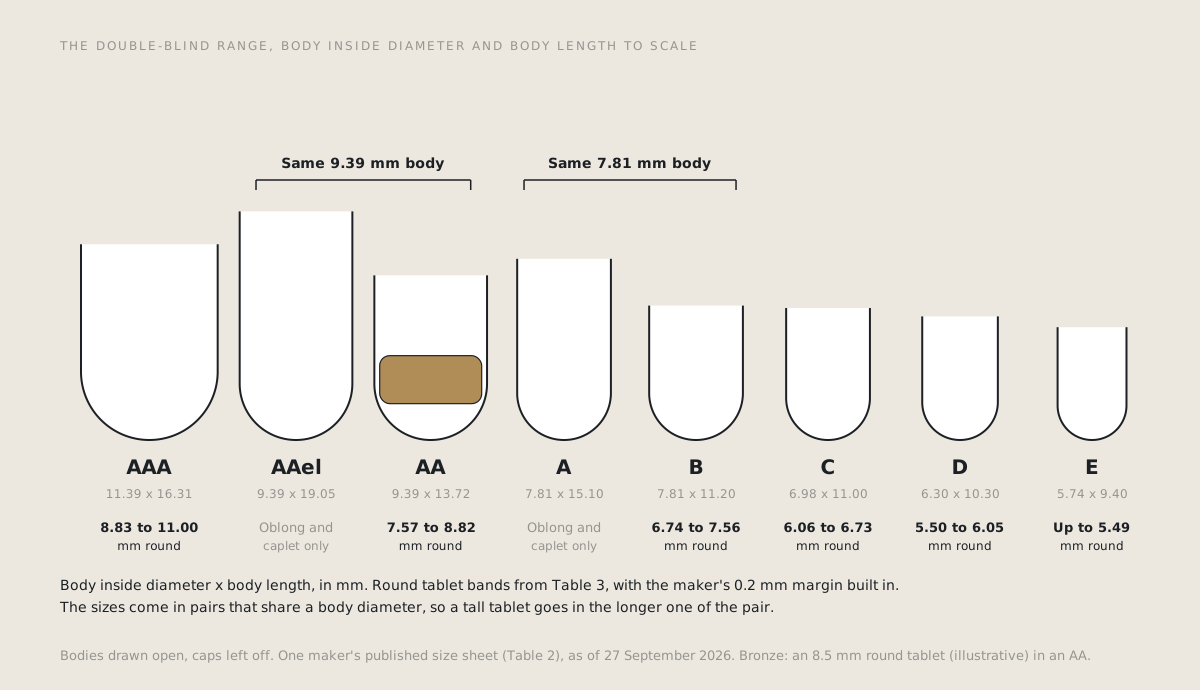
The tablet has to be smaller than both the internal diameter and the length of the capsule body, and one double-blind capsule maker publishes a sizing guide that maps tablet dimensions to a capsule size with a 0.2 mm safety margin already built in. The table below reproduces the dimension sheet and the bands. Measure the tablet with calipers, not from the product literature, because the maker's own footnote warns that "there can be subtle country-to-country differences in actual tablet dimensions" for a comparator made at several sites.
Table 2. The double-blind capsule range, dimension sheet. Lonza's Capsugel DBcaps range, from the maker's size information sheet. Volumes in ml, lengths in mm, weights in mg. The closed lengths are this maker's published nominals. Each maker publishes its own nominal closed length and tolerance, and they differ, so the dimension sheet for the lot you order is the one that counts. Eight sizes in gelatin and three in HPMC (the maker doesn't publish which three). A second maker's clinical range uses the same geometry for AAel, AA, A, and B, which suggests these four are becoming an industry-common footprint.
| Size | Body volume | Closed length | Body internal diameter | Body length | Empty weight | Powder capacity at 0.8 g/ml |
|---|---|---|---|---|---|---|
| AAA | 1.44 | 22.5 | 11.39 | 16.31 | 199.5 ± 12 | 1,152 |
| AAel | 0.97 | 22.6 | 9.39 | 19.05 | 171 ± 14 | 776 |
| AA | 0.80 | 17.5 | 9.39 | 13.72 | 138 ± 14 | 640 |
| A | 0.68 | 18.0 | 7.81 | 15.10 | 114 ± 9 | 544 |
| B | 0.50 | 14.2 | 7.81 | 11.20 | 82 ± 7 | 400 |
| C | 0.37 | 13.5 | 6.98 | 11.00 | 72 ± 6 | 296 |
| D | 0.30 | 12.6 | 6.30 | 10.30 | 59 ± 5 | 240 |
| E | 0.21 | 11.6 | 5.74 | 9.40 | 47 ± 4 | 168 |
Swipe across to see every column.
Two things about that table are worth a sentence each. The sizes come in pairs that share a body diameter and differ in length, AAel and AA at 9.39 mm, A and B at 7.81 mm, so a tall tablet goes in the longer of the pair and a flat one in the shorter. And AAel and AA have the external diameter of a standard 000 while A and B have the diameter of a 00, which is why they run on standard 000 and 00 change parts on most filling machines.
Table 3. Which size for which tablet. The maker's over-encapsulation sizing guide, which already includes a conservative adjustment factor of minus 0.2 mm against the minimum of the dimensional tolerance, in the maker's words. Round tablets by diameter. Oblong tablets and caplets by height (the long axis) against width.
| Round tablet diameter | Size |
|---|---|
| Up to 5.49 mm | E |
| 5.50 to 6.05 mm | D |
| 6.06 to 6.73 mm | C |
| 6.74 to 7.56 mm | B |
| 7.57 to 8.82 mm | AA |
| 8.83 to 11.00 mm | AAA |
Swipe across to see every column.
| Oblong height | Width up to 7.56 mm | Width 7.57 to 8.82 mm | Width 8.83 to 11.00 mm |
|---|---|---|---|
| Up to 8.74 mm | E, D, C, or B by width, as the round table | AA | AAA |
| 8.75 to 10.54 mm | D, C, or B by width | AA | AAA |
| 10.55 to 13.06 mm | A or AA | AA | AAA |
| 13.07 to 14.44 mm | A | AA | AAA |
| 14.45 to 15.76 mm | AAel or AAA | AAel or AAA | AAA |
| 15.77 to 18.39 mm | AAel | AAel | No size |
Swipe across to see every column.
A capsule inside a capsule follows the same rule. The maker's guide puts a standard size 5 inside a B or an AA, a size 4 inside an A, a size 3 inside an A or an AAel, and sizes 2 and 1 inside an AAel, and it lists no double-blind size for a standard 0, 00, or 000. A bench-top filler maker's own attachment table is more generous at the small end, putting a size 5 in anything from AAA down to D. If the protocol calls for over-encapsulating a size 0 capsule, the answer is the AAA or the AAel, and it needs a physical fit check before anyone orders a batch.
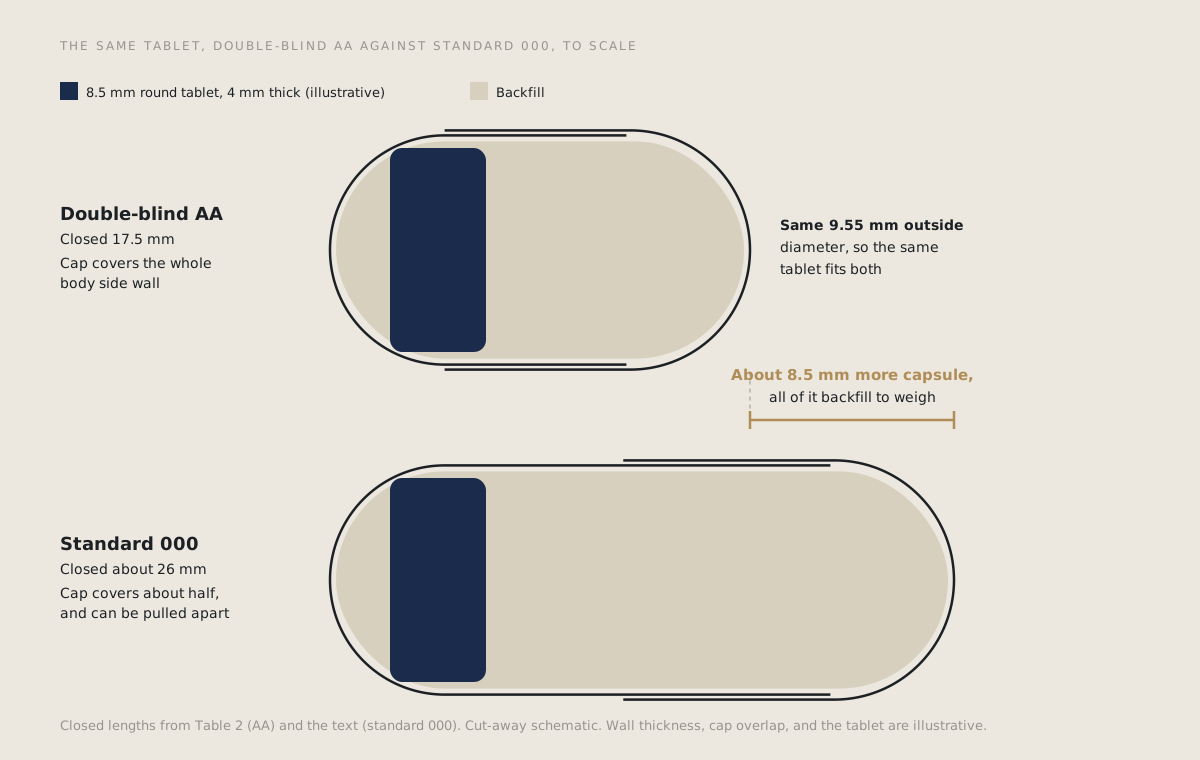
One sentence on the standard sizes, because they are used for this job too. Standard 0, 00, and 000 capsules are "widely used" for over-encapsulation in the textbook treatment of the subject, and the MHRA's own model dossier for an over-encapsulated tablet uses a size 00 in Swedish orange. The catch is the length. A 00 shares its 8.22 mm external body diameter with the double-blind A and B, so it takes the same tablet diameter, and a 000 shares its 9.55 mm with the AA and AAel. What the standard sizes add is body length, about 20 mm for a 00 against 11.2 mm for a B, which means more backfill to weigh and a longer capsule to swallow. The next section is about that trade. The standard sizes are set out in full in capsule dimensions by size. The fit selector further down does the arithmetic for both ranges.
Do I need a double-blind capsule, or will a standard opaque one do?
A double-blind capsule is wider and shorter than a standard one and has a cap that covers the whole body, so it takes a bigger tablet in a shorter shell, needs less backfill, and is hard to open without leaving a mark. A standard opaque capsule does the job for many tablets, costs less, runs on the change parts you already have, and is what the MHRA's model dossier used. Which one you need depends on the tablet, the study, and the equipment.
The extended cap is the feature people pay for. On a standard capsule the cap covers roughly half the body and there is a lip at each end to grip, so a curious subject can pull it apart and push it back together. On the double-blind design the maker says the cap "completely covers the side wall of the capsule body, making it virtually impossible to open the capsule without causing visible damage," with a dual locking ring around the full circumference. The EU GMP guideline for investigational products asks for exactly that, blinding "that resists tampering and clearly reveals when tampering has occurred," in the words of one maker's summary of it. For an outpatient trial where subjects take the capsules home, that matters. For an inpatient dose given under observation, it matters less.
The width is the second thing. Because the double-blind sizes are wider for their length, a tablet that would need a 000 in the standard range fits an AA at 17.5 mm closed instead of about 26 mm, going by the published nominals. The textbook figure is that a size C double-blind capsule in place of a standard size 0 "reduces the volume for overfilling by 40%," which is 40% less backfill to weigh, less capsule to swallow, and a smaller weight difference between the over-encapsulated arm and the placebo arm.
The case for a standard capsule is cost, availability, and tooling. Double-blind sizes are a special order in most markets, run on their own change parts on manual and semi-automatic fillers, and come in five standard opaque colors. A standard opaque 00 comes in a box from stock in many colors and runs on the ring you have. If the tablet fits a standard size with clearance, the trial is inpatient or the tamper risk is low, and the extra backfill doesn't push the capsule past the swallowability limits further down, a standard capsule is a defensible choice, and the MHRA's model dossier is the evidence that a regulator has seen one used.
Capsules.com supplies the standard sizes in opaque colors in gelatin and HPMC. For the double-blind range, ask us and we'll say who to call.
What goes in a matching placebo capsule?
Microcrystalline cellulose or lactose monohydrate, alone or as a 50:50 blend, with magnesium stearate under 0.5% if the active product has it too. The rule the CDMOs and the maker's white paper all give is the same one. Pick an excipient that is already in the product being matched, so that the placebo introduces nothing the active doesn't already carry.
The two defaults have opposite characters. Microcrystalline cellulose is hygroscopic and has a disintegrant action that depends on how much of it there is. Lactose monohydrate flows well and is hydrophilic, but it's avoided in lactose-intolerant populations, and it has a known interaction with gelatin that can slow the capsule's dissolution. One study concluded that "a 50:50 blend of both excipients would counterbalance the effect of each," which is why the blend is common. The MHRA's model dossier for an over-encapsulated tablet and its matching placebo chose lactose alone, with the one-line justification that "lactose is already present in the formulation for the licensed product."
Weight and rattle are the two ways a placebo gives itself away. The backfill exists so that "the patient is not able to determine the presence of another dose inside the capsule," in the maker's words, and so that the two arms can't be told apart by weight in the hand. One Canadian CDMO publishes the working tolerance, "a weight difference of less than 200 mg between the blinded forms is usually acceptable." The MHRA's model specification for the filled capsule is tighter than that on the capsule itself, capsule weight within ±10% of target on 30 capsules. In rare cases the backfill is left out of both arms so that the active and the placebo rattle the same way.
Table 4. A placebo capsule specification, as the MHRA's model dossier wrote it. The finished-product tests for a lactose-filled placebo in a Swedish orange size 00 gelatin capsule, from the mock IMPD published on gov.uk. Your dossier will differ. The shape is the point.
| Test | Acceptance criterion | Method |
|---|---|---|
| Appearance | 2-piece, Swedish orange opaque cap and body, unmarked hard gelatin capsule | Visual |
| Identification of gelatin | Tests A and B positive | Modified USP-NF gelatin monograph |
| Capsule weight | ±10% of target weight, n = 30 | Vendor method |
| Loss on drying | 13.0% to 16.0% | Modified USP <731> |
| Total aerobic microbial count | Not more than 1,000 CFU/g | USP <61> |
| Mold and yeast | Not more than 100 CFU/g | Ph. Eur. 2.6.12 |
| Specified pathogens | S. aureus, P. aeruginosa, E. coli, Salmonella absent | Ph. Eur. 2.6.13 |
Swipe across to see every column.
Two things that table shows. The empty capsule was declared "non-compendial" and given its own specification in the dossier, which is what the EU guidance asks for and the section on the IMPD explains. And the gelatin TSE position was handled by listing the gelatin supplier's certificates of suitability in an appendix, which is the TSE section further down.
Placebo for a liquid-filled capsule is a different problem and mostly a soft-gel one. The one caution worth carrying from that world is that a placebo oil is not inert. A medium-chain triglyceride placebo, two capsules a day for four weeks in a 30-subject crossover, significantly lowered blood EPA. The point for a hard capsule placebo is the same in principle. Whatever goes in has a physiology, and the protocol should say why it was chosen.
How often does matching go wrong? A 2020 study of non-commercial placebo-controlled trials found that 21% of the ones that answered used a non-matching placebo, that most of those didn't say so in the publication, and that the median cost of placebo and packaging was $58,286, about 10% of the trial budget. Six percent of the trials had been cancelled for lack of a placebo. A capsule supplier who can sell one box with the paperwork is a small part of fixing that.
What does over-encapsulation do to dissolution, and what do the regulators want to see?
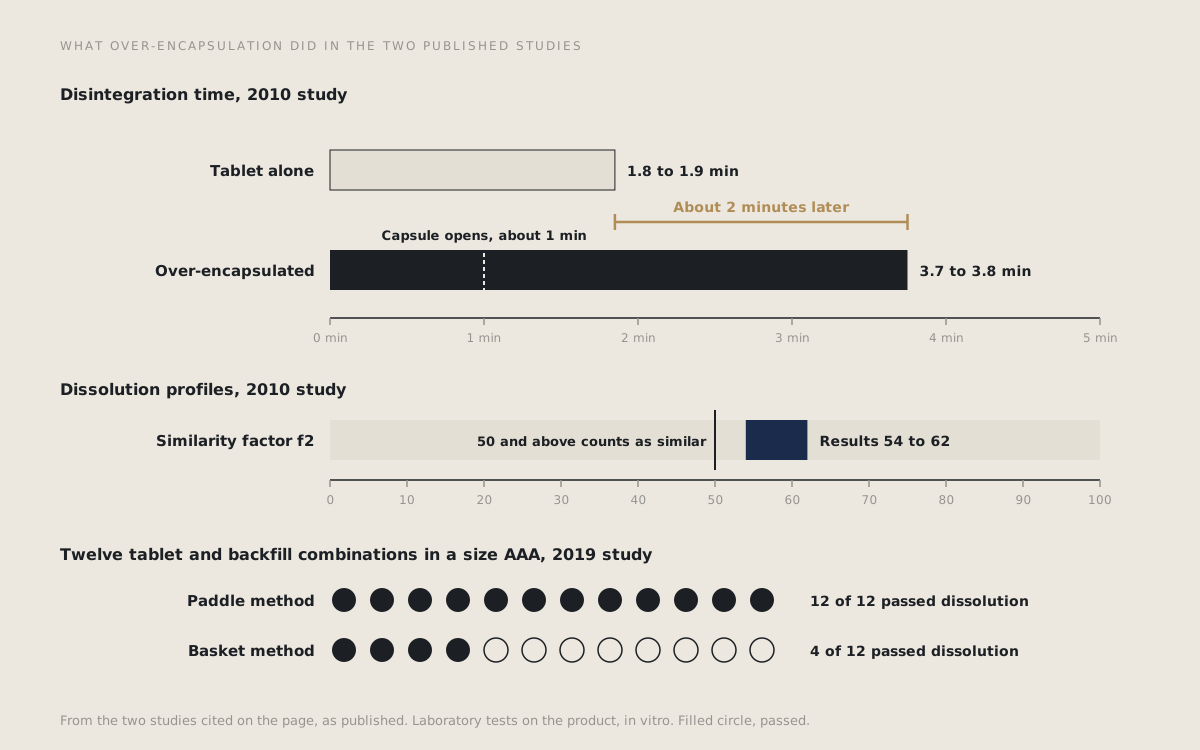
It delays it by about the time the capsule takes to open, roughly 2 minutes in the published studies, and the regulators want comparative dissolution in three media to show the comparator's release hasn't changed. If you add an excipient that isn't already in the comparator, the FDA asks for an in vivo study or a justification for not doing one. That last sentence is the one that decides most backfill choices.
The two studies people cite. A 2010 study over-encapsulated a propranolol tablet and a rofecoxib tablet in a double-blind size B and a standard size 00, with and without a lactose and microcrystalline cellulose backfill. Disintegration went from about 1.8 to 1.9 minutes for the bare tablets to 3.7 to 3.8 minutes over-encapsulated, the capsule ruptured after about a minute, and the dissolution profiles matched with f2 values between 54 and 62, all above the 50 that counts as similar. The authors concluded that over-encapsulation "poses no significant threat" to the comparison. A 2019 study in the Journal of Pharmaceutical Sciences took four marketed immediate-release tablets, one from each BCS class, over-encapsulated them in a size AAA with three different backfills, and found all twelve combinations passed disintegration and dissolution by the paddle method. Only four of twelve passed by the basket method, which is the practical lesson. Apparatus choice matters for a capsule, and the dissolution method should be chosen before the first batch, not after it.
Table 5. What the regulators ask for on a modified comparator. Quoted from the current documents.
| Regulator | Document | What it says |
|---|---|---|
| FDA | Bioavailability Studies Submitted in NDAs or INDs, General Considerations, April 2022, section V.B.1.a | "The sponsor should assess the impact of this over-encapsulation on the release of the drug substance from the drug product." Dissolution is enough "provided that: (1) no excipients beyond those that are already in the dosage form are added to the capsule; and (2) the dissolution profiles between the over-encapsulated and non-over-encapsulated products are comparable in three media at pH 1.2, pH 4.5 and pH 6.8." Otherwise "an in vivo study should be conducted unless the sponsor can provide a justification." Applies to the test product and the comparator alike |
| EMA | Guideline on the chemical and pharmaceutical quality documentation for IMPs, EMA/CHMP/QWP/545525/2017 Rev. 2, in effect 31 January 2022 | For an authorized product modified for a blinded study, "comparative dissolution profiles of both original and modified product should be provided to ensure unchanged bio-pharmaceutical properties." Where a modification may affect stability, stability data on the modified product before the trial starts, and no extrapolation beyond the original batch's shelf life |
| European Commission | Detailed guidelines on GMP for IMPs, C(2017) 8179 | "If a product is modified, data should be available (e.g. stability, comparative dissolution or bioavailability) to demonstrate that these changes do not significantly alter the original quality characteristics." A reference sample of the over-encapsulated comparator is taken after the additional processing. The expiry assigned to a blinded product is the shortest of its components' |
| MHRA | Model IMPD for an over-encapsulated tablet | Comparative dissolution not performed, justified on the basis that "the gelatin capsule will disintegrate within 5 minutes." A worked example of a risk-based argument, not a rule |
Swipe across to see every column.
In practice the CDMOs run twelve units in each of the three media and compare with f2, put the over-encapsulated product on concurrent stability, and choose the backfill from the comparator's own excipient list so that the first FDA condition is met. A US pharma company's published account of its own comparator program says dissolution was assessed on "every strength, every source, and every brand" of comparator, and that using an excipient not in the commercial formulation was treated as the most serious class of change.
One more sentence from the maker's white paper that a sponsor should read before breaking a tablet to make it fit. Some regulators do not accept a broken tablet inside a blinding capsule unless the tablet was designed with a score and studied that way. If the tablet doesn't fit, the answer is a bigger capsule, not a smaller tablet.
Which capsule color hides a tablet?
An opaque one, darker than the tablet, chosen so that no shadow, air pocket, or print shows through the shell. The five standard colors of the double-blind range are white, Swedish orange, gray, caramel, and yellow, all opaque, and they were chosen "based on globally accepted colorants and on sufficient opacity to ensure blinding." Swedish orange is the one in most of the published examples, including the MHRA's.
The failure mode has a name. Shadowing is a tablet visible through a shell that's too pale for it, and the maker's advice is that blinding capsules are "usually not the same color or shade of the unit being blinded, but rather slightly darker or more opaque." A white tablet in a white capsule can show as a shadow, and a red logo can show through a pale yellow. Hold a filled capsule against a window before you approve the color, and hold the placebo next to it.
Two constraints on the choice. The first is the iron limit. Opaque colors are mostly iron oxide pigments, and the US caps the elemental iron from a labeled daily dose at 5 mg, so a dark shell at several capsules a day can approach the limit, and one maker's white paper notes that "many countries have restrictions on particular colors or the total number of capsules." Ask the maker for milligrams of iron per capsule and do the arithmetic against the highest dose in the protocol. The second is titanium dioxide. Since August 2022 it is not permitted in food in the EU, it is still permitted in medicines everywhere, and a trial capsule is a medicine, so the trial can use a titanium dioxide white where a supplement can't. Both constraints are covered in full in which colorants are allowed in the US, the UK, and the EU.
Capsules.com's opaque shells are made without titanium dioxide in every market, which for a trial means the white is a calcium carbonate white, semi-opaque rather than fully opaque. For hiding a tablet, choose a colored shell rather than a white one, and test it against the tablet.
Gelatin or HPMC for a clinical capsule?
For a new molecule going into a capsule for the first time, HPMC, and specifically a gelling-agent-free HPMC, because it removes three problems before they arise. For over-encapsulating a marketed tablet, either works, and gelatin has the longer record. The full comparison, including what the material choice means for a pharmaceutical or clinical product, is on the gelatin vs HPMC guide. This section is only the clinical part of it.
The first problem is cross-linking. Gelatin reacts with trace aldehydes from an excipient, the drug substance, or a degrading component, and with heat and humidity, to form "a water-insoluble film or pellicle" that retards dissolution, and "once the cross-linking starts, it does not stop even when the cause is removed." That is why USP <711> carries a second tier with enzymes, pepsin below pH 4, papain or bromelain between 4 and 6.8, pancreatin at 6.8 and above, for gelatin products that fail tier one. A new chemical entity in early development often hasn't had its aldehyde profile characterized, and a stressed stability sample is exactly the condition that triggers it. HPMC has no protein to cross-link, so the second tier is never invoked and the sponsor never has to argue about it.
The second is moisture. Gelatin shells hold 13% to 16% water and become brittle below about 10%, so a hygroscopic drug substance that pulls water out of the shell breaks capsules, and a desiccant in the pack does the same. HPMC shells hold 3% to 8% and, in the maker's words, maintain "mechanical integrity under extremely low moisture conditions." For a powder-in-capsule study with a hygroscopic or moisture-sensitive drug substance, that decides it. The humidity numbers are in how much water is in a capsule, and why the number matters.
The third is the gelling agent. HPMC on its own doesn't gel on the pin at dipping temperature, so the first generation of HPMC capsules added carrageenan or gellan gum with potassium or calcium to set the film, and those capsules open more slowly in some media. In the published comparison, a carrageenan HPMC capsule released under 50% of a caffeine marker at 30 minutes in pH 1.2 with sodium chloride against over 90% for a gelling-agent-free HPMC, and switching the salt to potassium chloride delayed the carrageenan capsule further. In fasted volunteers under gamma scintigraphy, a carrageenan HPMC capsule opened at 9 ± 2 minutes against 7 ± 4 for gelatin, not a significant difference, so the in vivo effect is small. But a sponsor building a dissolution method for a new product doesn't want a shell whose opening depends on the ion content of the medium, which is why the gelling-agent-free grade is the one to specify for clinical work. Capsules.com predominantly supplies that grade.
What gelatin still has going for it is history and paperwork of a different kind. Decades of regulatory familiarity, a marginally faster mean opening time, and a lower price. Against that, a bovine gelatin capsule carries the TSE file described further down, and an HPMC one doesn't. For a matching placebo, the placebo has to be the same material as the active, so the material decision is made once and inherited.

Does the capsule need a drug master file, and how do I get a letter of authorization?
In the US an empty capsule is a Type IV drug master file article, an excipient, and most established capsule makers hold one. A DMF is not required for an IND. The letter of authorization that lets your IND reference the DMF is signed by the DMF holder, which is the maker, not the distributor, and there is no fee for a Type IV.
The FDA's public list of drug master files, updated quarterly, is where to check. Searching the second quarter 2026 list for empty capsules returns about 140 DMFs, all but one of them Type IV, from every large maker and dozens of smaller ones, with the earliest filed in 1968. The list shows the holder's legal name, the DMF number, the filing date, and whether the DMF is active or inactive, and the legal name is the thing to watch. One large maker's live DMFs are held under the name of its US manufacturing subsidiary rather than the brand name a buyer would search for, and several older DMFs under the brand name show as inactive. Ask the supplier for the DMF number and confirm the status is active on the list before you write it into the IND.
Whether the IND needs the DMF at all is a separate question, and the answer is usually no. The IND regulation, 21 CFR 312.23(a)(7), asks for "a list of all components" of the drug product and "the acceptable limits and analytical methods," and says that "reference to the current edition of the United States Pharmacopeia-National Formulary may satisfy relevant requirements." The FDA's 2019 draft DMF guidance goes further, "DMFs should be submitted only for excipients for which CMC and safety information is not available through reference to appropriate regulations or quality information through the USP-NF," and "information about the components and compositions, as well as safety information, can be provided directly to the authorized party without filing a DMF." So a compendial gelatin or HPMC capsule can be named in a phase 1 IND by supplier, grade, and specification, with the certificate of analysis, and no DMF reference. The DMF route earns its keep when the sponsor doesn't want to hold the maker's proprietary composition, the colorant loading or the gelling system, or when a reviewer asks for it.
If you do reference the DMF, the letter of authorization is "a formal signed document from a DMF holder," in the words of an FDA presentation on letters of authorization, naming the sponsor as the party authorized to incorporate the DMF by reference and stating which sections. Only the holder signs it. A distributor can request it from the maker on your behalf and pass it on, and that is what Capsules.com does, but the letter arrives on the maker's letterhead with the maker's signature. The DMF regulation, 21 CFR 314.420, also obliges the holder to notify every authorized party in writing of any change to the DMF, which is one of the reasons a DMF reference is worth having even when it isn't required.
What does the UK or EU file need for the capsule shell?
There is no excipient master file in the EU or the UK. The active substance master file is for active substances only. What the investigational medicinal product dossier asks for instead is a specification for the capsule shell, its qualitative composition, a pharmacopoeial reference for its materials, and for gelatin an adventitious agents evaluation, which in practice is the gelatin supplier's TSE certificate of suitability. The UK still accepts those certificates after leaving the EU.
The EMA guideline on quality documentation for investigational products, revision 2, in effect since 31 January 2022, sets it out section by section. In P.1, the composition, "for proprietary prefabricated components (e.g. capsule shells), flavours and excipient mixtures (e.g. film-coating mixtures), a qualitative composition is sufficient," so the maker has to disclose what's in the shell qualitatively, gelatin or hypromellose, water, colorants, opacifier, gelling agents, surfactant, but not how much. In P.4.1, the excipient specifications, "references to the Ph. Eur., the pharmacopoeia of an EU Member State, USP or JP should be indicated," and "specification for capsule shells should be provided." In P.4.5, excipients of animal origin are sent to appendix A.2, the adventitious agents safety evaluation, which is the TSE section. And in P.3, the name and address of every manufacturer involved, which for a capsule bought through a distributor means the maker's site.
The MHRA's model dossier is a worked example of the same thing on a UK form. It declares the capsule non-compendial, gives it the specification in Table 4, and handles TSE by listing the gelatin supplier's certificates of suitability, "Rx-CEP" numbers, in an appendix. It's a mock, not a rule, but it shows what a reviewer has seen and accepted.
On the certificates of suitability, the MHRA's post-Brexit guidance is unambiguous. They "are not affected by the UK no longer being a Member State of EU" because they are issued by the European Directorate for the Quality of Medicines, a Council of Europe body, and "the UK remains a member of the Council of Europe and a signatory to the Convention on the Elaboration of a European Pharmacopoeia." Applicants must include current copies, including for "materials of animal or human origin that have been subject to an evaluation of the risk related to transmissible spongiform encephalopathies." So a TSE CEP for gelatin is the same document in London as in Amsterdam.
The supplier side of the same file is the excipient risk assessment. EU GMP Chapter 5 requires that excipient suppliers be "controlled appropriately based on the results of a formalised quality risk assessment," and the 2015 Commission guideline on that assessment lists the risk factors, TSE, microbial contamination, supply chain complexity, daily patient intake among them, and says the evidence "should be obtained through audit or from information received from the excipient manufacturer," with GMP certification counting toward it. A gelatin capsule scores on TSE, microbial limits, and supply chain complexity, because there are three parties between the animal and the trial. That is why an EXCiPACT or NSF/IPEC/ANSI 363 certificate, a completed excipient information package, and a site audit report are the currency of capsule qualification in Europe, and what a capsule supplier questionnaire should ask sets out the questions.
What does "Ph. Eur." or "USP" mean on a capsule?
Less than the label suggests. The European Pharmacopoeia monograph for capsules, 0016, is a dosage-form monograph that tests the filled product, uniformity and disintegration, and does not specify an empty shell. The materials have their own monographs, gelatin at 0330 and hypromellose at 0348, and the colorants have to be authorized. So "Ph. Eur. grade capsule" means the shell is made from Ph. Eur. gelatin or hypromellose with authorized colorants, tested by the maker against an in-house specification designed so the filled capsule can pass the disintegration test. The United States Pharmacopeia was the same until recently, and it's changing.
Ph. Eur. 0016 defines capsules as "solid preparations with hard or soft shells of various shapes and capacities, usually containing a single dose of active substance(s)," permits the shell to contain "surface-active agents, opaque fillers, antimicrobial preservatives, sweeteners, colouring matter authorised by the competent authority and flavouring substances," and requires that hard capsules disintegrate within 30 minutes in water. The Japanese Pharmacopoeia takes the same shape. Neither has an empty-shell monograph, which is why the EMA guideline asks the sponsor to provide one.
The USP now has a monograph for Hard Gelatin Capsule Shells, and a Hypromellose Capsule Shells monograph has been in the pharmacopeial forum since 2016 with a draft loss on drying of 1.0% to 13.0%, disintegration within 30 minutes, and microbial enumeration. Once a shell monograph is official, "USP" on a capsule can mean the shell itself was tested to it, and that is the wording to ask for. Until the maker's certificate of analysis says "meets USP Hard Gelatin Capsule Shells," treat "USP" on a capsule as meaning the gelatin does.
For a sponsor the practical rule is the one the IND regulation and the IMPD guideline share. The capsule always needs a specification, and the maker's specification with the lot certificate of analysis is that document whether or not a pharmacopoeia has a monograph for the shell. What a capsule specification contains walks through the maker's specification and certificate, and how Capsules.com passes them through.
What TSE paperwork does a gelatin capsule need?
A statement from the maker, backed by the gelatin supplier's TSE certificate of suitability, that covers the species, the tissue, the country of origin and its risk category, the manufacturing process, and the exclusion of specified risk materials. For an HPMC capsule the question doesn't arise, and the file says so in one line.
The European position is the Note for Guidance EMA/410/01 rev. 3, applied through Ph. Eur. general chapter 5.2.8 and general monograph 1483. It covers excipients from TSE-relevant species, and gelatin is its worked example. Hides are "a safer source material as compared to bones." Bone gelatin must exclude skulls and spinal cords regardless of age or country, and vertebrae from cattle over 30 months in controlled and undetermined risk countries. The validated processes are listed by name, the alkaline lime treatment at pH 12.5 or above for at least 20 days, the acid process at pH below 3.5 for at least 10 hours, and the heat and pressure route at 133 °C for 20 minutes. For oral use, gelatin may come from negligible, controlled, or undetermined risk countries, categories A, B, and C, where parenteral gelatin is restricted to A and B. And the guideline says outright that "TSE Certificates of suitability issued by the EDQM may be used by the Marketing Authorisation holders or applicants as the basis of the risk assessments," which is why the CEP number is the thing to collect.
In the US the FDA's expectation traces to its 1997 guidance on sourcing and processing gelatin, and the cattle materials rule at 21 CFR 189.5 defines gelatin as obtained "by the partial hydrolysis of collagen derived from hides, connective tissue, and/or bone" and excludes it from the prohibited materials list while still excluding specified risk materials from its manufacture. Health Canada's position, since 2006, allows bone gelatin provided "the bones must not include the skull or vertebral column," and Canada, Australia, and New Zealand all recognize EDQM certificates.
Table 6. What a gelatin capsule's TSE statement should contain. Derived from the structure of EMA/410/01 rev. 3. Ask for it as a signed document, not an email.
| Line | What to expect |
|---|---|
| Species | Bovine, porcine, fish, or a mix, with the proportion if mixed |
| Tissue | Hide, bone, or both |
| Country of origin | Named, with its WOAH BSE risk category (A, B, or C) |
| Specified risk materials | Statement that skull, spinal cord, and for older cattle vertebral column are excluded |
| Process | Acid, alkaline, or heat and pressure, with the parameters or a reference to the validated process |
| Certificate of suitability | The gelatin supplier's TSE CEP number and its holder |
| Compliance statement | Complies with EMA/410/01 rev. 3 and Ph. Eur. 5.2.8; and for the US, sourcing consistent with FDA guidance |
Swipe across to see every column.
Capsules.com's gelatin capsules are bovine, from hide or bone, and the maker's TSE statement and the gelatin CEP reference travel with the documentation pack. HPMC still needs an origin statement of its own, plant cellulose, no animal-derived materials or processing aids, gelling system disclosed, and the GMO position, because a reviewer will ask for the negative statement as well as the positive one.
Can my pharmacy fill placebo or over-encapsulate tablets itself?
In the UK, only if it holds a manufacturer's authorization for investigational medicinal products with capsule manufacture listed on it, because the MHRA treats filling a capsule as manufacture, not assembly. In the US, under the IND, with the placebo described in the chemistry section and phase 1 CGMP in place. In the EU, a hospital pharmacy may prepare investigational products under a narrow exemption that each member state implements its own way. The three positions are different enough to take one at a time.
United Kingdom. The Clinical Trials Regulations 2004 exempt "assembly" of an investigational product in a hospital or health center by or under a pharmacist from the manufacturing authorization requirement. The MHRA Inspectorate's 2023 FAQ on investigational products draws the line in two answers. Assembly "is related to packaging and labelling only and not to the preparation of medicines from their ingredients." And to the direct question, "we perform over encapsulation of tablets in order to blind them. Capsules are containers so this counts as packaging doesn't it?" the answer is "No. Capsules are specifically excluded from the definition of a container in the Clinical Trials Regulations SI 2004 1031. An MIA(IMP) with 'capsule manufacture' listed as authorised would be necessary in this case." So an NHS manufacturing unit over-encapsulating or filling placebo for a trial needs the MIA(IMP) with capsule manufacture on it and a Qualified Person to certify the batch, and the NIHR toolkit adds that the exemption "does not apply to Phase 1 units or contract packaging organisations." The MHRA's model dossier shows the unit as "Hospital Manufacturing Limited" holding exactly that authorization.
United States. A placebo is an investigational new drug when the trial needs an IND, and a trial that uses only a placebo and "does not otherwise require submission of an IND" is exempt. The IND's chemistry section must include "a brief general description of the composition, manufacture, and control of any placebo used in a controlled clinical trial." For phase 1, the product is exempt from 21 CFR Part 211 by 21 CFR 210.2(c) but still subject to statutory CGMP, and the FDA's 2008 guidance on phase 1 CGMP, whose scope names "finished dosage forms used as placebos," asks for written procedures for components and a review of "the certificate of analysis (COA) and/or other documentation on each lot of material." Once the product is in phase 2 or 3, Part 211 applies in full. Investigational drug services pharmacies at university hospitals do prepare placebo and over-encapsulate under an IND on that basis, and the hospital pharmacy standards from ASHP and HOPA assume the active and placebo will be "identical in appearance, labeling, preparation time, expiration date and time, and supplies used." We found no FDA statement that addresses pharmacy-prepared placebo directly, so the IND's chemistry description is the mechanism, and the sponsor's regulatory contact should confirm it for the study.
European Union. The Clinical Trials Regulation defines an investigational medicinal product as one "being tested or used as a reference, including as a placebo," so placebo is manufactured under the GMP regulation for investigational products, with Qualified Person certification of every batch. Article 61(5) exempts relabeling and repackaging in hospitals and the preparation of magistral and officinal formula products for use as investigational products "in hospitals, health centres or clinics legally authorised in the Member State concerned," used exclusively at trial sites in the same member state, and Article 61(6) requires member states to set "appropriate and proportionate requirements" and inspect them. How each member state has done that varies, and a hospital pharmacy in Germany, Spain, or the Netherlands should check its national implementation before assuming the UK or US position applies.
Australia and New Zealand. Australia's clinical trial notification scheme is a notification, not an evaluation, and the TGA handbook says medicines manufactured in Australia for a trial are exempt from the manufacturing license, with the sponsor and ethics committee responsible for satisfying themselves the goods are made to GMP. New Zealand's Medsafe expects investigational products "including active comparators and placebos" to be made to GMP, requires manufacturers in New Zealand to hold a license, and asks for GMP certification of the manufacturer and the packer in the application.
Whoever fills the capsules, the labeling and sample rules are the same. Under the Clinical Trials Regulation's Annex VI, in a blinded trial "the name of the substance is to appear with the name of the comparator or placebo" on both products, so the label reads the same on the active and the placebo. The blinded product's expiry is the shortest of its components'. A reference sample of the over-encapsulated comparator is taken after the processing step, and reference and retention samples of blinded product are kept for at least two years after the trial ends. And the manufacturer and sponsor implement a procedure for "rapid unblinding" in an emergency.
Can I buy a few thousand capsules with full paperwork?
You can buy one box from Capsules.com with the same documents as a container, the maker's specification, the lot certificate of analysis, the composition and TSE statements, and the GMP certificates. A box is tens of thousands of capsules depending on size, and the price is the single-box book price. What we can't do is split a box, because the lot documentation follows the maker's sealed carton.
The reason this is worth a section is that small quantities with full paperwork are the gap the large makers leave. One large maker promises "a Certificate of Analysis with every capsule order" and says its double-blind range "can be ordered in any quantity," and it publishes no minimum, no price, and no lead time, so a hospital production manager who needs one carton has to open an account and wait for a quote. The small-lot sellers at the other end of the market sell bags of 100 to 50,000 online at supplement prices, with cGMP and ISO badges on the page, and none of the ones we read promised a lot-specific certificate of analysis or a maker's specification. A trial needs the paperwork more than it needs the price, and the CDMOs that over-encapsulate for a living say the same thing in their own words, "material reconciliation is critical" at small scale, and "check weighing is a critical part of the GMP process."
What a trial lot of empty capsules from Capsules.com looks like. One sealed carton from a single maker's lot, with the maker's certificate for that lot, the specification, the qualitative composition statement, the TSE statement or the plant-origin statement, the GMP and quality system certificates for the maker's site, the maker's name and site for your dossier, and for a US sponsor the DMF number with a letter of authorization requested from the holder. The box sizes, the price structure, and the sample terms are in what the minimum order for empty capsules is. If your protocol needs a size or a color we don't carry, or the double-blind geometry, say so when you write and we'll tell you who does.
What happens if the capsule changes mid-trial?
It becomes a change to the investigational product, and depending on what changed, a comparability exercise, a substantial modification to the trial, or a stopped line. The way to avoid it is to lock the capsule in early, get a change notification commitment in writing, and make sure the supplier tells you before it happens rather than after.
The excipient industry's own standard is the IPEC Significant Change Guide, which defines a significant change as "any change that has the potential to alter an excipient's physical, chemical or microbiological property from the norm, and/or that may alter the excipient's performance in the dosage form," classes changes across nine categories from site to raw materials, and gives no fixed notice period. It says "the user should be given as much advance notification of impending changes as is reasonably possible," so a fixed lead time has to come from your quality agreement, and six to twelve months for a significant change is a common ask. One line in that guide applies to any distributor, Capsules.com included. "For Distributors, any change to their supply source is a Level 2 change," which is a significant change that must be notified. A distributor that moves your product to a different maker has changed your excipient.
Two regulatory hooks add weight. A DMF holder "must notify all authorized persons in writing of any additions, changes, or deletions" to the DMF, so a US sponsor with a letter of authorization hears about a composition change through that route. And for a product that goes on to approval, the FDA's own procedure, MAPP 5016.6, classes "any change in capsule composition or appearance, including change in size, color or dye" as a prior approval supplement, with only a like-for-like supplier change reportable in the annual report. The FDA's May 2025 draft guidance on replacing color additives in approved drug products would move the swap of one listed color additive for another to a 30-day notice (a CBE-30 supplement), though it is still a draft and doesn't mention capsule shells by name. In the EU a comparable replacement excipient is a Type IB variation and a significant one a Type II. That is why the capsule a molecule enters phase 1 in tends to be the capsule it launches in, and why the choice deserves more attention than it usually gets at the time.
For a trial already running, the EMA guideline is the reference. "If changes in the formulation or dosage form compared to the IMP used in earlier clinical trials have been made, the relevance of the earlier material compared to the product under testing should be described," with comparative dissolution for a solid oral form and, "in those cases where comparability cannot be established in vitro, additional clinical data to support equivalence may be necessary." For the quality system side of it, how to write the change control record has a write-up to copy.
What to get from the supplier before the first order, in writing. That the product is made by one named maker at one named site. That a change of maker, site, composition, or specification will be notified in advance, with the notice period you need. And that the supplier will keep the maker's lot documentation for the life of the trial plus the retention period. Capsules.com commits to all three.
Which capsule for powder-in-capsule first-in-human studies?
An HPMC capsule, gelling-agent-free, in the smallest standard size that takes the highest dose in the study with room for a diluent if one is needed, and no larger than a 00. Powder in capsule, also called drug in capsule or API in capsule, is the fastest route to a first-in-human study because "the simplest formulation requires no formulating, as the active is dosed neat, filled into gelatin or HPMC capsules," and the capsule is the only thing in contact with the drug, so it's the only compatibility question.
The approach fits a drug substance that is "freely wettable and soluble" and stable as a powder, and the maker of the best-known micro-dosing system says its approach is "suitable for both gelatin and hydroxypropyl methylcellulose capsules." The dose window is wide. A contract manufacturer puts it at "0.1 mg to around 200 mg possible, but these doses will depend on the powder properties of the API," and the micro-dosing equipment dispenses "from 100 micrograms to 100 milligrams and beyond" into tared capsules at over 600 capsules an hour at about 2% relative standard deviation, or 300 to 400 an hour in practice. A published study of one automated system reports fills from 5 µg to 5 mg with adequate content uniformity. The maker's claim for the route is that first-in-human "can be reached up to 45%" faster than conventional formulation routes, 13 to 17 weeks, and another version of the same claim is "savings of up to 6 months." Batch sizes for phase 1 are a few hundred to a few thousand capsules, which is a working day on the equipment and one box of shells.
Why HPMC. The reasons are in the material section above, and they bite hardest here. A neat drug substance in a gelatin shell with no excipient to buffer it is the cross-linking case in its purest form, and a hygroscopic drug substance is the brittleness case. The maker of the micro-dosing system notes that HPMC is preferred for formulations "prone to cross-linking issues" and for hygroscopic fills, and a trial that starts in HPMC and stays there never has to run the enzyme tier or explain a broken capsule.
Which size. The FDA's guidance on the size and shape of tablets and capsules recommends that "the largest dimension of a tablet or capsule should not exceed 22 mm and that capsules should not exceed a standard 00 size," and it cites studies in which swallowing complaints rise "at tablet sizes greater than approximately 8 mm in diameter." The capsule fill weight calculator gives the fill weights by size for a given bulk density. For a micro-dose, the size is set by what the filling system can handle and by the diluent volume, not by the dose, and a size 2 or 3 with a lactose or microcrystalline cellulose diluent is common. For pediatric studies, the EMA's pediatric formulation guideline notes that "limited data in the literature are available regarding acceptability of different capsule sizes in different paediatric age group(s)," that capsules "may also be opened and their contents taken as such" where justified, and that mini-tablets of 2 to 3 mm "may be accepted by children from birth," which is a different dosage form and a different page.
One thing to decide at the same time as the capsule. The comparator and placebo strategy for phase 2. If the phase 2 design will need a matching placebo, the phase 1 capsule should be one that exists in the same size, color, and material as an opaque, so that the placebo can match it without a shell change between phases.
The documentation index
Eleven documents for each material (the TSE line applies to gelatin, the plant origin line to HPMC), and the reviewer who asks for them is the one who decides whether the trial starts on time. The table lists what each document is, which regulator asks for it, and whether Capsules.com supplies it as standard, on request, or not at all. It is the "documentation index" the clinical supply community asks for, and the prompt pack below turns it into a checklist for your market.
Table 7. The documentation package for an empty capsule going into an investigational product. "Standard" travels with every trial lot. "On request" is obtained from the maker for the named sponsor. Each line names where the requirement comes from.
| Document | What it is | Who asks | Gelatin | HPMC | From Capsules.com |
|---|---|---|---|---|---|
| Specification and lot certificate of analysis | The maker's product specification and the certificate for the lot you receive, naming the original manufacturer and site | 21 CFR 312.23(a)(7); IMPD P.4.1; EU GMP Chapter 5; IPEC CoA guide | Yes | Yes | Standard, maker's certificate unchanged |
| Pharmacopoeial statement | Gelatin or hypromellose to Ph. Eur., USP, or JP; colorants authorized in the named markets; shell designed to meet the disintegration test; USP shell monograph if claimed | IMPD P.4.1; IND component list | Yes | Yes | Standard |
| Qualitative composition | Every component of the shell by name, including opacifier and gelling system, and the titanium dioxide position | IMPD P.1; IPEC composition guide | Yes | Yes | Standard |
| TSE statement and CEP reference | Species, tissue, country category, process, gelatin supplier's TSE certificate of suitability | IMPD A.2; Ph. Eur. 5.2.8; EMA/410/01; FDA | Yes | Not applicable | Standard for gelatin |
| Plant origin and processing aids statement | Cellulose source, no animal-derived materials or processing aids, GMO position | IMPD P.1 and A.2 by negative statement | Not applicable | Yes | Standard for HPMC |
| GMP and quality system certificates | EXCiPACT or NSF/IPEC/ANSI 363 excipient GMP, ISO 9001, for the maker's site | EU 2015 excipient risk assessment guideline; EU GMP 5.29; FDA phase 1 guidance on components | Yes | Yes | Standard |
| Excipient information package or questionnaire | IPEC's three-part template, product regulatory data sheet, site quality overview, supply chain overview, or your questionnaire completed | EU risk assessment, chapter 3 | Yes | Yes | On request |
| Drug master file number and letter of authorization | The maker's Type IV DMF number, active on the FDA list, and a letter from the holder naming the sponsor | 21 CFR 314.420 for US sponsors referencing the DMF | Yes | Yes | On request, issued by the maker |
| Impurity and nitrosamine statements | ICH Q3D elemental impurities data or statement; ICH Q3C residual solvents; nitrite content and nitrosating agent statement | Sponsor's risk assessment; EMA nitrosamine Q&A; FDA nitrosamine guidance | Yes | Yes | On request |
| Shelf life and storage statement | The shelf life on the certificate and the storage conditions | IMPD P.8; stability of the excipient in the risk assessment | Yes | Yes | Standard |
| Change notification commitment | Written undertaking to notify a change of maker, site, composition, or specification in advance, with the notice period | IPEC significant change guide; 21 CFR 314.420(c); your quality agreement | Yes | Yes | Standard |
| Safety data sheet | The maker's SDS | Site safety, not the dossier | Yes | Yes | Standard |
Swipe across to see every column.
Halal, kosher, vegetarian, and allergen declarations exist for the same capsules and a sponsor sometimes wants them for the patient information leaflet. They aren't part of the regulatory file. What documents to hold for vegan, halal, kosher, and allergen claims covers them.
Over-encapsulation fit selector
Enter the tablet's dimensions, or the standard capsule size you want to hide, and the selector returns the double-blind size from the maker's sizing bands, the standard sizes that clear it, an estimate of the backfill weight at your excipient's bulk density (how to measure bulk and tapped density), and a flag if the result is past the 22 mm or size 00 limit the FDA cites. Nothing you enter leaves the page. It doesn't replace a physical fit check with the real tablet in the real capsule, and it says so. The prompt pack below takes the same inputs and adds the placebo specification, the dissolution plan, and the documentation checklist for your market. Get the AI prompt pack.
What is an AI prompt pack?
An AI prompt pack is a small set of files you load into the AI assistant you already use. The assistant then asks you the right questions, works through them with you using our reference data, and shows its working as it goes. We publish one with each article. We did the prompt engineering so you don't have to. Each prompt has been engineered so it asks the right questions in the right order, carries the reference data it needs, and says plainly what it doesn't know.
Inside the Clinical Capsule Blinding and Documentation AI Prompt Pack is a prompt file that turns your assistant (Claude, ChatGPT, Gemini, Grok) into a clinical supply planner for the capsule part of a trial, a workbook it fills in as you go, and a reference sheet with the dimension tables, the sizing bands, the regulatory citations, and the documentation index from this page. It walks you from the protocol's blinding requirement to a capsule size and backfill plan, a placebo specification in the shape of Table 4, a comparative dissolution plan that meets the FDA and EMA conditions, the documentation checklist for an IND, a UK CTA, an EU CTA, or an Australian or New Zealand submission, the questionnaire to send the capsule supplier, and the change control record if the shell has to change between phases.
Why a pack and not just a table? Because the right answer depends on your market, your comparator, your dose, and who is doing the filling, in that order, and a table can't ask which. It's the conversation we'd have with you on a call, packaged so you can have it at your desk with the protocol and the comparator's summary of product characteristics in front of you.
Use the form below to request this resource. Newsletter updates are a separate, optional choice.
Get the Clinical Capsule Blinding and Documentation AI Prompt Pack
Request the Clinical Capsule Blinding and Documentation AI Prompt Pack
Leave your details to request this resource.
If you'd rather talk it through, reply to any email from us or write to us through the contact page. A person who has read a mock IMPD and knows what a letter of authorization looks like will get back to you. If you want the documentation pack for a specific product before you order, ask for it by size and material.
Related.
- How to qualify an empty capsule supplier
- What a certificate of analysis and a specification contain
- Gelatin vs HPMC capsules
- How empty capsules are made, and where they come from
- Switching capsule supplier without stopping the line
- Capsules for compounding
Sources.
- Double-blind capsule range. Capsugel (Lonza), DBcaps product page and FAQ, capsugel.com; DBcaps capsule size information sheet (read from a third-party copy; cross-checked against the ACG Clinicaps dimension sheet); Clinical Trials Over-Encapsulation Sizing Guide (reproduced as Table 3.1 in "Hard Shell Capsules in Clinical Trials," CRC Press, via basicmedicalkey.com); Lonza press release 12 June 2020 on HPMC DBcaps; Rode, Bordes-Picard, Lamps, "Considerations in support of achieving successful double blinding and removing bias with over encapsulation," Lonza white paper, drug-dev.com, 2020. ACG, ACGcaps GC product page and pharma capsules brochure v1.2 (now v1.3). Torpac and Capsule Connection, ProFill OE data sheet (capsule-in-capsule attachment table). Standard sizes from the ACG table filed to FDA docket FDA-2013-N-1434.
- Practice and backfill. Ropack, "Over-Encapsulation Principles for the Blinding of Clinical Supplies"; Almac, "Unmasking the blind of over-encapsulation," white paper, 2021; Altasciences, blinded study materials page; Eramol, over-encapsulation page; Catalent, clinical supply packaging page; Back-Moore, "Qualification Strategies for Blinded Comparators, One Company's Perspective," Pharmaceutical Outsourcing; ONdrugDelivery, "Removing clinical trial bias with over-encapsulation"; Feton FMT DBcaps 120 and Dott. Bonapace IN-CAP product pages.
- Dissolution studies. Esseku et al., "The Effect of Overencapsulation on Disintegration and Dissolution," Pharmaceutical Technology 34(4), 2010, https://www.pharmtech.com/view/effect-overencapsulation-disintegration-and-dissolution; Maher et al., "Effect of Overencapsulation on the Disintegration and Dissolution of Licensed Formulations for Blinding in Randomized Controlled Trials," J Pharm Sci 108(3), 2019, 1227 to 1235, https://doi.org/10.1016/j.xphs.2018.10.035; Lu and Shah, "Dissolution of Gelatin Capsules: Evidence and Confirmation of Cross-Linking," Dissolution Technologies, August 2017; Dissolution Technologies, November 2014 stimuli article and May 2020 Q&A on USP <711> enzymes.
- Regulators on modified comparators and blinding. FDA, Bioavailability Studies Submitted in NDAs or INDs, General Considerations, April 2022, https://www.fda.gov/media/121311/download; EMA/CHMP/QWP/545525/2017 Rev. 2, in effect 31 January 2022, https://www.ema.europa.eu/en/requirements-chemical-pharmaceutical-quality-documentation-concerning-investigational-medicinal-products-clinical-trials-scientific-guideline; Commission Delegated Regulation (EU) 2017/1569; Detailed Commission guidelines on GMP for IMPs, C(2017) 8179, https://health.ec.europa.eu/document/download/a0b206a0-5788-406b-9e20-e0525b16e712_en?filename=guideline_adopted_1_en_act_part1_v3.pdf; Regulation (EU) 536/2014, Articles 2 and 61 and Annex VI, https://eur-lex.europa.eu/eli/reg/2014/536/oj; ICH E9, section 2.3.1, https://database.ich.org/sites/default/files/E9_Guideline.pdf; EudraLex Volume 4 Annex 13 (2010).
- Placebo. Mock IMPD for an over-encapsulated EU licensed medicinal product and a placebo to match, published on gov.uk, https://assets.publishing.service.gov.uk/government/uploads/system/uploads/attachment_data/file/343466/Over-encapsulation_of_a_tablet.pdf; Medicines for Human Use (Clinical Trials) Regulations 2004, regulation 37; MHRA Inspectorate, "Manufacture of investigational medicinal products: frequently asked questions," 3 February 2023, https://mhrainspectorate.blog.gov.uk/2023/02/03/manufacture-of-investigational-medicinal-products-frequently-asked-questions/; NIHR Clinical Trials Toolkit, trial supplies, https://www.ct-toolkit.ac.uk/routemap/trial-supplies; 21 CFR 312.2, 312.3, 312.6, 312.23 (https://www.ecfr.gov/current/title-21/chapter-I/subchapter-D/part-312/subpart-B/section-312.23); 21 CFR 210.2(c), https://www.ecfr.gov/current/title-21/chapter-I/subchapter-C/part-210/section-210.2; FDA, CGMP for Phase 1 Investigational Drugs, July 2008, https://www.fda.gov/regulatory-information/search-fda-guidance-documents/current-good-manufacturing-practice-phase-1-investigational-drugs; ASHP guidelines on investigational drug services, AJHP 75(8), 2018; HOPA investigational drug service standards, 2018; Speich et al., "A meta-research study revealed several challenges in obtaining placebos for investigator-initiated drug trials," J Clin Epidemiol, 2020, https://pubmed.ncbi.nlm.nih.gov/33242608/; medium-chain triglyceride placebo crossover, aclr.com.es; Medsafe, clinical trials regulatory approval and GCP guideline; TGA, Australian Clinical Trial Handbook.
- Documentation. FDA, Types of DMFs; DMF Guidelines (1989); draft guidance on DMFs (2019), https://www.fda.gov/media/131861/download; "Letters of Authorization: What FDA Wants You to Know" (FDA presentation), https://www.fda.gov/media/194091/download; List of Drug Master Files, 2Q 2026, https://www.fda.gov/drugs/drug-master-files-dmfs/list-drug-master-files-dmfs; 21 CFR 314.420, https://www.ecfr.gov/current/title-21/chapter-I/subchapter-D/part-314/subpart-D/section-314.420; GDUFA DMF fee page; 21 CFR 207.13; MAPP 5016.6, Change in Hard Gelatin Capsule Shell Supplier, recertified 2023, https://www.fda.gov/media/99625/download; FDA, Replacing Color Additives in Approved or Marketed Drug Products, draft guidance, May 2025, https://www.fda.gov/media/186692/download; FDA SUPAC-IR Questions and Answers (empty gelatin capsules not covered); MHRA, Handling of Active Substance Master Files and Certificates of Suitability, https://www.gov.uk/guidance/handling-of-active-substance-master-files-and-certificates-of-suitability--2; EDQM, background and legal framework, and TSE FAQ, and certification, https://www.edqm.eu/en/certification; EMA/410/01 rev. 3, OJ C 73, 5 March 2011, https://www.ema.europa.eu/en/documents/scientific-guideline/minimising-risk-transmitting-animal-spongiform-encephalopathy-agents-human-and-veterinary-medicinal-products_en.pdf; 21 CFR 189.5, https://www.ecfr.gov/current/title-21/chapter-I/subchapter-E/part-189/subpart-B/section-189.5; Health Canada 2006 gelatin position via NutraIngredients; Guidelines of 19 March 2015 on formalised risk assessment for excipients, 2015/C 95/02, https://eur-lex.europa.eu/legal-content/EN/TXT/?uri=CELEX:52015XC0321%2802%29; EU GMP Part I Chapter 5; Ph. Eur. 0016, 0330, 0348; USP <1151>; USP Hard Gelatin Capsule Shells monograph, https://doi.usp.org/USPNF/USPNF_M9475_02_01.html; ECA on the proposed USP Hypromellose Capsule Shells monograph; JP18 general rules for preparations; IPEC Significant Change Guide, 3rd revision, 2014; IPEC Certificate of Analysis Guide via Pharmaceutical Technology; IPEC Excipient Composition Guide, 2020; IPEC Excipient Information Package v4, 2020; EXCiPACT standards booklet 2021 and certificate holder register; NSF/IPEC/ANSI 363-2024; ICH Q3D(R1); EMA nitrosamine Q&A rev. 23; FDA, Control of Nitrosamine Impurities in Human Drugs, Rev. 2, September 2024; Commission variations classification guideline, B.II.a.3; 21 CFR 73.1200 (iron limit), https://www.ecfr.gov/current/title-21/chapter-I/subchapter-A/part-73/subpart-B/section-73.1200; Commission Regulation (EU) 2022/63 (titanium dioxide in food), https://eur-lex.europa.eu/eli/reg/2022/63/oj.
- First-in-human and size. Contract Pharma, "Choosing Oral Formulations for First-in-man Clinical Trials"; Drug Development and Delivery, "Oral Formulation Approaches for Different Stages of Clinical Studies"; Pharmaceutical Technology, "Recent Options for Phase 1 Formulation Development and Clinical Trial Material Supply"; Manufacturing Chemist, "The Lonza powder-in-capsule microdosing approach"; Lonza, micro-dosing and PIC evaluations brief; Capsugel Xcelodose S product deck; AAPS PharmSciTech 12(1), 2011, 88 to 95; Lewis et al., Br J Clin Pharmacol, 2009 (microdose definition); FDA, Size, Shape, and Other Physical Attributes of Generic Tablets and Capsules, 2015, https://www.fda.gov/media/87344/download; EMA/CHMP/QWP/805880/2012 Rev. 2, pediatric formulation guideline, https://www.ema.europa.eu/en/pharmaceutical-development-medicines-paediatric-use-scientific-guideline; Tablets and Capsules, "HPMC Capsules and Hygroscopic Fills"; Vcaps Plus white paper (Cadé); Drug Discovery and Development, "Thermogelled HPMC dissolves better"; Int J Pharm 2011, performance qualification of a new hypromellose capsule, Part II; Tuleu et al., Eur J Pharm Sci, 2007 (scintigraphy); ACG, HPMC capsules blog.
*Capsules.com supplies empty hard capsules in gelatin and HPMC to manufacturers, brands, pharmacies, and research teams. Capsules Direct Ltd, company number 17362490, 26 Rowood House, Bicester OX26 4PP, United Kingdom. UK 020 3905 1989 · US (816) 445-0042 · capsules.com. *