
Buying and production
Switching capsule supplier without stopping the line. The four gates, the trial box, and the paperwork
Plan a supplier change through documentation, dimensional checks, a trial box, and production qualification.
Written by A. Sanderson, CEO, Capsules.com

On this page
Most people who land on this page didn't plan to change capsule supplier. A lot separated in the hopper, or arrived brittle, or the incumbent put the price up, pushed the lead time out, or dropped a size. Now production wants the problem gone by next week and quality wants a supplier on the approved list before a single capsule runs. Both are right, and both can be done in the same two weeks if the switch is run as four gates rather than one leap.
This page walks through the switch the way we'd run it ourselves. What to get on paper before anything ships. What to check on the sample before a box goes in the hopper. What to measure on the trial run, and what to write down for the auditor. It applies whether you fill on a fully automatic machine, a semi-automatic, or a plate on a bench, and whether your quality system is 21 CFR 111, BRCGS, ISO 9001, or a pharmacy's own SOPs.
Nothing here is advice about what a capsule's contents do for the person who takes it. It's about dimensions, machines, lots, and records.
- Do I have to stop the line to change capsule supplier? No. Four gates, run in order, and the line keeps going on the old capsule until the new one has passed them.
- Are capsule sizes the same from every manufacturer? Nominally yes. Exactly, no, and the difference sits inside the tolerance band your machine notices.
- Will my machine need re-setting for a different maker's capsule? Usually, on an automatic. Separation vacuum and closing length are the two settings that move.
- What do I need from the new supplier before I order a sample? The specification with tolerances, a specimen certificate, the origin and allergen statements, and a change notification promise.
- How do I compare the new capsule's spec with the old one? Line by line, incumbent against candidate, with a pass, watch, or fail on each.
- How many capsules do I need for a trial, and what do I measure? A few hundred by hand, then the whole box, measured six ways.
- What is a parallel run, and do I need one? Two or three batches on the new capsule while the old one keeps running. Yes for an automatic line, optional for a bench.
- Do I need to re-tare or re-check my fill weight? Yes. Shell weight differs between makers, and your tare is set to the old one.
- What does my quality system require when I change capsule supplier? Supplier qualification, an updated risk assessment, a change record, and confirmation testing of the first lots.
- Is changing capsule supplier a regulatory change for a licensed medicine? In the US, a like-for-like gelatin shell change goes in the annual report. Anything else is a supplement. Ask your regulatory person early.
- What happens to my vegan, halal, or kosher claim? The certificate names the supplier. A new supplier means the certifier approves the new capsule before it runs.
- How do I write the change control record? Eight sections, and the trial log is the evidence.
- How long does switching capsule supplier take? Six to ten weeks for a supplement line with documents in hand. Months to years for a licensed medicine.
- Can I run two capsule suppliers at once? Yes, and for a line that runs one size daily, you should.
- What goes wrong when people switch in a hurry? The same three things, most of the time.
- Switch readiness checker Ten questions, a score, and the gaps.
- What is an AI prompt pack?
- Get the Capsule Supplier Switch Plan AI Prompt Pack
Where the numbers come from. The dimensional figures on this page are taken from the published specification sheets of five capsule makers, cited at the foot. The trial measurements and the timeline are our own recommendations from running the switch with customers, not an industry standard, and we say so where they appear. Our own measured data for the sizes we supply is being added as the bench work completes.
Do I have to stop the line to change capsule supplier?
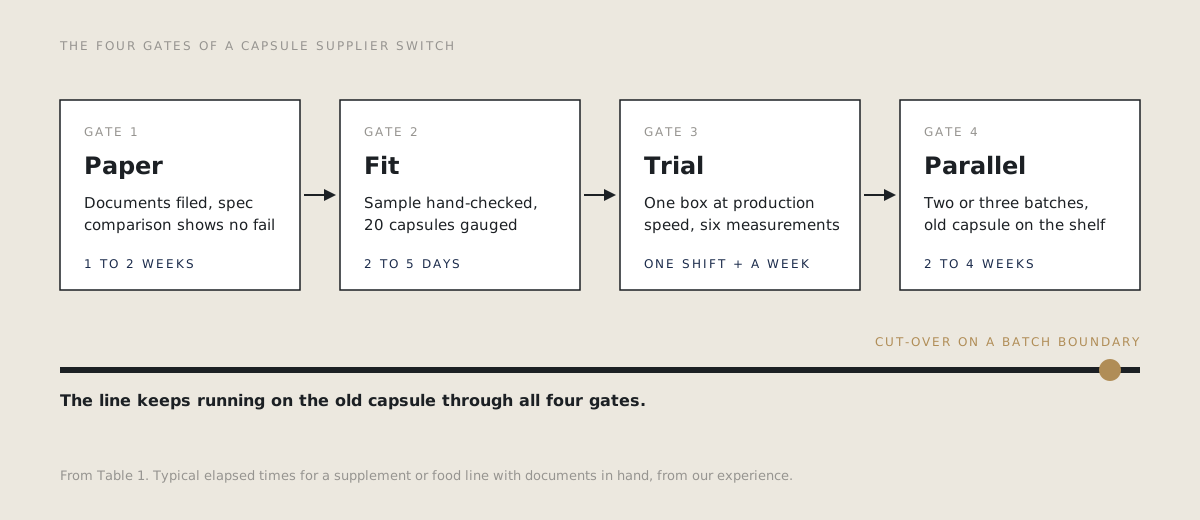
No. The line keeps running on the old capsule while the new one passes four gates, and the cut-over happens on a batch boundary you choose. Stopped lines come from skipping a gate, usually the second one, and finding out in the hopper what a ruler would have found on the bench.
Table 1. The four gates, what passes each, and who signs.
| Gate | What you're checking | What passes it | Who signs | Elapsed time, typical |
|---|---|---|---|---|
| 1. Paper | The candidate capsule matches your specification on paper, and the supplier's documents answer your questionnaire | Spec sheet, specimen COA, origin and allergen statements, certificates, change notification commitment, all filed | Quality | 1 to 2 weeks, mostly your own review calendar |
| 2. Fit | The capsule physically fits your change parts and separates by hand | A small sample checked in the segment or on the plate, closed length and diameters gauged | Production | 2 to 5 days including shipping |
| 3. Trial | One box runs on your machine at production speed with rejects, weights, and closed length inside your limits | A trial log with the six measurements below, compared with the last good lot of the incumbent | Production and quality | One shift, plus a week for results |
| 4. Parallel | Two or three production batches on the new capsule, with the old one still on the shelf | Batch records, weight results, and complaints (none) over the run | Quality | 2 to 4 weeks |
Swipe across to see every column.
The time column is what we see with supplement and food manufacturers who have their documents ready. A licensed medicine is a different calendar, and the regulatory section covers why.
The order matters more than the speed. Paper before fit stops you paying for a sample that was never going to pass the questionnaire. Fit before trial stops a box of 70,000 capsules going in a hopper set up for a different closed length. Trial before parallel means the first production batch on the new capsule isn't also the first time anyone measured one.
Are capsule sizes the same from every manufacturer?
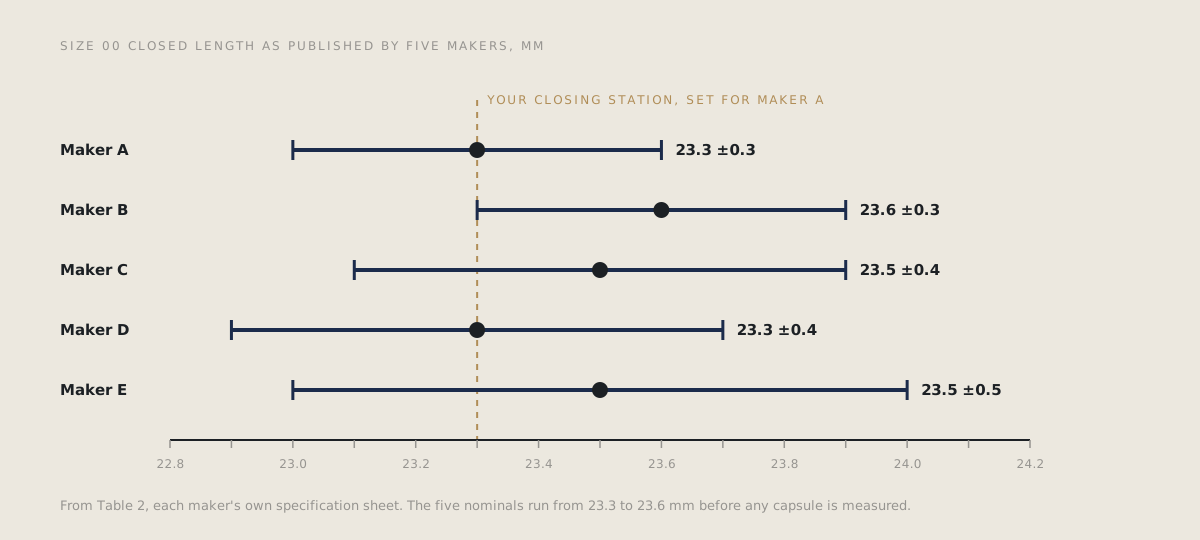
Nominally yes, and in practice almost. A size 00 from any maker is about 23.4 mm closed, about 8.5 mm across the cap, and holds about 0.9 ml. The catch is that "about" covers a spread as wide as one maker's whole tolerance band, and your change parts were cut for one point inside that spread.
Table 2. Size 00 and size 0 as published by five makers, mm. Compiled from the makers' own specification sheets and technical manuals, cited at the foot. Makers appear by letter because the point is the spread, not the ranking. Each maker publishes its own nominal closed length and tolerance, and they differ, so these figures are published examples. The dimension sheet for the lot you're running is the one that counts.
| Size | Figure | Maker A | Maker B | Maker C | Maker D | Maker E | Spread |
|---|---|---|---|---|---|---|---|
| 00 | Closed length | 23.3 ±0.3 | 23.6 ±0.3 | 23.5 ±0.4 | 23.3 ±0.4 | 23.5 ±0.5 | 0.3 |
| 00 | Cap length | 11.74 ±0.46 | 11.84 ±0.30 | 11.8 ±0.4 | 11.8 ±0.4 | 11.8 ±0.3 | 0.1 |
| 00 | Body length | 20.22 ±0.46 | 20.17 ±0.30 | 20.2 ±0.4 | 20.2 ±0.4 | 20.2 ±0.3 | 0.05 |
| 00 | Cap outside diameter | 8.53 ±0.06 | 8.57 ±0.06 | 8.55 ±0.03 | 8.52 ±0.06 | 8.54 | 0.05 |
| 00 | Body outside diameter | 8.18 ±0.06 | 8.23 ±0.06 | 8.22 ±0.03 | 8.16 ±0.06 | 8.20 | 0.07 |
| 0 | Closed length | 21.7 ±0.3 | 21.7 ±0.3 | 21.4 ±0.4 | 21.4 ±0.4 | 21.4 ±0.5 | 0.3 |
| 0 | Cap length | 10.72 ±0.46 | 10.72 ±0.30 | 10.7 ±0.4 | 11.1 ±0.4 | 10.8 ±0.3 | 0.4 |
| 0 | Body length | 18.44 ±0.46 | 18.44 ±0.30 | 18.5 ±0.4 | 18.5 ±0.4 | 18.4 ±0.3 | 0.1 |
| 0 | Cap outside diameter | 7.64 | 7.68 ±0.06 | 7.66 ±0.03 | 7.64 ±0.06 | 7.68 | 0.04 |
| 0 | Body outside diameter | 7.34 | 7.34 ±0.06 | 7.34 ±0.03 | 7.33 ±0.06 | 7.36 | 0.03 |
Swipe across to see every column.
Three things in that table decide whether a switch is easy or not.
First, closed length. The nominal closed length for a size 00 runs from 23.3 to 23.6 mm across published sheets, which is a full 0.3 mm tolerance band before any capsule is measured. Your closing station was set to one of those numbers. For a new capsule, set it from the closed length on the dimension sheet for the new lot, not from this table. One maker's manual says the closed joined length is given "as a filling machine set-up recommendation and not as an approval/rejection criterion," and that if the machine closes short "the cap or body may be damaged and the locking mechanism may fail; if longer, they may come apart." That's the setting to expect to move.
Second, diameters. The body outside diameter is the figure makers adjust to get the fit between cap and body right, which is why two of the sheets say the body diameter is indicative and shouldn't be measured with a vernier caliper. Diameter tolerances run from ±0.03 mm to ±0.06 mm depending on the maker. The clearance between a capsule and a segment bore is a few hundredths of a millimeter, so the diameter spread is the figure that decides whether capsules drop into the bores and separate cleanly.
Third, pre-lock length. Only one of the five makers publishes the length of the capsule as it arrives, before locking. The others don't. Pre-lock length is what the rectification block and the separation station see, and it's the figure we'd ask any candidate supplier for by name. The capsule sizes article covers what pre-lock and locked length mean and which one your machine needs, and why change parts are made to a size and a maker.
There's no ISO or pharmacopoeial standard for two-piece capsule dimensions. Sizes are a convention, each maker publishes its own nominals and tolerances, and each says they're subject to change. A capsule that matches your incumbent on paper to the last hundredth is rare. A capsule that runs on your machine after one afternoon of adjustment is normal.
Will my machine need re-setting for a different maker's capsule?
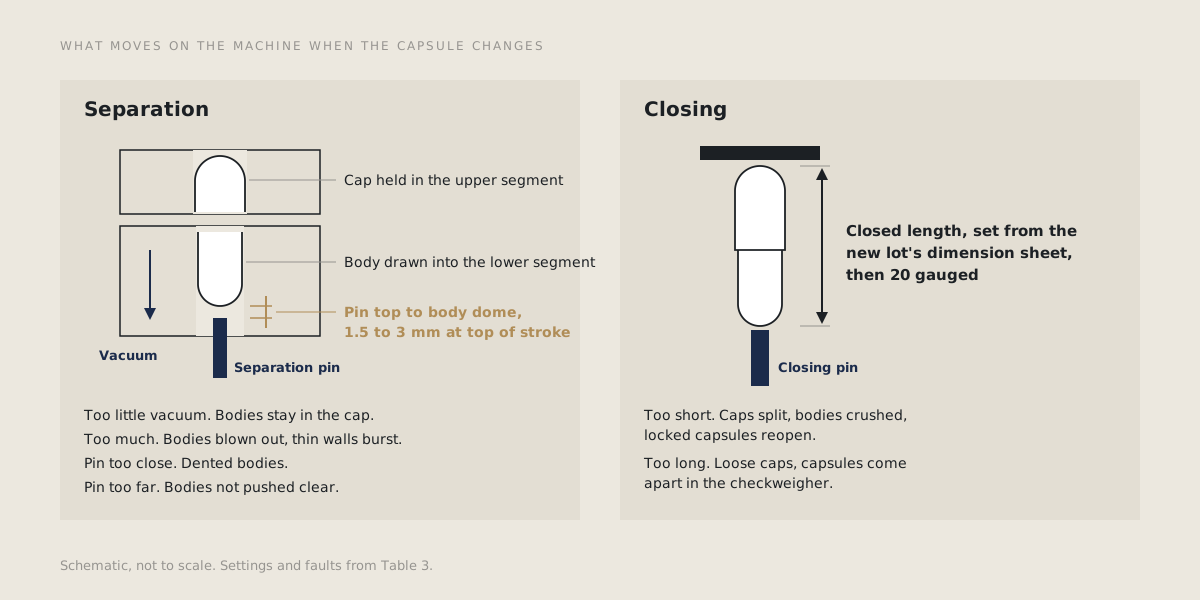
On a fully automatic machine, usually yes, and the two settings that move are separation vacuum and closing length. On a semi-automatic, sometimes. On a hand plate, rarely, because a plate tolerates a millimeter of length variation that a rectification block won't, though a plate has its own reasons a new supplier's capsules crush, split, or don't seat.
Two published sources say this plainly and they're worth having on the shop floor. A capsule maker's technical manual tells its own customers that its capsules "have a different behavior on filling machines than standard hard gelatin capsules," recommends checking the segments and bushes against the machine maker's specification, and says to increase "the level and quantity of vacuum in the capsule opening stage" and to confirm the orientation station set-up. A technical service engineer at another maker writes that "the force required to open capsules (termed pre-lock force) will change from one capsule supplier to another, because of differences in capsule pin design," and that the separation pin gap "sometimes requires fine-tuning when moving from one capsule supplier to another." The one machine maker's brochure we found that addresses the subject says the opposite, that capsules of all makes run without special tuning. In our experience the capsule makers are closer to the truth on an older or a heavily used machine, and the machine maker is closer on a new one with fresh segments.
Table 3. Settings that move when the capsule changes, and what you'll see if they're wrong.
| Setting | Why the capsule changes it | Too low or too short | Too high or too long | Where the fix is |
|---|---|---|---|---|
| Separation vacuum | Pre-lock force differs by maker and by lot | Unopened capsules rejected, bodies stay in the cap | Bodies blown out of the segment, thin walls burst | Ramp from no separation up until full separation, then to the middle of the machine maker's range |
| Closing length (closing pin height or stop) | Nominal closed length differs by up to 0.3 mm between makers | Caps split, bodies crushed, locked capsules reopen | Loose caps, telescoping, capsules come apart in the checkweigher | Set to the closed joined length on the new lot's dimension sheet, then gauge 20 filled capsules |
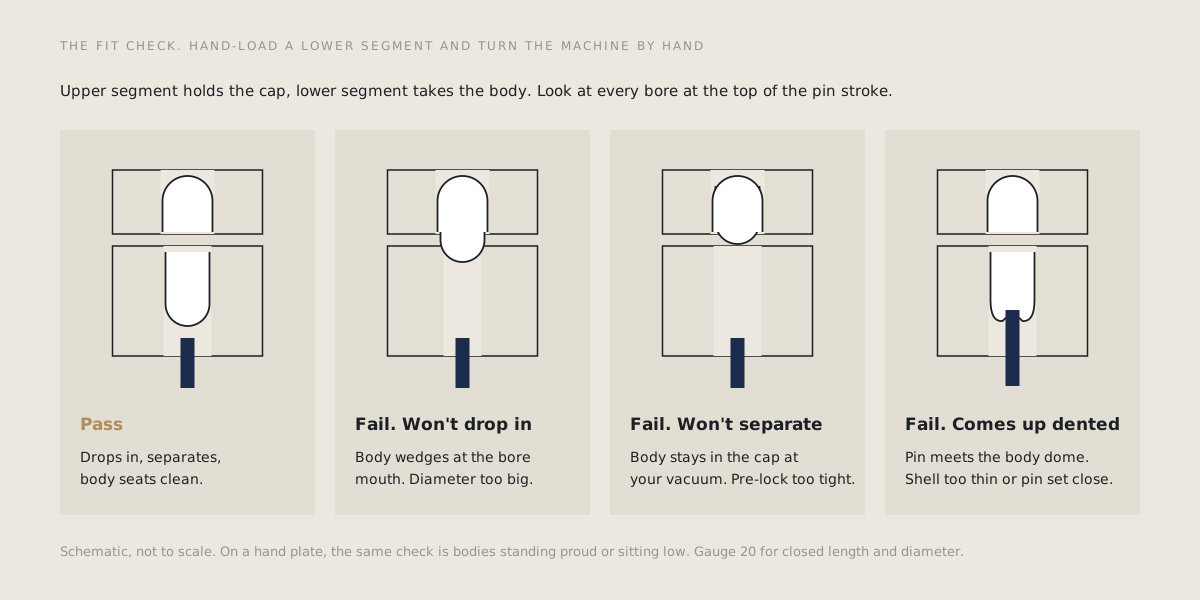
| Separation pin gap | Body dome height and body length vary | Pins hit the dome, dented bodies | Bodies not pushed clear, poor separation | 1.5 to 3 mm between pin top and body dome at the top of the stroke |
| Rectifier and magazine fingers | Pre-lock length and cap diameter vary | Capsules jam in the magazine, mis-oriented capsules | Capsules fall through unrectified | Check capsules sit vertical over the bore; clean the block |
| Segment fit | Body diameter is the figure makers adjust | Capsules stick in the bore, bodies don't seat | Capsules rattle, poor separation | Hand-load a lower segment and check every bore before the trial |
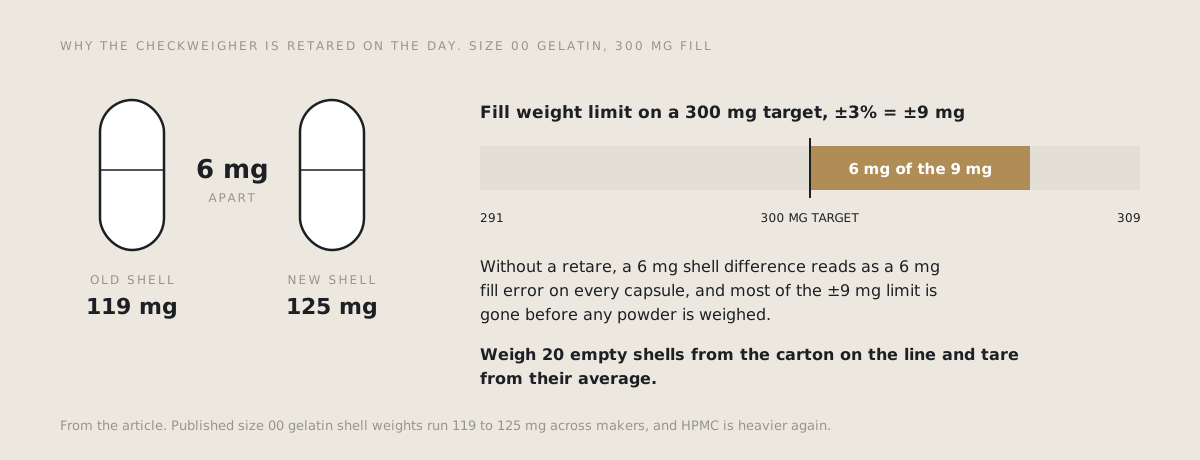
| Checkweigher tare | Shell weight differs by maker and material | Every capsule reads heavy, good capsules rejected | Every capsule reads light, underfills pass | Retare from 20 shells of the new lot on the day |
Swipe across to see every column.
The faults in the middle two columns are the same ones worked through in full in capsule filling faults and troubleshooting, with what to check first for each. If a new lot separates in the hopper or dents at closing, that page is where to go, and it tells you when the capsule is the cause and when it's the room or the setup.
Two things don't change with the supplier. The size tooling stays. Segments, dosing discs, and tamping pins are cut for a size, and a like-for-like switch keeps them. And the room stays. A dry room in winter will make any maker's gelatin capsule brittle, and a different supplier won't fix a humidity problem. The gelatin against HPMC article covers how each material runs on a filling machine at each humidity, including why HPMC shows static that gelatin didn't.
What do I need from the new supplier before I order a sample?
Nine documents, and a supplier who can't send them by return is telling you something. Ask for the current specification sheet with dimensions and tolerances, and ask for pre-lock length by name because it isn't always on the sheet. Ask for a specimen certificate of analysis for the exact size, material, and color you run, with real test methods, real limits, and real results. Ask for the species and country of origin declaration and the TSE/BSE statement if the capsule is gelatin. Ask for the allergen statement, the titanium dioxide statement, and any vegetarian, vegan, halal, or kosher certificate with the certifying body and the expiry date on it. Ask for the manufacturing site's GMP certificate or the equivalent, whichever standard the site holds. Ask for the storage conditions and shelf life, and how the capsules are packed. And ask, in writing, whether you'll be told before the specification, the material, or the manufacturing site changes.
That last one is the question most people forget, and it's the one that decides whether you find out about the next change from the supplier or from your own hopper.
The certificate of analysis article explains what each line on a capsule specification means and how to check the certificate against it. The supplier qualification article carries the capsule supplier questionnaire, the document list, and the change control clauses in full, and it's the page to send to your quality manager.
Two things about how we handle this ourselves. The specification and the certificate you get from us are the manufacturer's own documents, passed through unchanged with our covering letter, and we tell you who the manufacturer is once you're a customer (the article on how capsules are made explains why we name the maker after purchase and not before). And we'd rather you sent the same nine questions to three suppliers and compared the answers than sent them to us alone.
How do I compare the new capsule's spec with the old one?
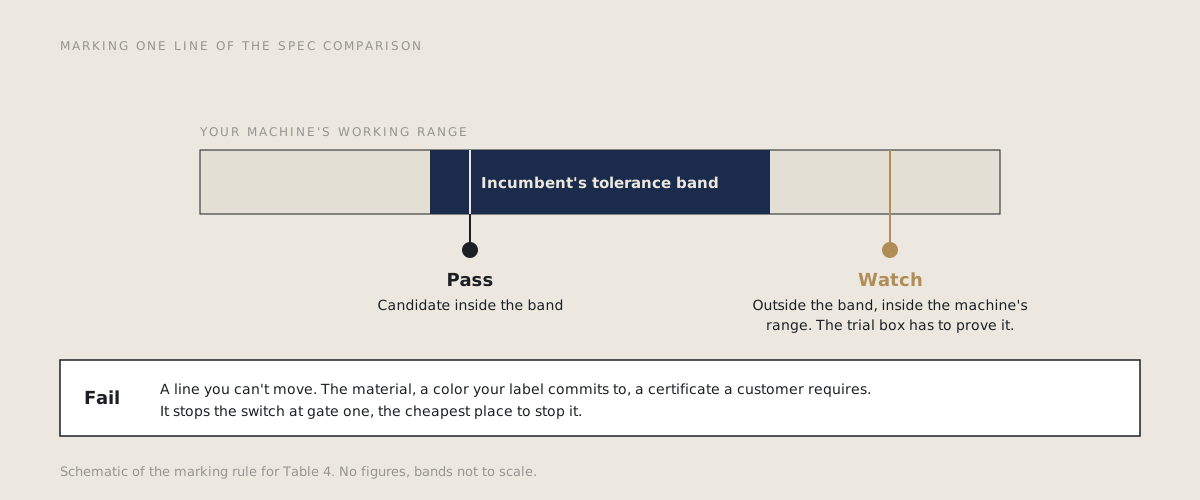
Put the two specification sheets side by side and give each line one of three marks. Pass means the candidate's nominal sits inside the incumbent's tolerance band. Watch means the candidate's nominal sits outside the incumbent's band but inside your machine's working range, so the trial has to prove it. Fail means the candidate can't meet a line you can't move, such as a material, a color your label commits to, or a certificate a customer requires.
Table 4. The specification comparison, line by line. The pack builds this sheet for you from the two documents.
| Line | Where it comes from | What a difference means on the line | Mark |
|---|---|---|---|
| Size and material, including HPMC type | Spec sheet | A different HPMC type (gelling agent or not) can change static and dissolution behavior | Pass or fail |
| Closed length and tolerance | Spec sheet | Closing station moves; blister or bottle fit can change | Pass or watch |
| Pre-lock length | Ask by name | Rectifier and separation behavior | Pass or watch |
| Cap and body length | Spec sheet | Fill volume, and a short body seats differently | Pass or watch |
| Cap and body outside diameter | Spec sheet | Segment fit and separation | Pass or watch |
| Shell weight and tolerance | Spec sheet | Your tare and your weight limits | Watch, always retare |
| Moisture or loss on drying range | Spec sheet and COA | Brittleness, static, and what the fill does to the shell | Pass or watch |
| Disintegration, as a shell property | Spec sheet and COA | A finished product limit you may be holding to | Pass or watch |
| Color, opacifier, TiO2 status | Spec sheet | Label claim, market rules on TiO2, batch-to-batch shade | Pass or fail |
| Spec sheet | Artwork approval, and a different ink | Pass or fail | |
| Lock design and pre-lock force | Ask | Separation vacuum setting | Watch |
| Visual defect classes and AQL | Spec sheet | Reject rate you should expect; makers publish Major A 0.010%, Major B 0.040%, Minor 0.25% to 1.0% | Pass or watch |
| Carton count, liner, and count tolerance | Spec sheet | Price per 1,000 and your reorder arithmetic; a 70,000 box and a 75,000 box are 7% apart | Watch |
| Storage conditions and shelf life | Spec sheet | Your warehouse and your first-in-first-out rule | Pass or watch |
| Species, origin, TSE/BSE | Statement | Your questionnaire and your customer's | Pass or fail |
| Allergen statement | Statement | Label and customer questionnaires | Pass or fail |
| Vegetarian, vegan, halal, kosher certificates | Certificate | Your on-pack claim, and the certifier has to approve the change | Pass or fail |
| Site GMP or quality certification | Certificate | Your supplier approval method | Pass or fail |
| Change notification commitment | Quality agreement or letter | Whether you hear about the next change first | Pass or fail |
Swipe across to see every column.
A sheet with no fails and a handful of watches is a normal result and the trial box is what turns the watches into passes. A sheet with a fail on material, color, or a certificate stops the switch at gate one, which is the cheapest place to stop it.
How many capsules do I need for a trial, and what do I measure?
Two checks, in order, from one box. First take a few hundred capsules out of the box and check them in the segment or on the plate by hand, before anything goes near the hopper. Then run the rest of the box at production speed for the trial. The numbers below are our recommendation from running switches with customers. No capsule maker or machine maker publishes a trial sample size, so treat these as a starting point rather than a standard.
The fit check takes twenty minutes and catches most of what would have stopped the line. Take a lower segment out of the machine, leave the upper in place, hand-load capsules from the new sample in their pre-locked state, and turn the machine by hand until the separation pins are at the top of their stroke. Capsules that don't drop into the bores, or don't separate at the machine maker's vacuum range, or come up dented, have failed the fit gate before a shift was booked. On a plate, load a sheet and look for bodies standing proud or sitting low. Gauge twenty capsules for closed length and diameter with a ring gauge or a go/no-go gauge rather than a caliper, because the shell deflects under a caliper jaw and reads low. The machine compatibility article sets out what to measure and gauge before switching capsule supplier on a running machine, including the bore check that stops a worn segment being blamed on the new capsule.
The trial box is one carton of the size you run most, filled with the product you run most, at the speed you run it. Log the six measurements below against the same six from the last good lot of the incumbent, which means pulling that lot's numbers before the trial starts.
Table 5. The six trial measurements, how to take them, and what passes. Acceptance figures are pharmacopoeial where one exists and ours where none does.
| Measurement | Method | Sample | Passes if |
|---|---|---|---|
| Separation failures | Count unopened capsules rejected at the separation station, or bodies left in caps | Per 1,000 capsules, three counts across the run | Not worse than the incumbent's last good lot, and inside your own reject limit |
| Closing failures and rejects | Count split caps, dented bodies, loose caps, telescoped capsules at the closing station and the checkweigher | Per 1,000, three counts | Same as above; makers' own AQL for machine-affecting defects is 0.040% or better |
| Closed length after filling | Gauge 20 filled capsules | 20, start, middle, and end of run | All inside the closed length tolerance on the new lot's dimension sheet; none open at the pre-lock |
| Weight variation | Weigh 20 filled capsules individually | 20 at start, middle, and end | For a supplement, each within 90% to 110% of the average (USP 2091). Under Ph. Eur. 2.9.5, not more than 2 of 20 outside ±10% (fills under 300 mg) or ±7.5% (300 mg and over), none outside double. For a medicine, USP 905 acceptance value 15.0 or below |
| Shell tare | Weigh 20 empty shells from the new lot on a balance reading to 0.1 mg | 20 | Recorded and used to retare; compare with the COA average |
| Disintegration | 6 capsules in water at 37 °C, your usual apparatus | 6 | All 6 inside your product limit, or the 16 of 18 rule on retest |
Swipe across to see every column.
Record throughput too, and the reject rate at each speed you tried, because the spec sheet carries neither.
Keep the trial box on its own. One lot, one supplier, one batch record. Label the trial capsules and the finished trial product as a trial, quarantine the finished product until quality has the results, and don't top up a production hopper from the trial box to save a walk. The storage article has the receipt checks (look, weigh, bend) for a damaged lot that go on the trial box when it arrives, and they're the same checks that go on every lot after the switch.
How we supply the trial box. It's a single box at the single-box price, paid up front, and its value is credited against your first production order of the same product, so if the trial works the box was free. We don't send free samples, so the fit check comes out of the same box.
What is a parallel run, and do I need one?
A parallel run is two or three production batches on the new capsule while the old capsule stays on the shelf and on the approved list, so that a problem in batch two sends you back to the incumbent rather than to a stopped line. On a fully automatic line, yes, you need one. On a semi-automatic, one batch is usually enough. On a bench plate in a compounding pharmacy, the trial box is the parallel run, because a hundred capsules by hand tells you what a hundred thousand would.
Run the parallel batches on the same product as the trial, on the same machine, with the same operator where you can. Change one thing at a time, and the capsule is the one thing. Compare three figures across the parallel batches with the incumbent's last three. Reject rate at the machine, weight variation on the finished product, and any complaint or deviation raised in the four weeks after release. If those three hold, the new capsule goes on the approved list as a full supplier rather than a trial one, and the cut-over is the next purchase order.
Two rules for the parallel run that save an argument later. Never run both suppliers' capsules in one batch, because the batch record has to trace each lot of every component to the finished batch, and a hopper with two lots in it can't. And keep the incumbent's remaining inventory sealed and dated. Opened cartons lose their moisture barrier, and the incumbent is your fallback for as long as the parallel run lasts. The storage article covers the opened-carton rule.
Do I need to re-tare or re-check my fill weight?
Yes, on the day the new capsule goes on the line, and again whenever a new lot goes on. Published shell weights for a size 00 gelatin capsule run from 119 mg to 125 mg across makers, and an HPMC 00 is heavier again, so a checkweigher tared to the old shell is wrong by up to 6 mg before any powder goes in. On a 300 mg fill with a ±3% limit, which is ±9 mg, that's most of the tolerance gone on the tare alone.
Weigh twenty empty shells from the carton that's on the line and tare from their average. Do the same after lunch if the room has changed, because gelatin shell weight moves with moisture. The storage article shows how far a shell weight can wander within one lot and why a fill weight drifts when nothing on the machine changed.
The fill weight itself shouldn't change on a like-for-like switch, because a size 00 body from any maker holds about 0.9 ml and your dosing disc hasn't moved. If the fill weight does move by more than the tare accounts for, the candidate's body length or diameter is different enough to change the fill volume, and that's a watch line on the spec comparison that just became a fail. The fill weight article covers how to calculate what a body should hold from your powder's density.
What does my quality system require when I change capsule supplier?
Four things, whichever system you run. Qualify the new supplier before you rely on its certificate. Update the raw material risk assessment, because a supplier change is a named trigger. Raise a change record with an impact assessment and someone's signature. And test the first lots against the certificate before you stop testing. The clause numbers differ, the four things don't.
Table 6. What each system asks for on a component supplier change. Clause text is quoted or closely paraphrased from the standard or regulation; the source list at the foot has each one.
| System | Qualify the supplier | Update the risk assessment | Change record | Confirm the first lots |
|---|---|---|---|---|
| 21 CFR 111 (US supplements) | 111.75(a)(2)(ii): to rely on a COA you "first qualify the supplier by establishing the reliability of the supplier's certificate of analysis through confirmation of the results of the supplier's tests," keep records of how, re-confirm periodically, and quality control approves the basis | 111.70 specifications for each component; an empty capsule is a component | Master manufacturing record and batch record identify each component's lot (111.210, 111.260) | 111.75(a)(2)(ii)(A) is the confirmation; 111.155 receiving, quarantine, and lot identification apply to every shipment |
| 21 CFR 117 Subpart G (US food, FSMA) | 117.410 approved suppliers and verification activities (audit, sampling and testing, records review) | 117.410(d) hazard analysis and supplier performance drive the verification | 117.475 documentation of verification | Sampling and testing is a named verification activity |
| ISO 9001 (2015 and 2026 editions) | 8.4.1 criteria for evaluation, selection, monitoring, and re-evaluation of external providers, with records | 8.4.2 type and extent of control based on impact on conformity | 8.5.6 review and control changes, record the results, who authorized, and actions | 8.4.2(d) verification activities you determine |
| BRCGS Food Safety Issue 9 | 3.5.1.2 approval by GFSI certificate, audit, or a questionnaire for low-risk suppliers only; 3.5.1.4 approved supplier list | 3.5.1.1 the raw material risk assessment "shall be updated when there is a change in ... the supplier of a raw material" | 2.12.3 HACCP review "prior to any changes" including "supplier of raw materials"; 5.2.2 label review on a supplier change; 3.6.4 specification review | 3.5.2.1 acceptance by sampling and testing, visual inspection, COA, or certificate of conformance, based on the risk assessment |
| ISO 22000:2018 | 7.1.6 criteria for evaluation, selection, monitoring, re-evaluation, with records | 8.5.1.2 raw material characteristics include source, place of origin, and method of production, all of which a new supplier changes | 7.4.3 the food safety team "shall be informed in a timely manner of changes in ... raw materials, ingredients and services" | 7.1.6(c) ensure the change doesn't affect the FSMS |
| 21 CFR 211 and EU GMP (licensed medicines) | 211.84(d)(2) a supplier's report of analysis may be accepted only after "appropriate validation of the supplier's test results at appropriate intervals," with at least one identity test; EU GMP 5.27 to 5.29 supplier qualification proportionate to risk, quality agreement, formal risk assessment for excipients | EU GMP 5.25, any change in materials that may affect quality should be validated | 211.100 and 211.180 written procedures and records; ICH Q10 change management | 211.84 identity test on every lot regardless |
| USP 795 (US compounding; see what USP 795 needs from your capsule supplier) | 6.2 a designated person selects components; non-API components "should" come from an FDA-registered facility with a COA | The SOP for selection and inventory control of components | Component receipt record with supplier name, lot, expiry, and any testing | COA reviewed on receipt against the monograph |
| MHRA Specials (UK unlicensed medicines; see what a UK specials manufacturer needs for the capsule shell) | Guidance 3.5.3, a vendor qualification program based on risk, approval "based on the combination of material and vendor" | Same | Periodic re-assessment | COA and analysis on receipt for lower-risk excipients |
Swipe across to see every column.
The paperwork sounds heavier than the machine work and usually is. The trial log from gate three is the evidence for most of it, which is why the log is worth keeping even when your system doesn't ask for one. The supplier qualification article carries the questionnaire and the quality agreement clauses that answer the first column, and how many lots to test before you trust the supplier's COA, which answers the last.
Is changing capsule supplier a regulatory change for a licensed medicine?
Yes, and how big a change depends on what else changes with the supplier. We're a capsule supplier, not your regulatory adviser, so what follows is what the published rules say, for you to take to whoever holds the file.
In the US, FDA's own reviewer policy on this exact question is a one-page document, MAPP 5016.6, "Change in Hard Gelatin Capsule Shell Supplier." It says that when an applicant changes the supplier of a hard gelatin capsule shell "with no change in capsule composition or appearance, the information should be submitted in an annual report," with the new supplier's name and address, a certification that the gelatin conforms to USP/NF, the BSE/TSE certification, and the new supplier's specification, "which should be consistent with existing specifications." It also says that "any change in capsule composition or appearance, including change in size, color or dye, or a change from gelatin to non-gelatin alternative, should be categorized as a prior approval supplement." So a like-for-like gelatin shell is the annual report. A move to HPMC, or a change of capsule color, is a prior approval supplement, and FDA's own drug shortage report puts a prior approval supplement at 4 to 10 months depending on whether an inspection is needed. For a color change that only swaps one color additive for another listed in FDA's color additive regulations, FDA's May 2025 draft guidance on replacing color additives in approved drug products proposes a changes-being-effected-in-30-days (CBE-30) supplement instead, though as a draft it isn't yet FDA's settled position. The MAPP covers gelatin only. For an HPMC shell, the general rule in 21 CFR 314.70 applies and your regulatory person will classify it.
In the EU and the UK, the variations classification guideline has no line that says "change of capsule shell supplier." Three categories are the ones your regulatory person will look at. B.II.a.4 covers a change in the weight of capsule shells, and it's a Type IA notification if dissolution is comparable and stability has started. B.II.c.3 covers a change in the source of a TSE-risk excipient, and gelatin from a new bovine source not covered by a certificate of suitability is a Type II variation under it. B.III.1 covers a new or updated certificate of suitability. A like-for-like HPMC shell from a new supplier with the same specification is, in most cases we've seen, handled inside the manufacturer's own change control with no variation, but that's a decision for the qualified person, not for us.
The clinical trial supply article covers the documentation index for an investigational product and what happens when the capsule changes mid-trial, which is where a capsule supplier change lands hardest, because the capsule is written into the IMP dossier.
What happens to my vegan, halal, or kosher claim when I change supplier?
The certificate has to be renewed for the new supplier before the new capsule runs, because the certifier approved a specific capsule from a specific supplier, not "an HPMC capsule."
Kosher certifiers keep an approved ingredient and supplier list for each certified product, and the Orthodox Union's guidance to its companies says that "although the ingredient may be approved from one supplier, the identical ingredient may be non-kosher when coming from a different supplier," and that the supplier on the delivery "must also be an exact match" to the list. The halal production standard used by one of the larger US certifiers says the same in its own words, that "all new suppliers or ingredients changed during the year's certification letter period are approved by the halal-certifying organization before being used," and that finding non-approved suppliers on inspection suspends the certification.
So the sequence is the candidate's own certificate on file at gate one, your certifier told at gate one, and the certifier's approval in hand before gate four. A vegetarian or vegan claim with no third-party certificate behind it rests on the supplier's statement, and the new supplier's statement has to say the same as the old one. The claims article covers what each claim rests on, including the difference between a supplier's statement and a certificate, and what the paperwork has to say.
How do I write the change control record?
Eight sections, filled in over the four gates rather than written at the end, so that the record is the project plan and not a story told afterwards.
Table 7. The change control record for a capsule supplier switch.
| Section | What goes in it | Filled at |
|---|---|---|
| 1. Change request | What's changing (supplier of size, material, color), why (the trigger), and what isn't changing (size tooling, product, process) | Before gate 1 |
| 2. Scope | Which products, lines, and sites; whether the incumbent stays on the list | Before gate 1 |
| 3. Impact assessment | Specification comparison result; effect on tare, weight limits, label, claims, registrations, customer notifications | Gate 1 |
| 4. Risk assessment | Raw material risk assessment updated; HACCP review where your system asks for one; pharma risk assessment per ICH Q9 | Gate 1 |
| 5. Implementation plan | Fit check, trial box, parallel batches, dates, and who runs each | Gate 1, updated through gate 3 |
| 6. Verification evidence | Trial log, parallel batch results, COA confirmation testing on the first lots, certifier approvals | Gates 2 to 4 |
| 7. Approval and effective date | Quality signature, the batch number the new capsule starts from, the approved supplier list updated | End of gate 4 |
| 8. Closure and review | Four-week review of complaints and deviations, incumbent's status decided (retained as second source or removed) | Four weeks after cut-over |
Swipe across to see every column.
The prompt pack writes sections 1 to 5 from your answers and gives you the trial log and the spec comparison as the evidence for section 6, in the shape your system uses. It will not sign section 7.
How long does switching capsule supplier take?
For a licensed medicine the calendar is the one in the regulatory section. Months for an annual report change once the qualification is done, and the qualification itself, with audit, stability, and a variation where one applies, runs from a year to two. Which is why a pharmaceutical customer rarely switches, and why the ones who do tend to add a second source rather than replace the first.
The way to shorten the six to ten weeks is to do gates one and two before you need them. A supplier whose documents are in your system and whose capsule has been through your segment is a two-week switch on the day the incumbent's lot fails. A supplier you're meeting for the first time that day is a ten-week one, with a stopped line in the middle.
Can I run two capsule suppliers at once?
Yes, and for a line that runs one size every day, you should. Dual sourcing a capsule costs one questionnaire, one trial box, and the discipline of ordering from the second supplier often enough that both stay approved. In return, the day one supplier's lot fails, the other is a purchase order away rather than ten weeks away.
Sole sourcing is the thing supply chain surveys keep finding at the bottom of a shortage. In a McKinsey survey of pharmaceutical supply chain leaders, nearly 50% named sole sourcing of inputs as a critical vulnerability. FDA's draft guidance on shortage risk management plans asks manufacturers to identify "sole source manufacturers of critical components" and lists "identifying alternative suppliers" as the risk reduction. Those are pharma documents, and the arithmetic is the same for a supplement line.
Three rules make dual sourcing work rather than just exist on paper. Hold both suppliers to the same specification, yours, not either of theirs, so that a lot from either one passes the same receipt checks. Run one supplier per batch, and record which, so that a complaint traces to one lot. And alternate. A second source you haven't ordered from in a year has drifted off your approved list in practice if not on paper, and its specification may have changed without you hearing. A quarterly order keeps the supplier live, the documents current, and the machine settings written down for both.
The buying article covers the arithmetic of a second source, how much cover to hold, and how to write a request for quotation both suppliers can answer the same way.

What goes wrong when people switch in a hurry?
Three things, most of the time. The box goes in the hopper before anyone gauged a capsule, and the closing station is set for the old length. The checkweigher keeps the old tare and rejects a shift's output. And quality finds out about the switch from the batch record, after the fact, and the change record gets written backwards.
If your switch is already underway and one of those three has happened, the fix is the same as the plan. Stop at the gate you skipped, run it, and carry on.
Switch readiness checker
Ten yes or no questions. Answer them for the switch you're planning and the checker gives you a readiness score, tells you which gate you're at, and lists the gaps with the section of this page that closes each one. It runs in the browser and stores nothing.
What is an AI prompt pack?
An AI prompt pack is a small set of files you load into the AI assistant you already use. The assistant then asks you the right questions about your switch, works through them with you using our reference data, and shows its working as it goes. We publish one with each article.
We've done the prompt engineering so you don't have to. The prompt in this pack has been expertly engineered to ask the questions in the order the four gates need them, to say when a figure comes from our reference data and when it comes from you, to mark every assumption it makes, and to refuse to make claims about what a capsule's contents do for anyone.
Why a pack and not just the tables? Because the tables can't ask you which machine you run, or read your two specification sheets and mark each line, or write the change record in the shape your auditor expects. The pack can.
Get the Capsule Supplier Switch Plan AI Prompt Pack
Request the Capsule Supplier Switch Plan AI Prompt Pack
Leave your details to request this resource.
The pack takes your current capsule, your machine, and your quality system, and returns a switching plan across the four gates, a line-by-line specification comparison of the incumbent against the candidate, a trial run protocol with a log to fill in, and the change control record drafted in the shape of your own system. Three files. The prompt, a workbook the assistant fills in, and a read-me.
If your switch doesn't fit the pattern on this page, or you're at gate three and the numbers don't look right, reply to any email from us or write to us through the contact page. A person who has stood at the machine while a new capsule went through it will get back to you. And if you'd rather run a box than read about one, ask for a trial box.
Related.
- Capsule machine compatibility and change parts
- How to qualify an empty capsule supplier
- What a certificate of analysis and a specification contain
- Capsule filling faults and troubleshooting
- Capsule moisture, storage, and shelf life
- Buying empty capsules. Price per 1,000, MOQ, and lead time
Sources.
- Capsule maker specification sheets and technical manuals used for Table 2 (makers by URL, not named in body copy; where the document is read on a copy, the maker's own page follows it): https://euromar.co.il/wp-content/uploads/2021/01/ConiSnap_brochure_full.pdf (maker's page https://www.capsugel.com/pharmaceutical-solutions/hard-empty-capsules/hard-gelatin-capsules) · https://falcaoteles.pt/sites/default/files/PDF/Technical_Manual_QUALI-V_ONLINE.PDF (maker's page https://www.qualicaps.com/Capsules/pharma/quali-v) · http://acgcapsule.weebly.com/uploads/1/0/8/6/108696183/hard_gelatin_capsule_shells_%C2%BB_dimensions.pdf (maker's capsule range brochure https://www.acg-world.com/sites/default/files/2023-09/Capsule_Range_Brochure-2017-Rev-6-12.3.18.pdf) · https://suheung.com/theme/suheung/img/Specification_EMBOCAPS.pdf · https://ss3-production-public.s3.amazonaws.com/seller-document/1/j8pLsl940fUHPJh9Nfh5yM2YhB82T74I.pdf (maker's page http://www.hgcapsule.com/en/pro_dot_18.html)
- Capsule maker guidance on filling machine settings and closed joined length (Quali-V technical manual, section 4.3): https://falcaoteles.pt/sites/default/files/PDF/Technical_Manual_QUALI-V_ONLINE.PDF (maker's page https://www.qualicaps.com/Capsules/pharma/quali-v)
- Troubleshooting capsule separation, pre-lock force and pin gap (capsule maker technical service, Tablets & Capsules reprint): https://blog.lyfegroup.com/troubleshooting-capsule-separation-following-five-steps-to-reduce-waste-and-downtime
- Machine maker brochure stating capsules of all makes run without special tuning (GKF 700): https://docs.marketpath.com/313fa825-ccba-46a7-a550-b39f3d2530a0/document/ca77100e-90ea-4032-9348-f68f45d866be/boschgkf-700capsulefillingmachine.pdf
- Empty capsule dimensions and weight as critical quality attributes for high-speed filling, Stegemann et al., AAPS PharmSciTech 2014: https://pmc.ncbi.nlm.nih.gov/articles/PMC4037476/
- Capsule pre-lock and opening force ranges (US patent 9,775,813): https://patents.google.com/patent/US9775813
- 21 CFR 111.70, 111.75, 111.155, 111.210, 111.260: https://www.ecfr.gov/current/title-21/chapter-I/subchapter-B/part-111
- 21 CFR 111.75, qualifying a supplier's certificate of analysis: https://www.ecfr.gov/current/title-21/chapter-I/subchapter-B/part-111/subpart-E/section-111.75
- 21 CFR 117 Subpart G, 117.410 and 117.475: https://www.ecfr.gov/current/title-21/chapter-I/subchapter-B/part-117/subpart-G
- 21 CFR 211.84, 211.100, 211.180: https://www.ecfr.gov/current/title-21/chapter-I/subchapter-C/part-211
- 21 CFR 314.70: https://www.ecfr.gov/current/title-21/chapter-I/subchapter-D/part-314/subpart-B/section-314.70
- FDA MAPP 5016.6, Change in Hard Gelatin Capsule Shell Supplier (effective 2016, recertified 2023): https://www.fda.gov/media/99625/download
- FDA draft guidance, Replacing Color Additives in Approved or Marketed Drug Products (May 2025): https://www.fda.gov/regulatory-information/search-fda-guidance-documents/replacing-color-additives-approved-or-marketed-drug-products
- FDA, Drug Shortages: Root Causes and Potential Solutions (2019, updated 2020): https://www.fda.gov/media/131130/download
- FDA draft guidance, Risk Management Plans to Mitigate the Potential for Drug Shortages (2022): https://www.fda.gov/media/158487/download
- FDA Dietary Supplement cGMP Small Entity Compliance Guide (2010): https://www.fda.gov/regulatory-information/search-fda-guidance-documents/small-entity-compliance-guide-current-good-manufacturing-practice-manufacturing-packaging-labeling
- EU GMP Chapter 5, Production (5.25 to 5.30): https://health.ec.europa.eu/system/files/2016-11/chapter_5_0.pdf
- EU variations classification guideline 2013/C 223/01 (B.II.a.4, B.II.c.3, B.III.1): https://eur-lex.europa.eu/legal-content/EN/TXT/?uri=CELEX:52013XC0802(04)
- BRCGS Global Standard Food Safety Issue 9, clauses 2.12.3, 3.5.1, 3.5.2, 3.6.4, 5.2.2: https://www.brcgs.com/product/global-standard-food-safety-issue-9/p-13279/
- ISO 9001:2026 clauses 8.4 and 8.5.6 (numbered the same as the withdrawn 2015 edition, which most certificates will cite until the transition ends 30 September 2029): https://www.iso.org/standard/88464.html
- ISO 22000:2018 clauses 7.1.6, 7.4.3, 8.5.1.2: https://www.iso.org/standard/65464.html
- USP General Chapter 795, Pharmaceutical Compounding, Nonsterile Preparations, section 6.2 Components (2023 revision): https://www.usp.org/compounding/general-chapter-795-pharmaceutical-compounding-nonsterile-preparations
- MHRA Guidance for Specials Manufacturers, section 3.5: https://www.gov.uk/government/publications/guidance-for-specials-manufacturers
- USP General Chapter 905, Uniformity of Dosage Units: https://www.usp.org/sites/default/files/usp/document/harmonization/excipients/m99694.pdf
- USP General Chapter 2091, Weight Variation of Dietary Supplements: https://doi.usp.org/USPNF/USPNF_M99985_02_01.html
- Ph. Eur. 2.9.5, Uniformity of mass of single-dose preparations (European Pharmacopoeia, EDQM)
- USP General Chapter 2040, Disintegration and Dissolution of Dietary Supplements (USP-NF)
- Orthodox Union, Ingredients: Protect Your Company (Schedule A and supplier matching): https://oukosher.org/btus/2015/03/18/ingredients-protect-your-company/
- Halal Industrial Production Standards (supplier and ingredient approval before use): https://www.halalcertified.com/wp-content/uploads/2019/05/HALALSTDa.pdf
- Natural Health Products Regulations SOR/2003-196, sections 11 and 12: https://laws-lois.justice.gc.ca/eng/regulations/SOR-2003-196/FullText.html
- TGA, Changing a listed or assessed listed medicine in the ARTG: https://www.tga.gov.au/resources/guidance/changing-listed-or-assessed-listed-medicine-australian-register-therapeutic-goods-artg
- McKinsey, Four ways pharma companies can make their supply chains more resilient (2021): https://www.mckinsey.com/industries/life-sciences/our-insights/four-ways-pharma-companies-can-make-their-supply-chains-more-resilient
*Capsules.com supplies empty hard capsules in gelatin and HPMC to manufacturers, brands, pharmacies, and research teams. Capsules Direct Ltd, company number 17362490, 26 Rowood House, Bicester OX26 4PP, United Kingdom. UK 020 3905 1989 · US (816) 445-0042 · capsules.com. *