
Formulation and filling
Capsule fill weight from bulk and tapped density, and what tamping actually adds
Understand the five powder densities, measure the range your filler can reach, and work out which capsule fits your blend on your machine.
Written by A. Sanderson, CEO, Capsules.com

On this page
You've picked a capsule size. Now the powder won't go in, or it goes in and the capsules come out half empty, or the fill weight wanders from one capsule to the next and nobody can tell you why. Most of those problems come back to the same thing. A capsule holds a volume, and how much of your powder fits in that volume depends on how dense you can make it in there. Not how dense it is in the tub. How dense it is inside the capsule, on your machine, with your powder.
This article is the working behind the size chart. It's for the person who has a dose, a blend, and a machine, and needs to make the three agree. Here's what's in it, so you can jump to the part you need.
- The five densities. Bulk, tapped, compressed, minimum slug, and slugged, and which ones your machine fills between.
- How to measure bulk and tapped density. Ten minutes with a graduated cylinder, and what the two numbers tell you about your powder.
- The calculation. From dose and density to the size that fits, with a worked example.
- Fill ranges by machine type. Why a hand plate, a bench-top, a dosator, and a tamping-pin machine get different weights into the same capsule.
- The slug floor and ceiling. Why a tamping-pin machine has a minimum and a maximum for every powder, how hard the pins press, and how to measure your own range.
- Flow. Hausner ratio, Carr's index, and what they predict about fill weight variation.
- When the dose won't fit. Densifying, splitting, and trimming excipients, in that order.
- Sizing without a bulking agent. How to set the dose and the size so the capsule fills on its own.
- The free AI prompt pack. Load it into ChatGPT, Claude, or Gemini, give it your ingredients and densities, and it returns the size, the tamping, and a batch sheet for 10,000, 100,000, and 1,000,000 capsules.
The size chart itself, the capsule dimensions, and the questions a first-timer asks are in capsule sizes, volumes, and fill weights. This page assumes you've read it or don't need to.
The five densities, and which one you're actually filling at
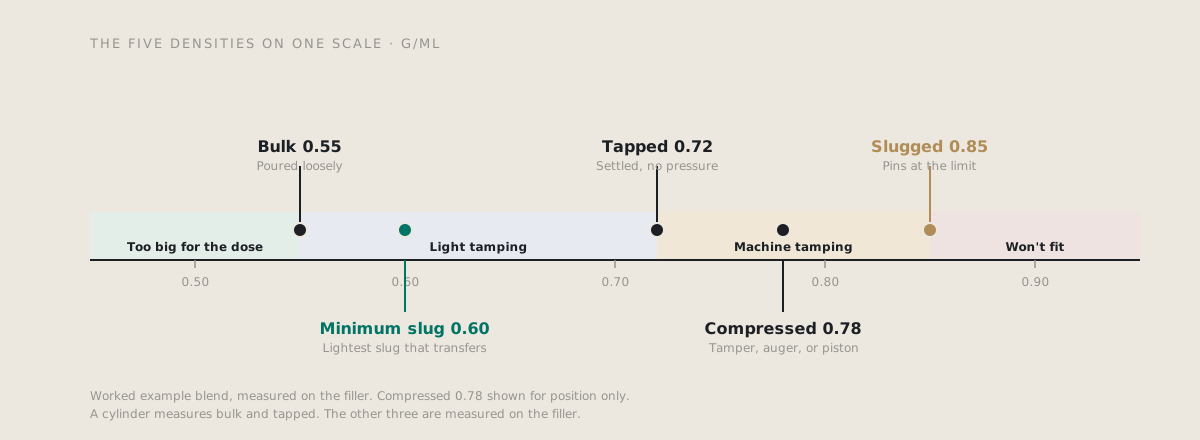
Most of the confusion in capsule sizing comes from using the wrong density. There are five you'll meet, from loosest to tightest.
Bulk density (also called loose density). The weight of your powder divided by the space it takes up when it's poured gently and left alone. This is what a hand plate fills at, and it's the lowest density your powder will ever be inside a capsule.
Tapped density. The same weight divided by the space it takes up after you've tapped the container until the powder stops settling. No pressure applied, just gravity and vibration. Tapped is always higher than bulk, and the gap between them tells you how much room the powder has to give. The standard way to measure both is USP general chapter <616>, Bulk Density of Powders, which the European and Japanese pharmacopoeias share under ICH Q4B Annex 13. Its Method I uses about 100 g of powder in a 250 ml cylinder and a tapping machine that drops the cylinder 14 mm about 300 times a minute, reading the volume after 10, 500, and 1,250 taps and stopping when two readings agree within 2 ml. A bench and a hand get you close enough to choose a size; the USP method is what you write in a specification.
Compressed density. What you get when something pushes on the powder rather than just shaking it, such as a hand tamper pressed down firmly, the auger on a bench-top filler, or the piston in a dosator. Above tapped. This is the ceiling we use for a hand plate, bench-top, or dosator, and there's no standard method, because it depends on how hard you push.
Minimum slug density. The lightest a plug can be and still hold together while a tamping-pin machine carries it over the capsule body and pushes it in. Below this the slug crumbles on the way and the powder drops. This is the floor on a tamping-pin machine, and it's usually above tapped density.
Slugged density. The tightest a machine can press the powder into a plug before it won't eject cleanly, the caps dent on closing, or the powder stops compressing. This is the ceiling on a tamping-pin machine, where pins form the slug in a dosing disc, and it's set by the powder and by how hard the machine can press. It is always higher than tapped density, sometimes by a lot, because tapping only settles powder and a pin under load squeezes the air out of it.
The first two you measure with a cylinder. The last three you measure on a machine, or with a slug gauge, because a cylinder never applies pressure. The weights you can get into a capsule run from bulk density at the bottom to slugged density at the top. Tapped density sits between them. We use it to mark where hand tamping stops, and we use the slugged or compressed density, measured on the filler, as the ceiling.
How do I measure bulk and tapped density?
Weigh out 25 to 100 g of your finished blend, pour it gently into a dry graduated cylinder, read the volume, and divide. That's bulk density. Then tap the cylinder until the level stops falling, usually a few hundred taps by hand or a set count on a tapping machine, read again, and divide again. That's tapped density. Repeat once and average. The standard method is USP General Chapter 616, and the whole thing takes about ten minutes.

Three things people get wrong. Measure the finished blend, not the individual ingredients, because density changes when powders are mixed. Use a cylinder wide enough that the powder doesn't bridge, or you'll read bulk density low. And write down the room humidity, because a hygroscopic powder measured on a wet day is a different powder.
If you can't measure and need a starting point, light botanical and plant powders often sit around 0.3 to 0.5 g/ml bulk. Amino acids and many vitamins around 0.5 to 0.7. Dense minerals like magnesium oxide or calcium carbonate can be 0.8 to 1.2 or more. A typical powder taps to somewhere between 1.2 and 1.4 times its bulk density. Those are guesses, and the answer is only as good as the density you feed it.
How do I calculate capsule fill weight from bulk density?
Divide your dose in grams by the capsule's volume in milliliters. That gives you the density the fill would need to reach in that size. Now compare it with the range your powder can reach. The floor is bulk density. The ceiling is slugged density. Tapped density sits in between and marks where hand tamping stops and machine compression starts.
So there are four bands. At or below bulk, the size is too big for the dose on a hand plate or a bench-top, because those fill the bodies full, and a dosator can meter a part fill. Light tamping, between bulk and tapped, which you can reach by hand with a tamper and any machine reaches easily. Compressed fill, between tapped and the ceiling, which needs a filler pressing the powder, a tamping-pin machine, a dosator, or an auger set firmly, and where fill weight variation rises as you get near the top. And won't fit, above the ceiling, where the answer is a denser blend, a split dose, or a bigger capsule.
If you haven't measured the ceiling, and most people haven't when they start, the third band is open at the top. A required density above tapped might fit and might not, and the cylinder can't tell you. That's not a reason to guess. It's a reason to measure, and the section on the slug floor and ceiling shows you how.
A worked example. Say your dose is 700 mg, your bulk density is 0.55 g/ml, your tapped density is 0.72 g/ml, and on your tamping-pin machine you've measured a slug floor of 0.76 g/ml and a slugged density of 0.92 g/ml. The floor sits a little above tapped, which is where it usually is.
Table 1. Required fill density by size for a 700 mg dose. Band is judged against bulk 0.55, tapped 0.72, slug floor 0.76, and slugged 0.92.
| Size | Volume (ml) | Required density (g/ml) | Band |
|---|---|---|---|
| 000 | 1.37 | 0.51 | Below bulk. Too big for the dose on a plate or bench-top, and far too loose to transfer on this machine |
| 00E | 1.02 | 0.69 | Between bulk and tapped. Light tamping by hand or on a dosator, but below the slug floor, so the slug won't survive the transfer on this machine |
| 00 | 0.91 | 0.77 | Just above the slug floor. Machine tamping, the comfortable setting on this machine |
| 0E | 0.78 | 0.90 | Just under slugged. Pins set hard, watch the weight variation |
| 0 | 0.68 | 1.03 | Above slugged. Won't fit |
Swipe across to see every column.
On this machine two sizes work, and they aren't equal. The 00 is the comfortable choice, just over the slug floor, with room above it before the pins run out. The 0E fits on paper because the slugged density was measured at 0.92, but 0.90 is close to it, so the pins are working near their limit and the fill weights will spread more. The 00E is the trap. On the cylinder numbers alone it looks like the easy option, a light tamp between bulk and tapped. On a tamping-pin machine it fails, because 0.69 is below the lightest slug that holds together, and the powder drops before it reaches the body. On a hand plate or a dosator the 00E would be fine. Without the measured floor and ceiling, the 00E would have looked safe and the 0E would have been a guess. Measuring them is what sorted the list. Whatever you pick, confirm it on the machine with a small batch. Paper density and machine density are not the same thing, and the rest of this page is about the difference.
The capsule fill weight calculator does this arithmetic for every size, and takes your measured slug range if you have one. The AI prompt pack does it for a blend with several ingredients. Get the AI prompt pack.
Why does the same capsule hold different weights on different machines?
Because the machine sets how dense the powder gets inside the capsule, and the four kinds of filler do that in four different ways.
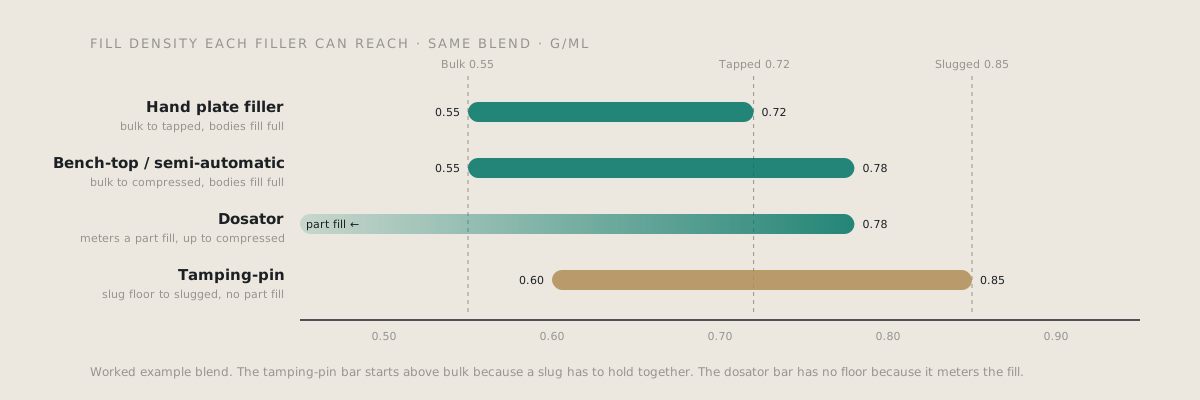
Hand plate fillers, the kind used in compounding pharmacies and by small brands (the compounding guide weighs a plate machine against the punch method). The powder is spread over a plate of open capsule bodies and swept in, then pressed with a tamper if you want more in. The fill is loose, somewhere between bulk and tapped density, and the plate fills the bodies full. A part fill isn't something a plate does consistently, because the powder goes on in the middle and gets spread outward, so the bodies in the middle are full before the ones at the edge have anything in them. If the dose is less than a full body holds at bulk density, the answer is a smaller capsule, not a lighter sweep. Bulk and tapped density predict these fillers well.

Bench-top and semi-automatic fillers, the machines a compounding pharmacy or a small manufacturer steps up to. Same principle, more capsules at once, and a tamping tool or vibration to settle the powder. The fill lands between bulk and tapped, and as with a plate the bodies fill full. If the machine has an auger that pushes the powder down into the bodies, the fill can go a little past tapped into what we called compressed density above, so treat tapped as the floor of the top of the range rather than a hard ceiling. Bulk and tapped density, the two numbers from the graduated cylinder, predict these fillers well.
Dosator machines, one of the two types of fully automatic filler. A tube plunges into a bed of powder, picks up a measured column, and ejects it into the body. Because the dosator meters a separately adjustable quantity of powder, it can deliver a partial fill, so a capsule can run a third or a half full. Depending on the powder and settings, the metered powder may form a plug. That's why dosators are the machine of choice for low fill weights, micro-doses, and potent ingredients where a few milligrams is the whole dose (the clinical guide covers capsules for powder-in-capsule first-in-human studies). The pharmaceutical dosator lines from MG2 and IMA Zanasi are sold on that, and the machine makers' own comparison guides say the same thing the other way round, that a tamping-pin machine is the wrong tool for a low fill weight.
Tamping-pin machines, the other automatic type and the most common in supplement manufacturing. Pins press the powder into a slug in the dosing disc, a thick plate with a ring of bores in it that the pins work down into across five stations, and the slug is then transferred over the capsule body and pushed in. This is where the range appears, and it gets its own section.
So bulk and tapped density, the two numbers you measured in the cylinder, give you a good first guess on a plate, a bench-top, or a dosator, and only a rough one on a tamping-pin machine. On a tamping-pin machine the numbers that matter are the slug floor and the slugged density.
What's the least and the most a tamping-pin machine can put in a capsule?
On a tamping-pin machine every powder has a floor and a ceiling for every size, and every capsule that comes off the machine sits between the two. Where it sits is a tamping setting.
If the slug isn't dense enough, it falls apart as the disc carries it over the capsule body and the powder drops before it reaches the body. So there's a floor, the lightest slug that survives the transfer. If the pins are set harder and harder, the powder eventually won't compress any further in that bore, or the plug won't eject cleanly, or the caps dent on closing. So there's a ceiling.

Say your blend has a tapped density around 0.55 g/ml, so the size chart says a 00 holds about 500 mg. On a tamping-pin machine you'd find the lightest slug that survives the transfer weighs about 550 mg, and the hardest you can press before something goes wrong is about 700 mg. So the range for that powder in a 00 on that machine is 550 to 700 mg, and the chart's 500 mg isn't in it. The floor sits above tapped density, because a slug has to be denser than settled powder to hold together. The ceiling sits well above tapped density, because a pin under load compresses powder further than tapping ever does. Bulk and tapped bracket the answer without being it.

How hard does a tamping-pin machine actually press? Harder than tapping, and nowhere near as hard as a tablet press. Researchers who put force sensors on the tamping pins of a production tamping-pin filler measured up to about 100 newtons per pin with a standard spring set, and more with heavier overload springs fitted. Spread over a size 00 pin, 100 newtons is roughly 2 megapascals of pressure, against the 100 megapascals or more a tablet press uses. That's why a plug is soft and crumbly rather than a tablet, and why the ceiling is a property of the powder and the pressure together. On most machines sold today you set the pin depth, not the spring. The pin goes down to the depth you've set and presses with whatever force the powder pushes back with at that depth. There's still a spring behind the pin, but its job is to give way if the powder pushes back harder than the pin can take, so you can't bend a pin or crash the machine by setting the depth too deep. So the force figures above are a guide to the range a machine works in, not a number you dial in. What you dial in is depth, and the powder sets the force.

How to measure your own range, on the machine. About twenty minutes with a box of capsules. Set the tamping as light as it will go and run a few hundred capsules. Turn it up in steps until the slugs transfer cleanly and the reject rate settles. Weigh 20 capsules, subtract the empty shell weight, and that's your floor. Then keep turning the tamping up until the plug stops ejecting cleanly, the rejects climb, or the caps start to dent. Back off one step, weigh 20, subtract the shell, and that's your ceiling. Write both down against the powder, the size, and the machine. The calculator and the AI prompt pack both take those two numbers.
How to measure it off the machine. A slug gauge. A die bored to the capsule body's inside diameter, a matching pin, and a force gauge reading in newtons. Weigh powder into the die, press to 50, 100, 150, and 200 newtons, and read the plug height at each step to get the density. Push the plug out through the bottom to get the ejection force, which tells you whether it'll leave a dosing disc cleanly and how much lubricant the blend wants. Press the ejected plug on its side until it breaks for its strength, which is what decides whether it survives the transfer. One die, three numbers. If you'd rather not build one, send us the powder. We press a slug of your blend in the size you're considering on our gauge, find the density at which it holds together and the density at which it stops taking more, and send you both as g/ml and as fill weights for that size, ready for the calculator. Email us first, through the contact page, with what the powder is, the size, and the dose you're aiming for. Don't post anything until you've heard back, because we need to know what's coming before it arrives. We'll reply with the address of whichever of our offices is nearer, UK or US, and the sample goes there marked for sample testing.
Can a tamping-pin machine do a part fill at all? With a thinner dosing disc, yes, and it comes with a fault attached. The dosing disc's thickness sets the longest slug the machine can make. The standard disc for a 00 is about 22 mm thick (here's the dosing disc thickness for each size), which is close to the body's depth, so a full slug fills the body. Discs come in other thicknesses, and if you fit a 10 mm disc to a 00 the machine can only ever make a slug 10 mm long. Push that into the body and the capsule is about half full, with a short pellet sitting loose inside it. That's a real way of getting a part fill on a machine that otherwise can't. The catch is that the pellet has a lot of empty capsule to rattle around in, and the slug that survived the transfer often doesn't survive dedusting, polishing, and packing. It breaks up, and what reaches the customer is a capsule that looks half filled with loose powder, weighs what it should, and gets returned anyway. So it's a route for a dose that has no other home, not a first choice, and if you take it, check capsules after packing and not only off the machine. Faults and troubleshooting on the capsule filling line has the fault side of this.
What do Hausner ratio and Carr's index tell me?
They tell you how well the powder flows, and flow is what decides whether every capsule weighs the same as the last one.
Hausner ratio is tapped density divided by bulk density. Carr's index is the gap between them as a percentage of tapped. Both come free from the cylinder measurement you already made. USP general chapter <1174>, Powder Flow, grades flow on a seven-step scale, and the three bands here are simplified from it. A Hausner ratio under 1.25 (Carr under 20) covers excellent to fair flow on that scale and shows a smaller gain from tapping. Between 1.25 and 1.4 (Carr 20 to 28), flow is fair to poor, expect some fill weight variation, and think about a flow aid. Above 1.4 (Carr above 28), the powder flows badly, has plenty to give to tamping, and will vary from capsule to capsule while giving it.
So a powder with a big gap between bulk and tapped is both good news and bad. Good because the powder has room to give. Tapping alone can add up to about 30% over bulk, and a tamping-pin machine presses further than tapping, so the gain from bulk to slugged can be larger still. Bad because the same gap is why the weight wanders. A dense, free-flowing granule with bulk 0.80 and tapped 0.85 gains about 6% from tapping and tends to fill more consistently; any further gain from machine compression has to be measured. Which of those you'd rather have depends on whether your problem is getting the dose in or keeping it consistent.
A flow aid such as silicon dioxide at 0.5% to 1% is the usual answer to poor flow, and it's a processing decision rather than a bulking agent. It adds a line to the label and almost nothing to the fill weight. Flow is confirmed on the machine, not on paper.

What do I do when the dose won't fit?
Three routes, in the order to try them. Densify the blend, split the dose, or trim what's in it.

Densify. Granulation or roller compaction takes a fluffy blend and turns it into a denser, better-flowing one, and it's the route most contract manufacturers reach for when a dose is a size too big for the capsule the brand wants. The gain can be large, a light botanical at 0.4 g/ml bulk can come out of a roller compactor at 0.7 or more, and it fixes flow at the same time. The cost is a process step and, for some actives, a stability question.
Split. Two capsules of a comfortable size instead of one that's hard to swallow. "Take two" on the label. For a consumer product this is often the better commercial answer, because a 000 is a lot to swallow and a size 0 isn't.
Trim. Look at the excipients. Anything in the blend that adds bulk without adding to the label claim is a candidate for cutting, and a blend built for tableting often carries excipients a capsule doesn't need.
What we don't recommend is going up a size and adding a bulking agent to fill the space. That's the next section.
How do I size a capsule to the dose without a bulking agent?
Start from the dose and the density and pick the size that fills, rather than starting from the size you've always used and filling the gap with something inert.
A bulking agent such as microcrystalline cellulose or rice flour at 20% to 50% of the fill exists to make a small dose look like a full capsule. It costs money, it adds a line to your label, it dilutes the active so the blend has to be mixed more carefully, and most of the time a smaller capsule would have done the job. The reason brands end up with one is usually that the capsule size was decided before the formulation, or was inherited from a previous product, or was chosen to look substantial on the shelf.

So do the sizing before the size is fixed, not after. Take the dose, measure the density, pick the filler, and run the calculation. It gives you the smallest capsule the dose fills on its own. Say that comes out as a size 1. There are three things you can do with that. You can sell the size 1, with nothing in it but the formula. You can go up to a 00 because the brand wants a bigger capsule on the shelf, and pay for it with a bulking agent, an extra line on the label, and a blend that needs more careful mixing. Or you can split the dose across two smaller capsules and put "take two" on the label, checking the size for half the dose so each capsule fills with nothing in it but the formula. The point of doing the calculation first is that you choose one, rather than finding out later that the bulking agent was a decision someone made by accident.
The exception is a small dose. A 50 mg active in a size 4 fills a quarter of the body, and at that point a diluent is the practical route, because a size 5 is awkward on many machines (see what each machine family accepts) and a quarter-filled capsule gives poor weight uniformity. Even then, ask first whether the dose could be split across fewer, larger capsules, or whether the product could be built around a size that fits.
Get the Capsule Fill Weight and Formulation AI Prompt Pack
Size your capsule and build your batch sheet in ten minutes.
Load the pack into ChatGPT, Claude, or Gemini. Work from dose and density to a capsule size, then fill a batch spreadsheet for 10,000, 100,000, and 1,000,000 capsules with weigh-outs and production time. It is volume, weight, density, and time, not advice about what the contents do.
Email delivery is not available yet. Sign-up is closed for now. You can use the fill weight calculator without signing up.
If your figures don't behave the way this page says they should, reply to any email from us or write to us through the contact page. One of us will get back to you, and we've all stood at the machine. And if you'd rather try a size than read about it, ask for a sample box. A sample is one box at the single-box price, paid up front, and its value is credited against your first order of the same product.
Related.
- Capsule sizes, volumes, and fill weights, with the size chart, the dimensions table, and the calculator
- Capsule machine compatibility. Which capsule runs on which encapsulator
- Faults and troubleshooting on the capsule filling line
- Capsules for compounding. Size for the dose, weights that pass
- Hygroscopic, oily, and low-moisture fills. Which capsule material, and why
Sources. Density method, USP General Chapter 616, Bulk Density of Powders, harmonized with the European and Japanese pharmacopoeias under ICH Q4B Annex 13. Flow bands, USP General Chapter 1174, Powder Flow. Dosators for low fill weights, Heda, Muteba, and Augsburger, AAPS PharmSci 2002, and MG2 Planeta product pages and the tamping-pin versus dosator comparison guides published by capsule filler makers. Tamping forces, Podczeck, Eur J Pharm Sci 2000; Cropp, Augsburger, and Marshall, Int J Pharm 1991; Heda, Muteba, and Augsburger, AAPS PharmSci 2002. Capsule volumes are the nominal figures published by the major capsule makers.
*Capsules.com supplies empty hard capsules in gelatin and HPMC to manufacturers, brands, pharmacies, and research teams. Capsules Direct Ltd, company number 17362490, 26 Rowood House, Bicester OX26 4PP, United Kingdom. UK 020 3905 1989 · US (816) 445-0042 · capsules.com. *