
Materials and formulation
Gelatin vs HPMC capsules. Which to use, and why
Compare gelatin and HPMC, from moisture and disintegration to shell cost, dietary requirements, and the questions to ask your supplier.
Written by A. Sanderson, CEO, Capsules.com

On this page
Gelatin or HPMC is the first material question anyone specifying a capsule has to answer, and the answer has moved a long way in ten years. When HPMC (hydroxypropyl methylcellulose, the plant-derived material in vegetarian capsules) first reached the market it was the awkward choice. It cost more, it ran worse on the filling machines, and it opened more slowly in the disintegration bath. Most of that is history. In supplements, HPMC has become the default for the new products we see, and the reason is on the label as much as in the capsule. Put gelatin on a pack and you rule out vegetarians, vegans, and anyone keeping halal or kosher, and you take on a set of paperwork about which animal the gelatin came from. HPMC carries none of that. Gelatin still has a place, and a large one. It's cheaper per thousand, it's what most registered medicines were developed in, it's the better oxygen barrier of the two, and in warm water it opens faster than anything else.
So here's our position, and then the working behind it. If you're making a supplement and nothing about your fill or your budget pushes the other way, use HPMC. Use gelatin when the shell cost decides, when a registered product is already built on it, or when the fill runs better in it. The decision table turns that into rules, and the AI prompt pack at the foot of the page works through your product with you.
- Which should I use? The decision table. Find your situation, read across.
- What each one is made of. Where gelatin comes from, where HPMC comes from, and the two ways HPMC capsules are made, and why to ask which type you're buying.
- Do HPMC capsules dissolve slower? The published figures, the 30 minute limit both have to meet, what cold water does to gelatin, and the video.
- Cross-linking. The gelatin problem that shows up at month six of a stability study.
- Moisture, brittleness, and storage. Why gelatin cracks in a dry room and HPMC doesn't, with the numbers.
- Hygroscopic, oily, oxygen-sensitive, and reactive fills. The short version. The long one is its own article.
- On the filling machine. Same change parts, a few different settings, and what to do about static.
- Storage and shelf life. The conditions the makers publish.
- Vegan, halal, kosher, and the paperwork. What each material lets you put on the pack and what you have to hold on file.
- BSE and TSE. What the certificate for bovine gelatin covers.
- Cost. What the premium is, and what it comes to per capsule.
- Pullulan, tapioca, and starch. The third material, and what "tapioca capsule" means.
- Acid-resistant and enteric capsules. Three different things that get sold under one name.
- For pharmaceutical and clinical work. Monographs, dossiers, and why gelatin persists in registered products.
- The free AI prompt pack. Load it into ChatGPT, Claude, or Gemini, describe your fill and your label, and it walks you to a material, a storage spec, and the questions to put to your supplier.
One note before the numbers. The figures on this page are the ones published by the major capsule makers, the pharmacopoeias, and peer-reviewed studies, and we say where each came from. They're good enough to choose a material and brief a supplier. Our own bench figures for the capsules we sell, disintegration and moisture first, measured the same way for both materials with the method stated, will replace them on this page when the work is done. Until then, confirm the ones that matter to you on a sample lot.
Gelatin or HPMC, which should I use?
For most supplement products, HPMC. For a registered medicine already validated in gelatin, or where the shell price is the deciding factor, gelatin. Table 1 lists the situations that decide it, and the rest of the page explains each row.
Table 1. Which material, by what's driving the decision. Start with the row that describes your product. If two rows point different ways, the one higher in the table usually wins, because label and fill constraints are harder to change later than price.
| What's driving the decision | Use | Why |
|---|---|---|
| The label will say vegetarian, vegan, halal, kosher, or "no animal ingredients" | HPMC | Gelatin is an animal product. HPMC is cellulose. |
| The fill is hygroscopic or moisture sensitive (many botanical extracts, probiotics, some minerals) | HPMC | An HPMC shell holds about a third of the water a gelatin shell does, and gives less of it up to the fill. |
| The fill contains an aldehyde source (PEG, lactose or other reducing sugars, some plant extracts) | HPMC | Gelatin cross-links with them on storage and can stop dissolving. HPMC doesn't. |
| The filling or packing room runs below about 35% or above about 65% humidity | HPMC | Gelatin goes brittle when dry and soft when damp. HPMC has a wider working window. |
| There's a desiccant in the bottle | HPMC | A desiccant dries a gelatin shell on purpose. HPMC doesn't mind. |
| You sell into compounding pharmacies or to customers with mixed dietary requirements | HPMC | One shell answers vegetarian, halal, and kosher at once. |
| The product is a registered medicine with a dossier built on gelatin | Gelatin | Changing the shell means new stability work and a regulatory variation. Stay put unless there's a reason to move. |
| Shell cost per thousand is the deciding number and the label has no constraint | Gelatin | Gelatin is the cheaper shell. The gap per finished capsule is a fraction of a cent, so check that the gap matters before you let it decide. |
| The fill oxidizes and the label doesn't need to be vegetarian | Gelatin | Gelatin is a far better oxygen barrier than HPMC. |
| The fill oxidizes and the label does need to be vegan | Pullulan | Pullulan is a better oxygen barrier than either, at a higher price. |
| The fill is acid sensitive and you want it to open later in the gut | Acid-resistant HPMC | A gelling-agent HPMC shell opens slowly in acid. A true enteric capsule uses an enteric polymer in the shell. Neither is gelatin. |
| The fill is an oil or a semi-solid | Either, sealed | Both take liquid fills. Gelatin has the longer sealing history, HPMC is the choice when the vehicle is hygroscopic. |
| The product is a clinical supply or a pharmaceutical second source and you'd rather not carry animal-origin paperwork | HPMC | No BSE/TSE statement, no certificate of suitability, no species declaration. |
Swipe across to see every column.
If you'd rather talk it through, the AI prompt pack asks you about your fill, your label, your market, and your filling room, and returns a material with the reasoning shown. Get the AI prompt pack. And if you're not sure, ask for a sample box of each material and run your fill through your machine. Each is one box at the single-box price, credited against your first order of that product, and a box of each and an afternoon answers more than a page of tables.
What are gelatin capsules and HPMC capsules made of?
A gelatin capsule is made from collagen, the protein in animal hide and bone, cooked out and purified. An HPMC capsule is made from cellulose, the fiber in wood pulp and cotton, chemically modified so it dissolves in water. Both are formed the same way, by dipping steel pins into a solution, letting a film set on the pin, drying it, and cutting it to length.
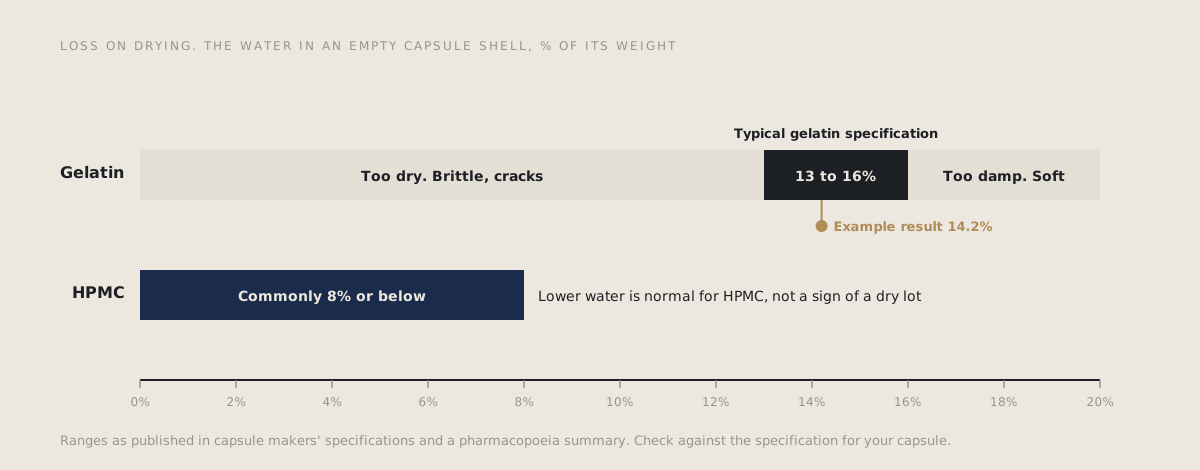
Gelatin has been the capsule material since the 1840s. For hard capsules it comes almost entirely from cattle and pigs. Bovine hide and bone are treated with lime (which gives what the trade calls type B gelatin) and pigskin with acid (type A). Some makers blend the two, because bone gelatin gives a firmer shell and pigskin a clearer, more flexible one. The gel strength is stated in Bloom, and hard-capsule gelatin sits around 200 to 280 Bloom. The harmonized pharmacopoeial monograph for gelatin also allows fish and poultry, and fish gelatin exists, but bovine and porcine are what you'll find in a standard capsule unless the maker says otherwise. On a specification you'll see the source, the type, and the Bloom, and the source is the line that decides what the label and the religious certificates can say. Our gelatin capsules are bovine, from hide or bone. A gelatin capsule leaves the factory holding 13 to 16% water, and that water is structural. Dry it out and the shell cracks.
HPMC stands for hydroxypropyl methylcellulose, and the pharmacopoeias call the same substance hypromellose. It's cellulose with two kinds of small side groups attached so that the polymer dissolves in water and forms a film. The cellulose comes from softwood pulp or cotton linters. So a "vegetable capsule," "veggie cap," "vegetarian capsule," or "cellulose capsule" (the consumer terms, all meaning the same thing) is made from trees or cotton, not from vegetables. In trade language, and on this site, the material is HPMC. It's an approved food additive in the US (21 CFR 172.874) and the EU (E464), it's been a tablet coating and binder for decades, and it's been sold as a capsule shell since the late 1990s. An HPMC capsule leaves the factory at about 4 to 7% water, and some makers offer an extra-dry grade at 2 to 3.5% for moisture-sensitive fills.
There are two ways to make an HPMC capsule, and the difference shows up later in how the capsule opens. Gelatin sets as it cools, so a gelatin capsule is made by dipping a warm pin into gelatin solution and letting the film gel as it cools. HPMC does the opposite. The solution gels when heated and stays liquid when cold. The first HPMC capsules got round that by adding a gelling agent. Carrageenan or gellan gum, with a little potassium or calcium to make it set, let the film form on a cool pin the same way gelatin does. Those are gelling-agent capsules, and a lot of the market still runs on them. The later method, on the market since 2007, heats the pins to 70 °C or more and uses the HPMC's own tendency to gel when hot, with no gelling agent at all. Those are thermogelation capsules, the shell is HPMC and water and nothing else, and they're now the type the big makers lead with. The difference matters because the gelling agents react to acid and to ions, which shows up in the disintegration section below. You can't tell the two apart by looking. The specification states which one a capsule is, and if it doesn't, ask. We can supply both types.
Both materials take the same colorants, and both can be made clear or opaque. If you sell into the European Union the shell has to be opaque without titanium dioxide, and where titanium dioxide is banned and what replaces it is its own subject.


Do HPMC capsules dissolve slower than gelatin?
In a beaker of water at 37 °C, yes, by a few minutes. In the published pharmacopoeial test both materials open well inside the 30 minute limit. In volunteers, gelatin opens in about 5 to 7 minutes with warm water and HPMC somewhere between 9 and 20 depending on the study and the type, and the difference disappears if the water is cold.
The numbers. In the harmonized disintegration test the pharmacopoeias describe (six capsules in water at 37 °C, agitated in a basket), a gelatin capsule typically opens in under 10 minutes, and usually in one to three. An HPMC capsule opens in about three to ten, depending on the type. One maker's bulletin puts its thermogelation capsules at 3.8 to 4.5 minutes across three lots. Both pharmacopoeias set the limit for a hard capsule at 30 minutes, with a rule that lets you test a further twelve if one or two of the first six fail. So on paper HPMC is slower, and on paper both pass with a wide margin. If you're writing a specification, that's the answer that matters.
A gelatin shell is a protein that melts and dissolves at body temperature, so it goes fast. An HPMC shell has to hydrate before it opens, so there's a lag of a few minutes, and then it goes. That lag is what the studies in people measure. Two scintigraphy studies, where volunteers swallowed labeled capsules and a gamma camera watched them open, put carrageenan HPMC at about 9 minutes against 7 for gelatin in fasted volunteers, and 16 against 12 after food. Neither difference reached statistical significance. A 2025 study using thermogelation HPMC and a caffeine fill had the HPMC capsule opening at about 20 minutes and gelatin at about 5.5, so the gap depends on the type and the fill as well as the material. Both are inside what the pharmacopoeias ask for, and for an immediate-release supplement the difference is rarely a problem. We can say that as a physical statement about the shell, and nothing about what the contents do once they're out.
Two things do matter. The first is cold water. Gelatin mostly doesn't dissolve below about 30 °C. In that same 2025 study a gelatin capsule taken with a cold drink took three times longer to open, 16.5 minutes against 5.5, while the HPMC capsule opened at the same 20 minutes warm or cold. HPMC dissolves down to about 10 °C. If your product is taken with iced water, that's worth knowing, and it's the opposite of gelatin's reputation for speed.
The second is the gelling agent. Carrageenan and gellan both react with ions, and gellan sets harder in acid, so a gelling-agent HPMC capsule can open slowly and unevenly in the stomach, in a potassium buffer, or in milk. In one maker's test at pH 1.2, the carrageenan type had released under half its fill at 30 minutes and the thermogelation type over 90%. In simulated milk it was under 30% against over 90%. In the most-cited study of the older gellan type, capsules that opened normally in plain water failed to rupture in acid at all. The thermogelation type doesn't have that problem, which is most of the reason it exists. If your product has a dissolution specification, or a customer who runs one, or is taken with food, the type of HPMC you're buying is the first thing to establish, and the type to ask for is thermogelation.
One caution on reading any of these figures. A 2013 study had both HPMC types taking 20 to 25 minutes to open in plain water, far slower than the makers' figures, and its fill was a green tea extract that the authors think was interacting with the shell. The fill changes the number. That's why every figure above states what was in the capsule, and why we're measuring empty shells on our bench first, so the material's own figure is on record before any fill is added.
Does gelatin cross-link, and what does that do to dissolution?
Yes. Gelatin can react with trace aldehydes to form bonds between its protein chains, and the result is a thin insoluble skin on the capsule that stops it releasing. HPMC doesn't do this. It's the reason some gelatin products pass dissolution at release and fail at six months.
The reaction needs an aldehyde, and they come from more places than you'd think. Formaldehyde, glutaraldehyde, and glyoxal are the textbook culprits. Polyethylene glycols oxidize in storage and form aldehydes. Lactose and other reducing sugars react with amines in the fill. Some plant extracts carry aldehydes of their own. Rayon coil in the bottle has been traced as a source. Heat, humidity, and UV light all speed the reaction up. The cross-linked shell forms what the literature calls a pellicle, a clear water-insoluble membrane on the shell, and the capsule swells in the dissolution bath but won't let go of its fill.
The pharmacopoeias know about this. The USP dissolution chapter, <711>, allows a second tier of testing for gelatin capsules that fail. You repeat the test with an enzyme in the medium, pepsin at low pH or pancreatin at intestinal pH, and if the capsule then passes, the failure is attributed to cross-linking rather than to the product. The FDA's 1997 dissolution guidance says the same thing. That works for a medicine with a dissolution specification. It doesn't help a supplement brand that gets a complaint about capsules found intact.
What to do about it. If the fill contains PEG, lactose, a botanical extract, or any of the other fills that react with gelatin, and the product is gelatin, run the dissolution at three and six months on stability and don't wait for the twelve-month pull. Keep the finished product out of heat and humidity. Or use HPMC, which is what a lot of formulators do when the fill has a known aldehyde source. Studies that exposed both materials to the same conditions found the reaction in gelatin and not in HPMC. Cross-linking is the most common reason a pharmaceutical product moves from gelatin to HPMC that has nothing to do with the vegetarian label.
What's the moisture content of a gelatin capsule and an HPMC capsule, and why does it matter?
A gelatin capsule is 13 to 16% water. An HPMC capsule is 4 to 7%. That single difference explains most of how the two materials behave in a warehouse, in a filling room, and against a hygroscopic fill.
The specification line is loss on drying. For gelatin the makers publish 13.0 to 16.0%. For HPMC the published specifications vary more, 4 to 6% from one maker, 6 to 7% from another, and up to 8% as a cap on others. If you're checking a certificate of analysis, a gelatin lot at 14.2% is normal, and an HPMC lot at 5.1% is normal too, and neither figure means anything about the other material. How to check a COA against the specification goes through the line.
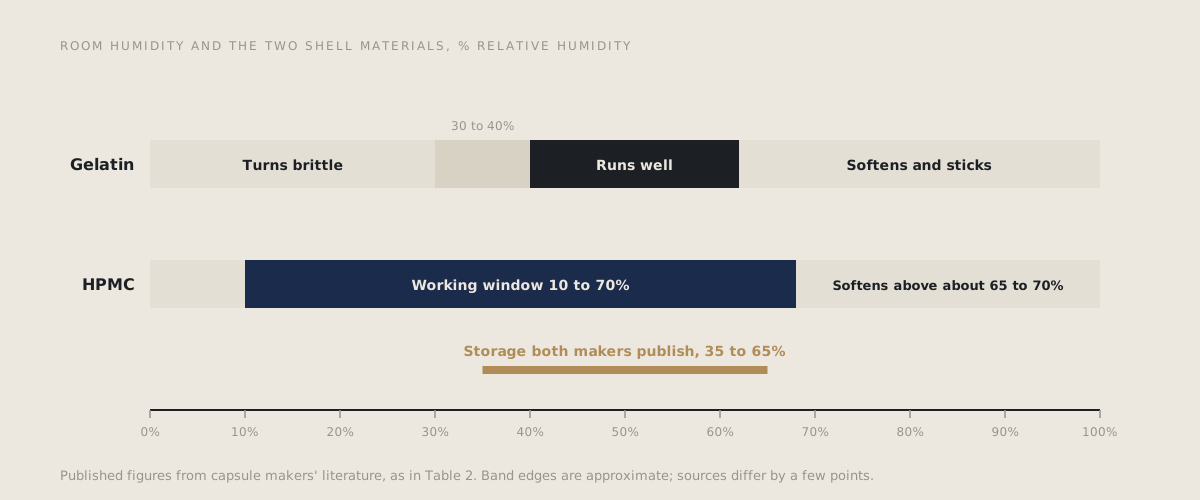
Gelatin's water is part of the structure. Below about 10% the shell turns brittle (sources put the onset anywhere from 10 to 13%), and in practice that happens once a room drops under roughly 30 to 40% relative humidity for long enough for the capsules to equilibrate. The symptom on the line is bodies splitting at separation or cracking under the tamping station (the brittle and cracked shell fault in the troubleshooting list), and in the bottle it's a cracked capsule that leaks powder. Above about 60 to 65% humidity the opposite happens, the shell softens, capsules stick to each other and to the machine, and the closing station starts to dent them. The shell also changes size with its water, about 0.5% in dimension for each 1% of moisture, which is enough to matter at the separation station, where the tooling allows only a little play. So gelatin has a working window of about 35 to 65% relative humidity, and the makers say to store it at 15 to 25 °C inside that window.
HPMC holds less water and holds it less tightly. It stays flexible when dried, and one maker has dried its HPMC capsules to under 1% water without them losing strength. In a maker's drop test at 2.5% humidity, where every gelatin capsule broke, about one in five thermogelation HPMC capsules did. It softens above about 65 to 70% humidity, a little higher than gelatin. The makers recommend the same 35 to 65% for storage but quote a working window of 10 to 70%, and some rate the material to 30 °C. In practice that means an HPMC capsule survives a dry winter room and a humid summer one that would have a gelatin capsule cracking or sticking. Extra-dry grades of both materials exist for the most moisture-sensitive fills, at 2 to 3.5% for HPMC and 9 to 10.5% for gelatin, and the gelatin one is already at the edge of brittle.
Table 2. Gelatin and HPMC side by side. Published figures from the major capsule makers' technical literature and the pharmaceutical literature. Our own measured values will replace the moisture and disintegration lines.
| Property | Gelatin | HPMC |
|---|---|---|
| Made from | Collagen from bovine or porcine hide and bone. Fish and poultry allowed by the monograph | Cellulose from softwood pulp or cotton linters |
| Water content as made | 13 to 16% | 4 to 7%. Extra-dry grades 2 to 3.5% |
| Turns brittle | Below about 10% water, or a room under about 30 to 40% RH | Stays flexible down to under 1% water |
| Softens and sticks | Above about 60 to 65% RH | Above about 65 to 70% RH |
| Storage the makers recommend | 15 to 25 °C, 35 to 65% RH | 15 to 25 °C (some makers to 30 °C), 35 to 65% RH, working window 10 to 70% |
| Opens in water at 37 °C, published test | Under 10 minutes, usually 1 to 3 | About 3 to 10 minutes, by type |
| Dissolves in cold water | Needs about 30 °C | Dissolves at about 10 °C |
| Sensitive to acid or ions in the medium | No | The gelling-agent type can be. The thermogelation type is not |
| Cross-links with aldehydes | Yes, and dissolution can slow over shelf life | No cross-linking reported |
| Oxygen barrier | Good | Poorer. One maker's data puts HPMC at up to 50 times more permeable |
| Same dimensions and change parts | Yes | Yes |
| Empty shell weight, size 00 | About 123 mg | About 136 mg |
| Vegetarian and vegan | No | Yes, subject to the colorant and the print ink |
| Halal and kosher | Only with certified sourcing and slaughter. Porcine gelatin, never | Yes. The major makers hold both certificates |
| Animal-origin paperwork | BSE/TSE statement or certificate of suitability | Not applicable |
| Shell price | Lower | Commonly quoted at 25 to 50% more per thousand |
Swipe across to see every column.
Moisture moves between the shell and the fill until the two agree, and that's the row in Table 1 about hygroscopic fills. A gelatin shell with 14% water sitting on a dry, thirsty powder will give water up to the powder and go brittle in the process, while the powder cakes. In one accelerated test, gelatin shells lost 22% of their weight to a hygroscopic fill in 72 hours while HPMC shells lost under 4%. Neither shell will protect a hygroscopic fill from a humid room forever, and the published stability studies say as much. The shell buys time. The foil and the desiccant do the rest, and that desiccant is the other reason HPMC wins here. A gelatin capsule in a bottle with a desiccant is being dried on purpose. An HPMC capsule doesn't mind. Shelf life, humidity, and whether the finished bottle needs a desiccant or foil are worked through in full elsewhere.
Which material for a hygroscopic, oily, oxygen-sensitive, or reactive fill?
HPMC for anything hygroscopic, moisture sensitive, or carrying an aldehyde source. Gelatin for an oxygen-sensitive fill where the label doesn't need to be vegetarian, and pullulan where it does. Either for an oil, with a sealing step. The long version, which capsule material for which fill with fill trials, is its own article.
Oxygen goes the other way from water. Gelatin and pullulan shells have low oxygen permeability, and HPMC lets oxygen through much faster, up to 50 times faster on one maker's data. So for a fish oil, a probiotic, or an extract that oxidizes, gelatin is the better of the two common materials, and pullulan is the material the makers now sell for that job. HPMC needs the bottle, the desiccant, and the oxygen absorber to do the work the shell isn't doing.
Can you put oil in a gelatin capsule? Yes, and people have for decades. Both gelatin and HPMC hard capsules take oils, pastes, and semi-solids, filled to about 90% of the body and then sealed, either with a band of the same material around the joint or by fusing the cap to the body. Gelatin is the more common shell for liquid-filled hard capsules and HPMC is used where the vehicle is hygroscopic or cross-linking is a concern. What neither shell tolerates is a fill with much water in it, because the water goes into the shell. The published rule of thumb is that if the filled capsule's water content moves by no more than 2% over six months at 25 °C and 65% RH, a gelatin shell will hold. Fills with glycerin, propylene glycol, or liquid PEG usually fail that test in gelatin, which is why they go in HPMC.

Do gelatin and HPMC capsules run the same on a filling machine?
They're the same size to the same standard, so they run on the same change parts, and a modern HPMC capsule fills and closes at the same reject rate as gelatin in the makers' published trials. You may need to adjust a setting or two, and you may see static with HPMC that you didn't see with gelatin.
The sizes are identical. A size 00 HPMC capsule has the same closed length, cap diameter, and body diameter as a size 00 gelatin capsule. In our experience the same segments, dosing discs, and closing parts handle both, since change parts are cut to a size and a maker rather than a material. Switching material doesn't mean new tooling. It does mean a box run through the machine before you commit a shift. The makers' published figures show small differences at the cap-and-body joint between makers and between types, and separation vacuum and closing pressure are the settings that notice. Pre-lock length and separation behavior vary by maker more than by material.
HPMC earned its reputation for being harder to run when it first arrived, and that reputation is now mostly out of date. The first-generation gelling-agent capsules showed wider fill-weight variation and more powder leaking at the joint than gelatin, and the studies that compared them say so. The thermogelation type fixed most of that. One maker's published figures put its fill-weight variation at about 3.3% against 5.5% for the earlier type, and its rejects on high-speed equipment below 0.01%, and I haven't found a maker that publishes a speed penalty for HPMC. If you last tried HPMC capsules ten years ago and gave up, the thermogelation type is worth a second run.
Static is the one that still comes up. The trade line is that HPMC carries less static than gelatin. The most recent measured study we could find, from 2025, says the opposite. HPMC capsules picked up more charge than gelatin after filling, charged less at 51% room humidity than at 22%, and charged less at higher machine speeds and with an external lubricant on the shell. In practice HPMC capsules cling to the bowl, to plastic scoops, and to each other in a dry room. Either way the fixes are the same, and they're about the room and the machine rather than the shell. Keep the filling room at 45 to 55% relative humidity, ground the machine, and get plastic bags and totes out of the room in favor of stainless steel. If capsules are carrying a ring of powder under the cap edge, deionized air at the polisher clears the ring where bristles won't. The troubleshooting guide works through HPMC static and sticking step by step.
Two smaller things. If your capsules are sticking together in the bowl, check the humidity before you blame the material. Above 65% both shells soften, and capsules that were fine in the carton will start to cling in the hopper within an hour of the bag being opened. And at the same size an HPMC shell weighs a little more than gelatin, a size 00 about 136 mg against 123 (shell weights for every size), so set the tare on the checkweigher for the material you're running, not the last one. An HPMC shell's weight also moves less with the room, because it holds less water to lose, so the gross weight of an HPMC capsule drifts less through a shift (why fill weight drifts when nothing changed).
How should I store gelatin and HPMC capsules, and what's the shelf life?
Both materials store at 15 to 25 °C and 35 to 65% relative humidity in the original sealed packaging, and the makers state shelf lives of five years for both under those conditions. HPMC tolerates a wider band, and some makers publish 15 to 30 °C and up to 70% RH for it.
Gelatin has one more number. It starts to melt at 30 to 32 °C, and it cross-links fastest at high humidity, so a pallet left on a loading dock in August is a gelatin problem before it's an HPMC one. Keep the liner sealed until the box is on the machine, because the liner is what holds the shell's water where the maker set it. The shelf life on your own lot is on its certificate of analysis, and that's the figure to use. Storage conditions for empty capsules are worked through in full, with humidity, temperature, and what happens to each material over time.
Are HPMC capsules vegan? What about halal and kosher?
An HPMC capsule is vegetarian and vegan. Gelatin never is. Halal and kosher are where it gets complicated, and where the wording on your pack has to match a certificate in your file.
HPMC is a plant-derived polymer with nothing animal in it, and the major makers hold vegan certification on their standard ranges. The two things to check are the colorant and the ink. Carmine, the red pigment made from insects, appears in some capsule colors and would take a capsule out of the vegan claim, and some printing inks use shellac. Ask for the colorant declaration with the capsule specification and the question answers itself.
There's also a difference between a statement and a certificate. A supplier statement says the capsule contains no animal-derived material. A certification, from The Vegan Society in the UK or Vegan Action in the US, means the certifier has reviewed the ingredients and sub-ingredients, the processing aids, and the supply chain, and licensed its trademark for the product. Retailers increasingly ask for the second. The same goes for halal and kosher, where the certificate names the certifying body and the site, and expires. Keep the dates.
Gelatin is an animal product, so a gelatin capsule can't be vegetarian. Whether it can be halal or kosher depends on the animal and on how it was slaughtered. Porcine gelatin is neither, and can never be. Bovine gelatin can be certified halal or kosher only when the hide came from animals slaughtered to the relevant rules under supervision, and the supervising body tracks the material from the abattoir to the capsule. Fish gelatin from an acceptable species can qualify without the slaughter question. In practice, certified halal or kosher gelatin capsules exist and are a small, specialist part of the market. If a supplier offers you a gelatin capsule as halal or kosher, ask to see the certificate, check which body issued it, and check that the capsule lot traces to it. A general statement that the gelatin is bovine is not a certificate.
HPMC sidesteps the whole question. The major makers' HPMC ranges carry halal and kosher certification as standard, and that's the practical reason compounding pharmacies, contract manufacturers with mixed customer bases, and brands selling into more than one market have moved to it. One shell, one set of documents, and the label can say vegetarian, vegan, halal, and kosher without a species declaration.
What that means for the pack. The claims you can print depend on the certificate you hold, not on the material in general, and the retailer or the regulator will ask for the document. Which claims the paperwork supports, and how to word them for the US and the UK, is its own article. Our own certificates for the capsules we sell are available on request.
What does a BSE/TSE certificate for gelatin capsules cover?
It states the species, the tissue, the country where the animals were raised and slaughtered, and the process the gelatin went through, and it's the document that lets a quality manager accept bovine gelatin into a supplement or a medicine. HPMC has no animal origin, so its equivalent is a statement that says so, and many makers issue one anyway because questionnaires ask.
The rules come from the European regulators. The EMA's note for guidance on minimizing the risk of transmitting animal spongiform encephalopathy agents (EMA/410/01, revision 3) is the reference, and the European Pharmacopoeia's chapter 5.2.8 carries the same text. It classes countries by risk, it treats hide as a safer raw material than bone, and it requires skulls and spinal cord to be removed before bone is processed. It accepts three validated processes, acid, alkaline, and heat with pressure, as reducing any TSE agent present. A gelatin maker can hold a TSE certificate of suitability from the EDQM, and a capsule maker's statement will usually cite it. In the US, the FDA's position, set out in its 1997 notice on BSE risk in gelatin, is that risk depends on country of origin, tissue, process, and route of administration, and its food rule on prohibited cattle materials expressly excludes gelatin and hides.
Either way a gelatin lot arrives with a species declaration, a country of origin, and a TSE document, and the BSE/TSE part of your supplier questionnaire has to hold all three. An HPMC capsule has none of that, because there's no animal in it. Our gelatin is bovine, from hide or bone, and the TSE statement for the current lot is available on request with the specification. The rest of the documentation (the certificate of analysis, the specification, the allergen and GMO statements) is the same for both, and what a certificate of analysis contains is set out line by line.
How much more do HPMC capsules cost than gelatin?
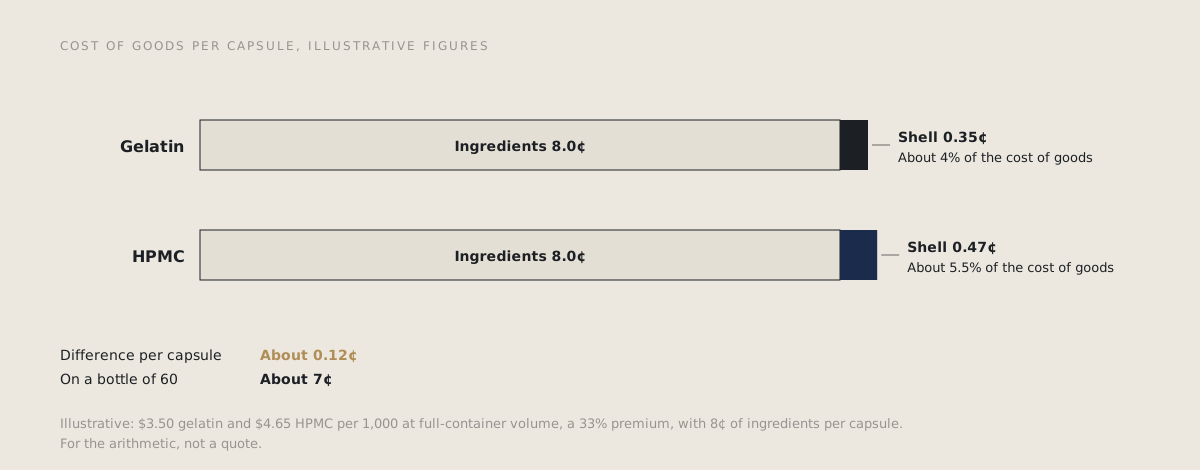
More per thousand, and commonly quoted at 25 to 50% more at manufacturing quantities, rising to about double at small retail packs. Per finished capsule, the difference is a fraction of a cent, and it's usually smaller than the swing in your ingredient cost between two lots.
Here's the arithmetic on an illustrative price. Say gelatin is $12.00 per 1,000 and HPMC is $16.00 per 1,000, which is a 33% premium. Per capsule that's 1.2 cents against 1.6 cents, a difference of 0.4 cents. If your ingredients cost 8 cents a capsule, the shell went from 13% of the cost of goods to 17%. On a bottle of 60 capsules, the whole difference is 24 cents. Whether that's decisive depends on your margin and your volume, and for a high-volume commodity product it can be. For a brand selling a bottle at $25, it rarely is, and it buys the label claims and the paperwork position above.
Gelatin's price also has costs that don't show on the quote. Tighter humidity control in the filling room, the documentation on animal origin, and the customers who won't buy an animal-derived product are all real, and they're the reason the market has been moving. The market reports don't agree on the numbers, but they put gelatin at somewhere between 60% and 73% of capsules sold worldwide, with most of that volume in pharmaceuticals. They do agree that the plant-based share is the part growing faster. In supplements, and especially in new brands, HPMC is the material we see specified by default.
Price structure, volume breaks, and minimum order for both materials are on our product pages rather than here. How capsule pricing, volume breaks, and minimums work is covered in the buying guide.
What are pullulan capsules, and what's a tapioca capsule?
Pullulan is the third capsule material, a polysaccharide made by fermentation, and a "tapioca capsule" is a pullulan capsule whose starch feedstock came from tapioca. It's vegan, halal, and kosher like HPMC, it's a far better barrier to oxygen than either gelatin or HPMC, and it costs more than both.
Pullulan is produced by a yeast-like fungus, Aureobasidium pullulans, fed on starch, and one maker uses tapioca starch as the feed, which is where the name on the pack comes from. Pullulan itself is the fermentation product, not tapioca. The capsule that results is clear and glossy, looks like gelatin, and is made from a material that has been a food additive for decades (E1204 in the EU, GRAS in the US). Its case is oxygen. The maker's own figures put its oxygen barrier at several hundred times better than HPMC and several times better than gelatin, without publishing the absolute permeability. Treat the claim as directional and ask for the data if oxygen is your problem. For a fill that oxidizes, some oils and some vitamins for example, it's the shell to test first. Its water content sits between the other two at about 10 to 13%, so it's less forgiving of dry conditions than HPMC, and it disintegrates in a similar time to gelatin. The price is the catch. Trade quotes put pullulan capsules at two to three times the price of gelatin, and the range of sizes and colors is narrower. Choose pullulan when the fill oxidizes and the label has to be vegan. For a dry powder that doesn't, HPMC does the same job for less.
A true starch capsule, molded from potato starch rather than dipped, existed in the 1990s and passed the same disintegration tests as gelatin. None of the major makers list one today, and when someone says "tapioca capsule" or "starch capsule" they almost always mean pullulan. If a supplier offers you a starch capsule, ask what the polymer actually is.
What's an acid-resistant HPMC capsule, and is it the same as an enteric coating?
No. Three different things get sold as acid-resistant or enteric, and only one of them meets the pharmacopoeial definition of delayed release, which is no more than 10% released after two hours in acid.
The first is an acid-resistant HPMC capsule. It's a gelling-agent HPMC shell, usually with gellan gum, made so that it opens slowly in acid and normally once the medium is less acid. In a scintigraphy study the maker published, release started at about 52 minutes and was complete at about 72, roughly 45 minutes later than a standard capsule. That's a real delay, and it's useful for probiotics, enzymes, and other fills that don't do well in acid. But the maker describes it as designed release, not enteric, and independent tests in 0.1 N hydrochloric acid had one brand starting to rupture at 40 minutes and another between 4 and 15 minutes. A 2022 study concluded that commercial "enteric" capsules don't always meet the pharmacopoeial limit, and even a coated gelatin capsule failed in that study. The second is an enteric capsule, where an enteric polymer is built into the shell itself. That does meet the delayed-release monographs, with no coating step. The third is an enteric coating applied to a filled and sealed capsule, which is the traditional pharmaceutical route and a process, not a capsule.
For a supplement where the aim is to get past the stomach some of the time, the first is usually what people want and what they can afford. It handles like any other HPMC capsule, and the brand should call it delayed release. For a medicine that needs an enteric claim, the second or the third, with a dissolution test against the pharmacopoeial method. Gelatin doesn't appear in any of the three, because gelatin dissolves in acid.
What does the material choice mean for a pharmaceutical or clinical product?
Both materials are pharmacopoeial, both are available from makers holding a US drug master file, and both run in the same equipment. The differences that matter in a regulated product are cross-linking, dissolution behavior in the medium your specification uses, and the cost of changing a shell once a dossier is filed.
The monographs are simple enough. Gelatin has its own in the European Pharmacopoeia and the USP, hypromellose has its own, and the capsules monograph covers the finished shell in either material. The major HPMC makers hold US drug master files for their capsules, so a letter of authorization for a filing is a normal request. If you're specifying an HPMC capsule for a filing, the type (thermogelation or gelling agent) belongs in the specification, for the dissolution reasons above. The material choice is locked in for the life of the product, so make it on measured dissolution in your own medium with your own fill.
Against that, most registered oral capsule products were developed in gelatin, their stability data is in gelatin, and their dissolution methods were written for gelatin. Moving one to HPMC means new stability batches, a possible change of dissolution medium, and a regulatory variation. That's why gelatin persists in pharmaceuticals long after it stopped being the default in supplements, and it's a good reason. It's also why a new product, or a clinical supply that hasn't yet been filed, is the moment to choose, because the choice is nearly free then and expensive later. For matching placebos and over-encapsulated tablets, both materials are used, opacity and size matter more than material, and the effect of the shell on a comparator tablet's dissolution is something to measure rather than assume. Placebo, over-encapsulation, and the documentation a clinical supplier needs have their own article.
What is an AI prompt pack?
An AI prompt pack is a small set of files you load into the AI assistant you already use. The assistant then asks you the right questions about your product, works through them with you using our reference data, and shows its working as it goes. We publish one with each article, and this one is the second.
Inside the Capsule Material Selector AI Prompt Pack is a prompt file that turns your assistant (Claude, ChatGPT, Gemini, Grok) into a material advisor, a one-page reference sheet with the figures from this page, and a worksheet the assistant fills in with your answers. Paste the prompt in and it asks about your fill (is it hygroscopic, is it an oil, does it contain PEG, lactose, or an extract, does it oxidize, is it acid sensitive). Then it asks about your label (vegetarian, vegan, halal, kosher, and which markets) and your process (room humidity, whether there's a desiccant in the pack, how the product is taken). Then your regulatory position (supplement or medicine, and whether a dissolution specification exists), and your budget. It gives you back a material, the HPMC type if it's HPMC, and the reasons. Then the storage and humidity specification to write into your process, the tests to run on a sample lot, and the six questions to put to whichever capsule supplier you're talking to.
Why a pack and not just the table? Because the table can't ask you whether your fill contains PEG. The pack does, and it explains why it's asking. It works for the founder who has just been asked "gelatin or veggie?" by a co-packer and doesn't know what either implies. It works for the formulation scientist who has heard of cross-linking and wants the checklist done in ten minutes. It's the conversation we'd have with you on a call, packaged so you can have it at your desk with your own product in front of you.
Use the form below to request this resource. Newsletter updates are a separate, optional choice.
Get the Capsule Material Selector AI Prompt Pack
Request the Capsule Material Selector AI Prompt Pack
Leave your details to request this resource.
If we haven't answered your question, or your product doesn't fit a row in the table, reply to any email from us or write to us through the contact page. A person who has run both materials will get back to you. And if you'd rather run them than read about them, ask for a sample box of each.
Related.
- Hygroscopic, oily, and low-moisture fills. Which capsule material, and why
- Capsule moisture, storage, and shelf life
- Vegan, halal, kosher, and allergen claims for capsules
- Capsule machine compatibility
- How empty capsules are made, and where they come from
- Capsules for clinical trials
Sources.
- Shell water content, storage, shelf life, machine speed, reject rate, and the "same dimensions as gelatin" statement for thermogelation HPMC: a major capsule maker's published product FAQs, 2020 to 2026. https://www.capsugel.com/knowledge-center/nutra/capsules/vcaps-plus-frequently-asked-questions and https://www.capsugel.com/knowledge-center/nutra/capsules/conisnap-frequently-asked-questions
- HPMC loss on drying 4.0 to 6.0%, storage 15 to 30 °C, filling room 20 to 25 °C and 35 to 55% RH, liquid fill to 90% of body volume, US DMF numbers: a second capsule maker's technical manual. https://falcaoteles.pt/sites/default/files/PDF/Technical_Manual_QUALI-V_ONLINE.PDF (copy of the manual; the maker's own product page: https://www.qualicaps.com/Capsules/pharma/quali-v)
- Gelatin under 10 minutes and thermogelation HPMC 3.8 to 4.5 minutes in water; carrageenan HPMC under 50% at 30 minutes at pH 1.2 and under 30% in simulated milk; breakage at 2.5% RH; fill-weight variation 3.29% against 5.45%: capsule maker's technical bulletin, 2012. https://www.pharmaexcipients.com/wp-content/uploads/attachments/Vcaps+Plus+White+Paper.pdf (copy of the bulletin; the maker's own product page: https://www.capsugel.com/pharmaceutical-solutions/hard-empty-capsules/vcap-plus-hpmc-capsules)
- Review of HPMC capsule chemistry, manufacture, brittleness thresholds, gelatin needing about 30 °C, HPMC dissolving at 10 °C, no cross-linking in HPMC: Al-Tabakha M. M., Journal of Pharmacy and Pharmaceutical Sciences 13 (2010) 428. https://journals.library.ualberta.ca/jpps/index.php/JPPS/article/view/8870
- In vivo opening, gelatin 7 minutes against carrageenan HPMC 9 minutes, not significant: Tuleu C. and colleagues, European Journal of Pharmaceutical Sciences 30 (2007) 251. https://www.sciencedirect.com/science/article/abs/pii/S0928098706003368 Fed state, 12 against 16 minutes, not significant: Jones B. E. and colleagues, International Journal of Pharmaceutics 424 (2012). https://www.sciencedirect.com/science/article/abs/pii/S0378517311011604
- HPMC lag of at least 5 minutes, in vivo opening about 20 minutes warm or cold, gelatin 5.5 minutes with warm water and 16.5 with cold: Sarwinska D. and colleagues, International Journal of Pharmaceutics: X (2025). https://www.sciencedirect.com/science/article/pii/S2590156725000271
- Green tea fill, HPMC and HPMC-gellan 20 to 25 minutes, gellan 35% at 2 hours in acid: Glube N. and colleagues, Results in Pharma Sciences 3 (2013). https://www.sciencedirect.com/science/article/pii/S2211286313000031
- Gellan HPMC failing to rupture in acid and lag in fasted volunteers: Cole E. T. and colleagues, Pharmaceutical Research 21 (2004). https://link.springer.com/article/10.1023/B:PHAM.0000026430.73789.e6
- Thermogelation HPMC developed 2006, launched 2007, moisture 2 to 6% against 13 to 15%, improved weight variation and leakage against carrageenan type: Ku M. S. and colleagues, International Journal of Pharmaceutics 386 (2010) 30. https://www.sciencedirect.com/science/article/abs/pii/S0378517309007765 Carrageenan HPMC delayed by potassium ions: Ku M. S. and colleagues, International Journal of Pharmaceutics 416 (2011). https://www.sciencedirect.com/science/article/abs/pii/S0378517311001839
- Gelatin not dissolving below 30 °C, HPMC temperature-independent: Chiwele I., Jones B. E., Podczeck F., Chemical and Pharmaceutical Bulletin 48 (2000) 951. https://www.jstage.jst.go.jp/article/cpb1958/48/7/48_7_951/_article
- HPMC gels at 75 to 90 °C, no cross-linking: Vlad R.-A. and colleagues, Pharmaceutics 17 (2025) 784. https://www.mdpi.com/1999-4923/17/6/784
- Ph. Eur. monograph 0016, Capsules, hard capsules 30 minutes, gastro-resistant 2 hours in acid. Ph. Eur. 2.9.1 disintegration method and the 16 of 18 rule. USP General Chapter 701 and 2040. Harmonized disintegration test: ICH Q4B Annex 5, Disintegration Test General Chapter, FDA. https://www.fda.gov/regulatory-information/search-fda-guidance-documents/q4b-annex-5-disintegration-test-general-chapter
- USP <711> tier 2 enzymes for cross-linked gelatin, and the causes of cross-linking: Gray V. and colleagues, Dissolution Technologies, November 2014, and Lu X. and Shah P., Dissolution Technologies, August 2017. https://dissolutiontech.com/DTresour/201411Articles/DT201411_A01.pdf and https://dissolutiontech.com/issues/201708/DT201708_A01.pdf FDA guidance, Dissolution Testing of Immediate Release Solid Oral Dosage Forms, 1997. https://www.fda.gov/media/70936/download
- Gelatin brittle below 10%, hygroscopic fill studies: Jones B. E., Tablets and Capsules. https://www.tabletscapsules.com/3641-Technical-Articles/598122-HPMC-Capsules-and-Hygroscopic-Fills-Some-Clarification/ Brittleness of empty gelatin capsules below 40% RH: Kontny M. J. and Mulski C. A., International Journal of Pharmaceutics 54 (1989). https://www.sciencedirect.com/science/article/abs/pii/0378517389901683 Dimension change 0.5% per 1% moisture: Jones B. E., Hard capsules, in Aulton's Pharmaceutics. https://www.pharmaexcipients.com/wp-content/uploads/attachments/Capsules.pdf
- Extra-dry moisture ranges and compression fracture data: Coulman S. and colleagues, ONdrugDelivery, 2020. https://ondrugdelivery.com/evaluating-the-mechanical-properties-of-extra-dry-hard-shell-capsules/
- Gelatin shells lost 21.99% against HPMC 3.62% at 72 hours: Analytical testing and evaluation of capsules, textbook chapter. https://basicmedicalkey.com/analytical-testing-and-evaluation-of-capsules/ The 2% over six months rule of thumb for liquid fills: Biyani M., Pharmaceutical Technology. https://www.pharmtech.com/view/selecting-excipients-liquid-filled-hard-capsules Liquid-fill sealing methods: https://www.capsugel.com/knowledge-center/capsules/liquid-filled-hard-capsules-sealing-technology
- Oxygen permeability, HPMC up to 50 times gelatin and pullulan: Vergauwen B., Manufacturing Chemist. https://manufacturingchemist.com/news/article_page/Formulating_for_the_modern_consumer/143419 Sorption isotherms, gelatin most hygroscopic, pullulan intermediate, HPMC least: Yang and colleagues, International Journal of Biological Macromolecules 159 (2020). https://www.sciencedirect.com/science/article/abs/pii/S0141813020332621
- HPMC capsules charge more than gelatin, less at 51% RH than 22%: Stankovic-Brandl M. and colleagues, Journal of Pharmaceutical Sciences (2025). https://www.sciencedirect.com/science/article/abs/pii/S0022354925002394
- Gelatin melting at 30 to 32 °C and cross-linking fastest at high RH: Munters, Processing magazine. https://www.processingmagazine.com/material-handling-dry-wet/article/21128487/the-perfect-climate-for-capsule-storage
- Gelatin sources and type A and type B processes: Gelatine Manufacturers of Europe. https://www.gelatine.org/en/gelatine/manufacturing.html Bloom 200 to 280 for hard capsules: a gelatin maker's hard-capsule page. https://www.gelita.com/en/markets-we-serve/pharma/hard-capsules Harmonized Gelatin monograph including fish and poultry: USP Pharmacopeial Discussion Group. https://www.usp.org/harmonization-standards/pdg/excipients/gelatin
- HPMC manufacture from wood pulp or cotton, 21 CFR 172.874, E464: USDA technical report, 2002. https://www.ams.usda.gov/sites/default/files/media/Hydroxpropyl%20Methylcellulose%20TR.pdf 21 CFR 172.874, Hydroxypropyl methylcellulose. https://www.ecfr.gov/current/title-21/chapter-I/subchapter-B/part-172/subpart-I/section-172.874
- EMA/410/01 rev. 3, minimising the risk of transmitting animal spongiform encephalopathy agents. https://www.ema.europa.eu/en/documents/scientific-guideline/minimising-risk-transmitting-animal-spongiform-encephalopathy-agents-human-and-veterinary-medicinal-products_en.pdf EDQM certificate of suitability procedure. https://www.edqm.eu/en/background-legal-framework FDA 1997 notice on BSE risk in gelatin: https://www.govinfo.gov/content/pkg/FR-1997-10-07/html/97-26501.htm 21 CFR 189.5 excluding gelatin and hides from prohibited cattle materials: https://www.ecfr.gov/current/title-21/chapter-I/subchapter-E/part-189/subpart-B/section-189.5
- Vegan certification requirements: The Vegan Society, https://www.vegansociety.com/trademark/vegan-trademark-standards and Vegan Action, https://vegan.org/certification Kosher gelatin: Orthodox Union, https://oukosher.org/blog/consumer-kosher/gelatin-revisited/ Halal gelatin: https://medcraveonline.com/MOJFPT/meeting-the-requirements-of-halal-gelatin-a-mini-review.html
- Pullulan origin, E1204, GRAS, oxygen barrier: USDA technical report, 2018. https://www.ams.usda.gov/sites/default/files/media/PullulanTechnicalReportFinal09072018.pdf Pullulan moisture 10 to 13% and oxygen claims: https://blog.lyfegroup.com/hpmc-capsules-vs-pullulan and https://nutraceuticalbusinessreview.com/protect-oxygen-sensitive-ingredients-with-capsugel-plantcaps-capsules and the maker's own product page, https://www.capsugel.com/nutraceutical-solutions/hard-empty-capsules/nutraceutical-plantcaps-capsules Potato-starch capsules, 1995: https://www.sciencedirect.com/science/article/abs/pii/0378517395044620
- Acid-resistant capsules, 45 minutes later, 52 minutes in vivo: https://www.capsugel.com/nutraceutical-solutions/hard-empty-capsules/hpmc-designed-release-capsule Rupture at 40 minutes and 4 to 15 minutes in 0.1 N HCl: Al-Tabakha M. M., Journal of Young Pharmacists 7 (2015) 36. https://doi.org/10.5530/jyp.2015.1.7 Commercial enteric capsules not always meeting the pharmacopoeial limit: Fülöpová N. and colleagues, Pharmaceutics 14 (2022) 1577. https://www.mdpi.com/1999-4923/14/8/1577 Enteric-polymer capsules: https://www.prnewswire.com/news-releases/capsugel-launches-vcaps-enteric-capsules-for-enteric-protection-and-delayed-release-300336094.html
- Cost, gelatin about 30% cheaper to produce: https://blog.lyfegroup.com/differences-between-gelatin-capsules-and-hpmc-capsules Retail pack prices roughly double for vegetarian: https://www.tlcapsules.com/blog/how-much-does-a-pack-of-small-empty-capsules-cost-388866.html
- Market share, gelatin between about 60% and 73% depending on the report, non-gelatin growing faster: Grand View Research, https://www.grandviewresearch.com/industry-analysis/empty-capsules-market Mordor Intelligence, https://www.mordorintelligence.com/industry-reports/empty-capsule-market IMARC, https://www.imarcgroup.com/empty-capsules-market
- Shell weights by size: compiled in P01 from the major makers' published charts.
*Capsules.com supplies empty hard capsules in gelatin and HPMC to manufacturers, brands, pharmacies, and research teams. Capsules Direct Ltd, company number 17362490, 26 Rowood House, Bicester OX26 4PP, United Kingdom. UK 020 3905 1989 · US (816) 445-0042 · capsules.com. *