
Claims and documentation
Vegan, halal, kosher, and allergen claims for capsules. What the paperwork has to say before you print it
Understand the evidence behind vegetarian, vegan, halal, kosher, and allergen claims before choosing wording for a product label.
Written by A. Sanderson, CEO, Capsules.com
On this page
The material a capsule is made of decides which claims are possible. The document in your file decides which claims you can print. Those are two different questions, and most of the trouble brands get into on pack comes from answering the first one and assuming the second. An HPMC capsule (hydroxypropyl methylcellulose, the plant-derived material in vegetarian capsules) is vegan as a material, and a red HPMC capsule colored with carmine is not vegan at all. A bovine gelatin capsule is possible to certify halal, and a general statement that the gelatin is bovine is not a certificate.
So here's our position, and the working follows. Treat every claim on the pack as a claim about a piece of paper. Vegan, vegetarian, halal, kosher, gluten-free, non-GMO, allergen statements, and organic each rest on a specific document from the capsule maker, with a specific scope and a specific expiry date, and your finished product inherits the claim only if the rest of the formulation and the line earn it too. This page goes through each claim in turn, says what the shell can and can't support, names the document behind it, and shows how the wording differs between the US and the UK. The claims checker on this page turns your list of claims and your material into the documents you need to hold, and the AI prompt pack at the foot of the page writes the technical file entry and the pack wording for you.
- Are HPMC capsules vegan, and are gelatin capsules vegetarian? Yes and never, with the two exceptions that catch people.
- Can I print "vegan," or do I need a certificate? No legal definition anywhere, so the certifier's standard is the definition.
- Are gelatin capsules halal? Are HPMC capsules halal? The three conditions for gelatin, and why HPMC sidesteps them.
- Does the halal certificate work in my export market? Recognition by body, and Indonesia's 17 October 2026 deadline.
- Are gelatin capsules kosher, and what does pareve mean? Fish and hide gelatin, the OU position, and HPMC as pareve.
- What's the difference between a statement and a certificate? Who signed it, who checked it, and when it expires.
- What allergens are in an empty capsule? None of the 14 or the nine, with a fish gelatin exception.
- Can I say "allergen-free" or "free from"? The FSA's line between vegan and free-from.
- Are capsules gluten-free, and can I print it? 20 ppm on both sides of the Atlantic, and what the statement covers.
- Are capsules non-GMO? Cotton linters, 0.9%, and the Non-GMO Project.
- Can I use an HPMC capsule in a USDA Organic product? No. Gelatin yes, pullulan partly. The one that catches people out.
- Which colorants take a capsule out of a vegan claim, and can I say "no artificial colors"? Carmine, shellac, and the FDA's February 2026 letter.
- How do I list the capsule shell in the ingredients? Hypromellose, gelatin, and the species, US and UK.
- The claims checker. Tick the claims, pick the material, get the document list.
- What documents should I hold, and who will ask for them? The technical file for the shell, in one table.
- What do you hold for the capsules you sell? Our own certificates and statements.
- The free AI prompt pack. Load it into ChatGPT, Claude, or Gemini, describe your product and your markets, and it writes the claims matrix, the technical file entry, and the pack wording.
One note before the detail. This page is about the shell. The claim on your finished product depends on every ingredient in the fill, the colorants, the line it's packed on, and your own certifier, and nothing here is legal advice. The regulatory text and certifier standards are cited from the primary sources, and the list is at the foot of the page. Where we describe our own documents, the certificates themselves are the authority.
Are HPMC capsules vegan, and are gelatin capsules vegetarian?
An uncolored HPMC capsule is vegan and vegetarian, and a gelatin capsule is neither. Gelatin is collagen from the hide and bone of cattle and pigs (fish in a few specialist products), so no gelatin capsule can be described as vegetarian under any scheme in use. HPMC is cellulose from softwood pulp or cotton linters, chemically modified, with nothing animal in the polymer.
Two things can take a plant capsule out of a vegan claim, and both sit in the colorant declaration rather than in the material. The first is carmine (E120 in Europe, "cochineal extract" or "carmine" on a US label), a red pigment made from the cochineal insect, which appears in some red, pink, and purple capsule colors. The second is shellac (E904), a resin from the lac insect, which some capsule printing inks use as a binder. A printed HPMC capsule in a carmine red is a vegetarian capsule that fails a vegan audit. Ask for the colorant declaration for the specific color you're buying, and ask what's in the print ink if the capsule is printed. Iron oxides, titanium dioxide, spirulina, and the synthetic dyes are all fine on the vegan question, whatever else you think of them.
Pullulan, the fermentation-derived material in a small share of premium plant capsules, is vegan by the same test. Gelatin from fish is still gelatin, and still not vegetarian.
If you're choosing between the two materials for reasons beyond the label, the gelatin against HPMC comparison works through dissolution, moisture, fills, and cost, and its decision table puts the label question first because label constraints are the hardest to change later.
Can I print "vegan," or do I need a certificate?
You can print "vegan" on a supplier's statement, and most retailers will ask you for a certificate. Neither the EU, the UK, nor the US has a legal definition of "vegan" or "vegetarian." Regulation (EU) 1169/2011 told the European Commission to adopt an implementing act defining them, and the act still hasn't been adopted. The UK carried the same regulation into its own law with the same gap. In the US the words are unregulated marketing terms, policed by the general ban on misleading labelling and, in practice, by class-action lawyers.
That gap is why the certifiers matter. Their standards are the working definitions, and a retailer who asks for "the vegan certificate" means one of these.
| Scheme | Where it's used | What it requires of the product | Notes for a capsule |
|---|---|---|---|
| The Vegan Society Vegan Trademark | UK, used internationally | No animal product, by-product, or derivative in manufacture or development. No animal testing by or for the company. Diligent minimization of cross-contamination from non-vegan lines. Renewed yearly | Registered per product. The capsule maker's registration covers the empty capsule; the brand registers the finished product |
| Vegetarian Society Approved (vegetarian and vegan marks) | UK | No animal-derived ingredient (vegan mark). Genetically modified ingredients not eligible. Reasonable steps against cross-contamination, with cleaning between runs | The GMO exclusion means a vegetarian claim under this mark also needs the GMO statement |
| V-Label (EVU and ProVeg) | Continental Europe, the most common mark on shelf | Not of animal origin at any stage, processing aids included. Unintended traces below 0.1% (1 g/kg) in the final product. Products that need GMO labelling can't be licensed. Regular audits | The 0.1% trace figure is the only numeric threshold among the four |
| Vegan Action Certified Vegan | US | No animal ingredients, no animal testing, controls on shared equipment | The usual mark on US supplement shelves |
Swipe across to see every column.
Sources are The Vegan Society trademark standards, the Vegetarian Society trademark criteria, the V-Label criteria, and Vegan Action's certification page, all in the list at the foot.
What the capsule maker gives you is one of two things. A statement, on the maker's letterhead, that the capsule contains no animal-derived material and lists the ingredients. Or a certificate or license, where one of the schemes above has reviewed the ingredients and the plant and licensed its mark for the product. The second is worth more, and a maker who holds it will say so on the specification. The next section on statements against certificates goes through the difference in general. For the vegan claim specifically, the practical rule is that a statement supports your own "suitable for vegans" wording, and a mark on your pack needs your own license from the scheme, because the capsule's certificate covers the capsule and your product is more than a capsule.
One more thing on wording. The Vegetarian Society's mark and the V-Label both exclude products that need GMO labelling, so in Europe a vegetarian claim under a mark carries a GMO position with it. The gluten and GMO sections below cover what the paperwork says.
Are gelatin capsules halal? Are HPMC capsules halal?
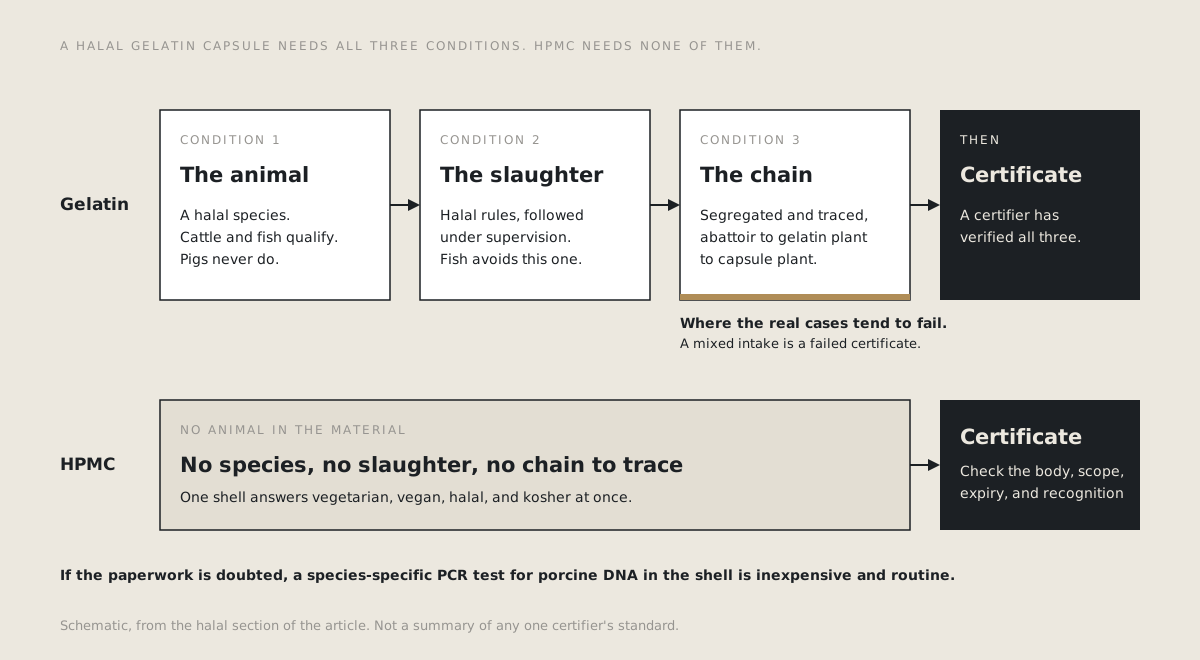
An HPMC capsule from a certified plant is halal, and a gelatin capsule is halal only when three conditions hold and a certifier has verified them. There's no legal definition of halal in the UK, the EU, or US federal law; certification is private, and a few US states have consumer-protection laws (New Jersey's Halal Food Consumer Protection Act, for one) that make it an offence to misrepresent the standard a product is sold under.
For gelatin, the three conditions are the animal, the slaughter, and the chain. The animal has to be a halal species, so cattle and fish qualify and pigs never do. The slaughter has to have followed halal rules under supervision. And the material has to have been segregated and traced from the abattoir to the gelatin plant to the capsule plant, because gelatin plants process hides and bones from many sources and a mixed intake is a failed certificate. The failure in the real cases tends to be the third one. A trade summary of certifier requirements describes a bovine collagen that lost its halal status because "the cowhide raw material for the bovine collagen, its origin could not be fully traced." Fish gelatin from an acceptable species avoids the slaughter question and still has to trace.
Certified halal gelatin capsules exist and are a small, specialist part of the market. If a supplier offers you a gelatin capsule as halal, there are four things to check. The certificate itself, not a line on the specification. The body that issued it. Whether that body is recognized in the market you're selling into (the next section). And whether the capsule lot you're buying traces to the certified production, which means the certificate scope and the lot paperwork have to line up. A species-specific PCR test for porcine DNA in a capsule shell is inexpensive and is what an importer or a certifier will run if they doubt the paperwork, so a claim that can't survive one shouldn't go on the pack.
HPMC sidesteps the whole question. There's no animal in the material, so there's no species, no slaughter, and no chain to trace, and the major makers' HPMC ranges carry halal certificates as standard. What you check is narrower. The certifying body, whether the certificate covers the site or the product range, the expiry date, and the body's recognition where you sell. One shell answers vegetarian, vegan, halal, and kosher at once, which is the practical reason contract manufacturers with mixed customer lists and brands selling into more than one market have moved to it.
Does the halal certificate work in my export market?
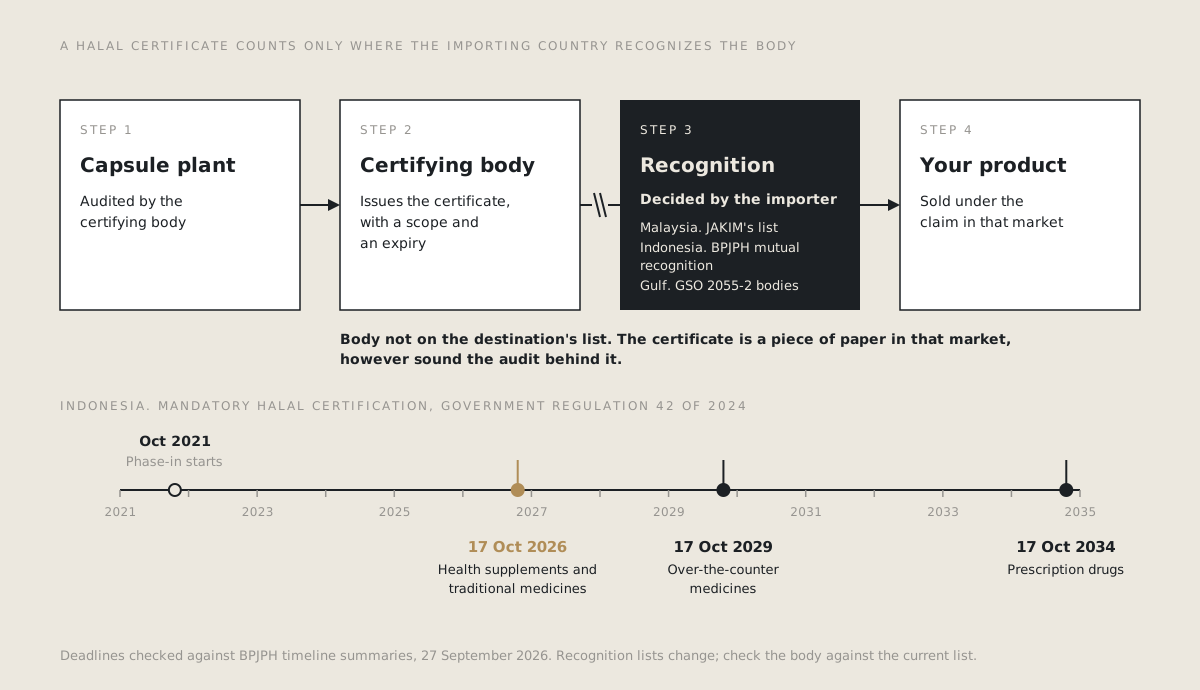
A halal certificate is only as good as its recognition where the product is sold, and the importing country decides that, not the certifier. Malaysia's JAKIM publishes a list of foreign bodies it recognizes. Indonesia's BPJPH recognizes foreign bodies under mutual recognition agreements. The Gulf states require certification by a body accredited under the GSO 2055-2 scheme for imported goods. A certificate from a UK or US body that isn't on the relevant list is a piece of paper in that market, however sound the audit behind it.
The date that matters right now is Indonesia's. Under Government Regulation 42 of 2024, health supplements and traditional medicines come under mandatory halal certification from 17 October 2026, at the end of a phase-in that started in October 2021. Over-the-counter medicines follow on 17 October 2029 and prescription drugs on 17 October 2034. A foreign product certified by a body that holds a mutual recognition agreement with BPJPH doesn't have to be re-certified in Indonesia; the foreign certificate is registered before distribution. A product without a recognized certificate can't be sold as a supplement there after the date. So if your supplement goes to Indonesia in an HPMC capsule, the question for your capsule supplier this month is which body issued the certificate and whether BPJPH recognizes it. Ask for the certificate and check the body against the BPJPH list yourself.
Are gelatin capsules kosher, and what does pareve mean?
An HPMC capsule from a certified plant is kosher and pareve, and a gelatin capsule is kosher only from one of two sources under supervision. Pareve means neither meat nor dairy, so the capsule can be used with either, which is why it matters for a supplement that might be taken with a meal.
The two kosher gelatin sources, as the Orthodox Union describes them, are fish gelatin from kosher species processed in a plant handling only kosher fish, and bovine gelatin from the hides of kosher-slaughtered animals. The OU treats hide gelatin as pareve ("gelatin produced from all parts of the hide are considered pareve and may be used with dairy"), because the hide is rendered inedible during processing. Porcine gelatin is never kosher, and gelatin from cattle that weren't kosher-slaughtered isn't accepted by the OU. So, as with halal, the certificate on a gelatin capsule is about the abattoir and the chain, and a general "bovine" statement doesn't get you there.
You'll hear that some rabbinic authorities treat gelatin capsules on medicines as inedible and of no kosher concern, and the OU's own article notes the view. Don't build a supplement claim on it. Retailers and certifiers treat a supplement as a food, and the consumer reading your pack does too.
For HPMC the position is simple. A plant-derived shell with no animal input is pareve by nature, and the major makers hold kosher certificates from one of the large agencies (OU, OK, Star-K, and Kof-K in the US; KLBD and the Manchester Beth Din in the UK). The document is a letter of certification naming the products, the plant, the status (pareve), and an expiry, normally a year out. The two things to check are that the letter names the capsule range you're buying and that the date hasn't passed.
What's the difference between a statement and a certificate?
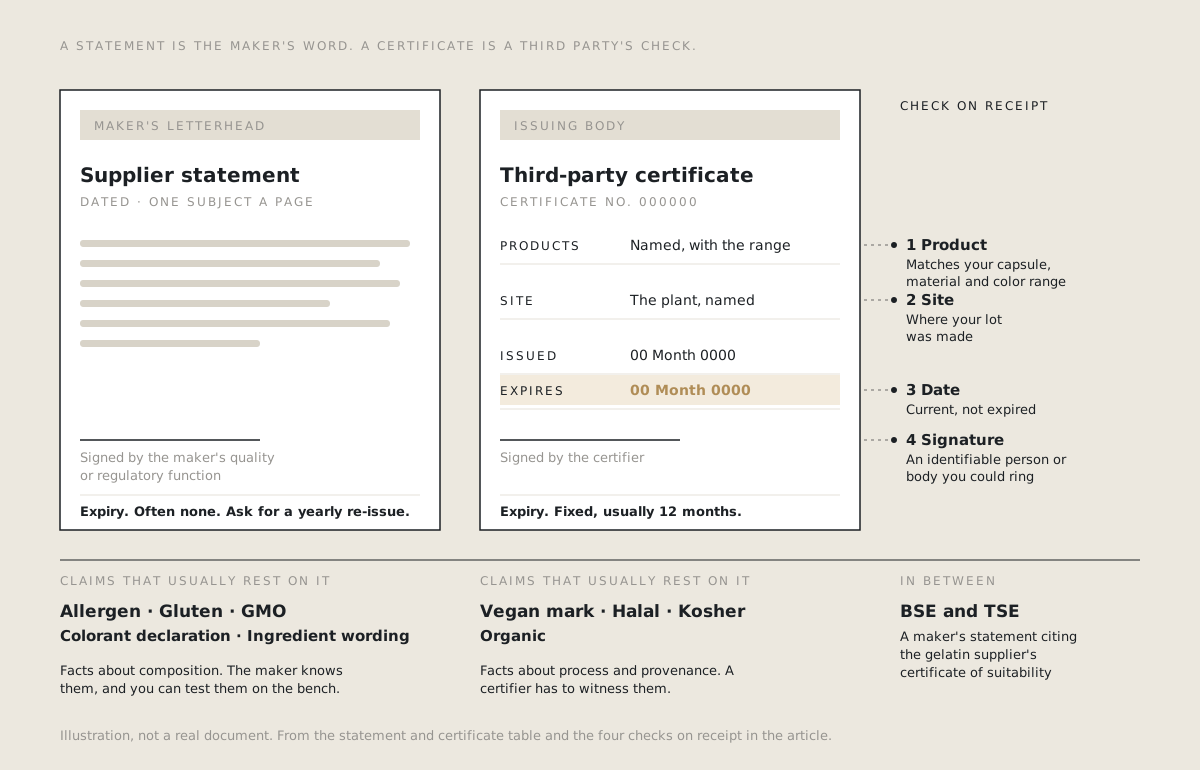
A statement is the maker telling you something about the product; a certificate is a third party telling you they checked. Both are useful and they aren't interchangeable, and a good technical file holds the right one for each claim.
| Supplier statement | Third-party certificate | |
|---|---|---|
| Who signs it | The maker's quality or regulatory function | An independent body (a certifier, a Beth Din, a halal authority, The Vegan Society) |
| What it covers | What the maker says the product contains or doesn't | What the body verified, at the site named, for the products named, in the period named |
| Typical form | Letter on the maker's letterhead, dated, often one page per subject (allergen, gluten, GMO, TSE, vegetarian) | Certificate or letter of certification with a number, a scope, an issue date, and an expiry |
| Expiry | Often undated or "valid until further notice"; ask for a re-issue each year | Fixed, usually 12 months, sometimes up to three years for halal |
| Who accepts it | Your own risk assessment, most B2B customers, a supplier questionnaire | Retailers, importers, export markets, and any consumer-facing mark on your pack |
| What it can't do | Make your finished product certified | Certify anything outside its scope, including your product |
Swipe across to see every column.
The claims split along that line. Allergen, gluten, and GMO positions normally rest on statements, because they're facts about composition that the maker knows and that you'd test on your own finished product anyway. Vegan, halal, kosher, and organic normally rest on certificates, because they're facts about process and provenance that a customer can't test on the bench and a certifier has to witness. BSE and TSE for gelatin sits between the two, a maker's statement that cites the gelatin supplier's EDQM certificate of suitability, and the gelatin against HPMC article covers what a BSE/TSE certificate for gelatin capsules covers.
Whatever the document, check four things on receipt. The product it names matches the capsule you're buying, down to the material and the color range. The site it names is where your lot was made, which matters when a maker runs more than one plant (see how to know who made your capsules). The date is current. And the signature or the certifier is identifiable, with a contact you could ring. The certificate of analysis article goes through what a certificate of analysis contains, how these documents arrive with a lot, and how to file them.
What allergens are in an empty capsule?
None of the listed allergens, on either side of the Atlantic, with one exception for fish gelatin. A standard capsule is gelatin or HPMC, water, and, for an opaque or colored shell, the colorants. Some HPMC capsules made by the gelling-agent process also contain carrageenan or gellan gum and a potassium salt (the gelatin against HPMC article explains the two HPMC types). None of those is on the EU and UK list of 14 allergens or the US list of nine.
The 14 in the EU and UK (Regulation 1169/2011 Annex II, carried into UK law) are cereals containing gluten, crustaceans, eggs, fish, peanuts, soybeans, milk, nuts, celery, mustard, sesame, sulphur dioxide and sulphites above 10 mg/kg, lupin, and molluscs. The nine in the US are milk, eggs, fish, crustacean shellfish, tree nuts, peanuts, wheat, soybeans, and, since 1 January 2023 under the FASTER Act, sesame.
The fish gelatin exception is worth knowing even if you never buy one. Annex II exempts "fish gelatine used as carrier for vitamin or carotenoid preparations" and fish gelatin used as a fining agent in beer and wine. A fish gelatin capsule shell is neither, so a fish gelatin capsule declares fish as an allergen in the EU and UK. In the US, fish has to be declared by species, so the pack says "fish (tilapia)" or whichever species the gelatin came from. Bovine and porcine gelatin aren't allergens under either regime.
What the maker's allergen statement does is say all of this against the two lists, in writing, and usually adds gluten and sulphites explicitly because supplier questionnaires ask about them. File it with the specification. It feeds your own allergen risk assessment for the finished product; it doesn't replace it, because the fill and the packing line are where the allergens in a supplement come from.
Can I say "allergen-free" or "free from"?
Not on the strength of the capsule, and be careful with the words even when the whole product qualifies. The UK Food Standards Agency drew the line in its September 2023 guidance, and the line is worth learning whichever market you're in. A "vegan" claim "is not about food safety." A "free-from" claim "should guarantee allergen absence" and needs rigorous controls to back it. So a vegan product can carry a "may contain milk" precautionary statement, and a "milk-free" product cannot, because the second is a safety promise to someone with an allergy.
The same guidance says precautionary allergen labelling ("may contain") belongs only where a risk assessment finds a cross-contact risk that segregation and cleaning can't remove, that it must name the specific allergen ("may contain peanuts," not "nuts"), and that it shouldn't sit on the same pack as a free-from claim for the same allergen.
For the capsule, the maker's allergen statement supports your risk assessment. For the pack, "free from" and "allergen-free" are claims about the finished product, the fill, and the line, and the safe wording for the shell alone is a description ("vegetarian capsule shell") rather than a safety promise. In the US the same logic applies under the general prohibition on misleading labelling, and "allergen-free" on a supplement invites the question "which allergens, and tested how."
Are capsules gluten-free, and can I print it?
Gelatin and HPMC contain no gluten, and the "gluten-free" claim on your pack is about the finished product and rests on a threshold of 20 parts per million in both the US and Europe. In the US, 21 CFR 101.91 defines "gluten-free" as less than 20 ppm gluten, and the claim is voluntary. In the EU, Regulation 828/2014 sets "gluten-free" at no more than 20 mg/kg and "very low gluten" at no more than 100 mg/kg (the second only for foods made from gluten cereals processed to reduce gluten). The UK kept 828/2014 after leaving the EU.
The maker's gluten statement is a statement of composition. It says the capsule contains no gluten-bearing ingredient and, if the plant is clean of them, that there's no cross-contact risk from the site. It isn't a test result on your product, and a retailer asking for one wants an ELISA on the finished capsule with its fill. If your fill is a botanical, a fermentation product, or anything with a wheat-adjacent supply chain, the test is where the claim is won or lost, and the shell is the easy part.
Are capsules non-GMO?
Gelatin and HPMC are not genetically modified organisms, and the paperwork question is about the raw material behind them. HPMC is made from cellulose, and cellulose comes from softwood pulp or cotton linters. Cotton is a genetically modified crop in most producing countries, so a maker's GMO statement for HPMC normally says either that the cellulose source isn't a GMO or that the material contains no detectable modified DNA or protein, which is true of a highly refined derivative either way. Gelatin comes from cattle and pigs, which aren't GMOs, and the statement addresses feed only if a scheme asks about it.
In the EU and UK, Regulations 1829/2003 and 1830/2003 require labelling of food and ingredients produced from GMOs, with a 0.9% adventitious threshold per ingredient, and products from animals fed GM feed don't need labelling. A capsule from a maker with a GMO statement doesn't trigger the label. Remember that the Vegetarian Society's marks and the V-Label both exclude products that need GMO labelling, so the GMO statement is part of a European vegetarian claim, not a separate line.
In the US, the National Bioengineered Food Disclosure Standard covers dietary supplements and turns on detectable modified genetic material, which a refined capsule material won't normally carry. The voluntary mark retailers ask for is Non-GMO Project Verified, and it evaluates animal-derived inputs by reviewing the animal's feed and requiring that feed's high-risk ingredients to come from non-GMO sources, which is a harder ask of a gelatin supply chain than of a cellulose one.
Can I use an HPMC capsule in a USDA Organic product?
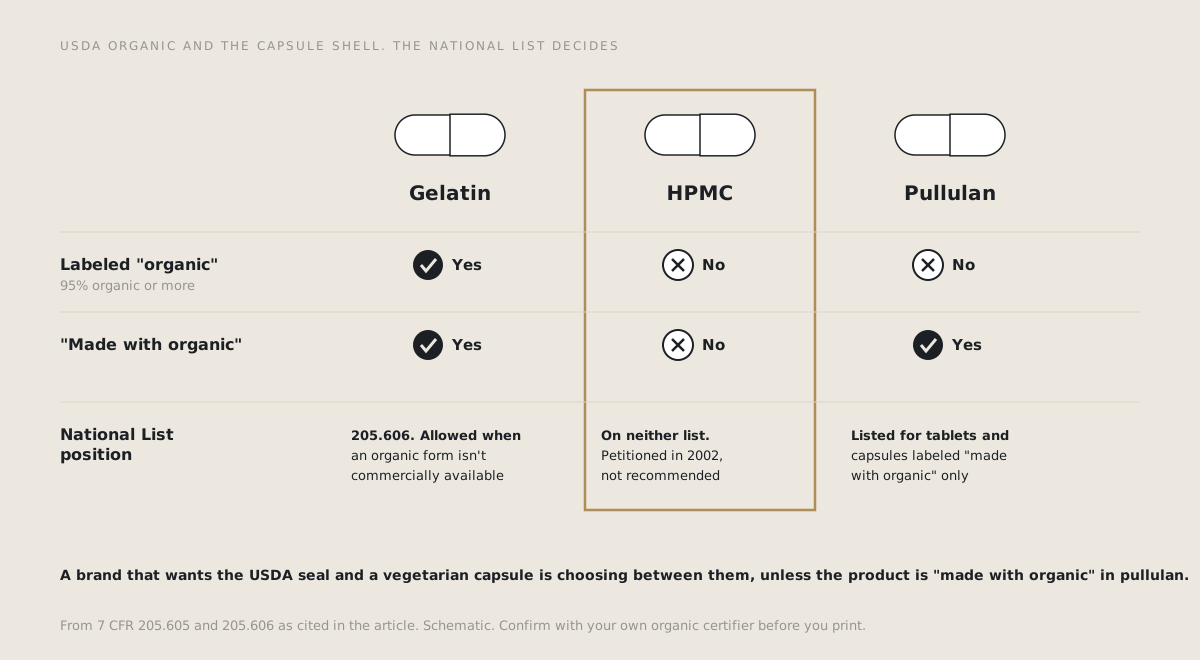
No. A supplement in an HPMC capsule can't carry the USDA Organic seal or the "made with organic" claim, and the same supplement in a gelatin capsule can. The finding comes from the National List rather than from anything about the material's safety.
Under the National Organic Program, any non-organic ingredient in a product labelled "organic" (95% organic or more) or "made with organic" has to appear on the National List at 7 CFR 205.605 or 205.606. The capsule shell is an ingredient. Gelatin is on 205.606 as an allowed non-organic agricultural ingredient when an organic form isn't commercially available. Hydroxypropyl methylcellulose isn't on either list. Cellulose appears on 205.605 only "for use in regenerative casings, powdered cellulose as an anti-caking agent (non-chlorine bleached) and filtering aid," which doesn't cover a capsule. Pullulan appears "for use only in tablets and capsules for dietary supplements labeled 'made with organic,'" so a pullulan capsule gets a product to "made with organic" and no further.
The history explains the gap. HPMC was petitioned onto the list in February 2002, by a Canadian herb company, "as an ingredient of hard capsules used for encapsulating powdered herbs" for vegetarian and religious customers. The National Organic Standards Board reviewed it in September 2002 and didn't recommend it for rulemaking, and the petition is closed. No later petition has reopened it.
So a brand that wants both the USDA seal and a vegetarian capsule is choosing between them, unless the product is formulated to "made with organic" in pullulan. Confirm the position with your own certifier before you print either way, because certifier practice on shells varies and the rule has been petitioned before. The EU organic regulation has its own list and its own logic, and we haven't worked through it here.
Which colorants take a capsule out of a vegan claim, and can I say "no artificial colors"?
Carmine and shellac take a capsule out of a vegan claim, and as of February 2026 a US brand can say "no artificial colors" about a capsule colored only with natural-source pigments. Both points are about the colorant declaration, which is why we keep saying to ask for it.
Carmine (E120 in Europe) is the red pigment from the cochineal insect. In the US, 21 CFR 73.100 has required since January 2011 that cochineal extract and carmine be declared by name on the label, so a red or pink capsule colored with carmine can't sit behind "color added," and the ingredient takes the product out of both vegan and vegetarian claims. Shellac (E904), the insect resin used in some capsule printing inks, does the same to a printed capsule. Iron oxides, titanium dioxide, spirulina, beet, and the synthetic dyes have no animal origin.
Titanium dioxide has its own history. It's been banned as a food additive in the EU since August 2022, it's still permitted in Great Britain and in the US, and its position in medicines is a separate question. Opacity without titanium dioxide, and what the alternatives do to the color range, is covered in the capsule colors article.
On the synthetic dyes, the US position moved in 2025 and 2026 and it affects capsule colors. FDA revoked the authorization for FD&C Red No. 3 on 15 January 2025, with a food compliance date of 15 January 2027. In April 2025 FDA and HHS announced a plan to remove the six remaining petroleum-based certified dyes (Green 3, Red 40, Yellow 5, Yellow 6, Blue 1, and Blue 2) from the food supply, tracked as voluntary industry pledges against a target of the end of 2027, and began the steps to revoke Citrus Red 2 and Orange B. Then on 5 February 2026 FDA issued a letter to industry permitting a "no artificial colors" claim on products whose only color additives are the non-certified, natural-source colors, which had been prohibited before. The letter doesn't name dietary supplements, but supplements are foods under the Federal Food, Drug, and Cosmetic Act, so the discretion appears to extend to them. Check that with your regulatory adviser before you print it.
For a capsule that means two things. A shell colored with iron oxides, spirulina, or beet can now support "no artificial colors" on a US pack, and a shell colored with an FD&C dye can't. And a brand that reformulates its colors away from the certified dyes should ask the capsule maker for the new colorant declaration, because the old one is the document a regulator will ask to see.
"Natural" on its own is a different problem. FDA has no definition of "natural" for food and hasn't ruled since asking for comments in 2015. The UK has FSA guidance from 2008 on the use of the word. Neither material makes a plain "natural capsule" claim safe. Gelatin is animal-derived and heavily processed; HPMC is chemically modified cellulose. The defensible wording is about origin ("plant-derived capsule") or about colors ("no artificial colors" under the FDA letter), and we'd leave "natural" alone.
How do I list the capsule shell in the ingredients?
By its common or usual name, in the ingredient list, in both markets, and the wording differs a little between them. The capsule is an ingredient of your product, not packaging, and the US, EU, and UK rules all treat it that way.
In the US, 21 CFR 101.36 and 101.4 put the shell in the "Other ingredients" line of a supplement label under its common or usual name. "Hypromellose" is the USP name for HPMC and is accepted on its own; "vegetable capsule" on its own is common on shelf and thinner, and the safer form is both, "Hypromellose (vegetable capsule)." Gelatin is declared as "gelatin," and the species isn't required, though a brand making a halal or kosher claim will want "bovine gelatin" on the pack so the claim reads sensibly. Colors in the shell are declared, the certified dyes by name (FD&C Blue No. 1), carmine by name, and the others as "color added" or by name.
In the EU and UK, the shell's ingredients go in the ingredient list, typically as "Capsule shell: hydroxypropyl methylcellulose" or "Capsule shell: hypromellose (E464)," or "Capsule shell: gelatin (bovine)." Colours are declared with their function and their name or E number ("colour: iron oxides (E172)"). Species isn't required for gelatin under 1169/2011, and retailers expect it, and a halal or kosher claim without it invites the question.
What you can't do in either market is leave the shell off the list, describe it as packaging, or describe HPMC as "vegetable" without the name of the substance somewhere on the pack. If your capsule is one of the gelling-agent HPMC types, the carrageenan or gellan gum and the potassium salt are ingredients too, and they go in the list. Ask the maker for the ingredient declaration for the exact capsule and copy it.
The claims checker
Tick the claims you want on the pack, pick the capsule material and color, and the checker tells you which documents you need to hold from the capsule maker, which claims the shell can't support at all, and where the wording differs between the US and the UK. It's a shortcut through the sections above, and it links to each one.
The checker knows the rules on this page and nothing about your product, so treat its output as the list of questions to put to your capsule supplier and your certifier, and take the AI prompt pack below when you want the technical file entry and the pack wording written out.
What documents should I hold, and who will ask for them?
Hold one document per claim, filed against the capsule specification, with the expiry dates in a log, and expect the retailer, the importer, and the auditor to ask for different ones.
| Claim on your pack | Document from the capsule maker | Statement or certificate | Who asks | Notes |
|---|---|---|---|---|
| Vegetarian, vegan, "no animal ingredients" | Vegetarian or vegan statement, or the maker's Vegan Society, V-Label, or Vegan Action registration, plus the colorant declaration for your color | Statement supports wording; certificate needed for a mark | Retailer, marketplace, certifier | Check carmine and shellac on the colorant declaration. Your own mark needs your own license |
| Halal | Halal certificate naming the body, the site or products, and the expiry | Certificate | Importer, export authority, retailer, consumer | Check the body's recognition in the destination market. Indonesia's supplement deadline is 17 October 2026 |
| Kosher (pareve) | Letter of certification from the agency, naming products, plant, status, expiry | Certificate | Retailer, consumer, kosher agency for your own product | HPMC is pareve. Gelatin only from fish or kosher-slaughtered hide sources |
| Allergen statement | Statement against the EU/UK 14 and the US nine, dated | Statement | Auditor (BRCGS, 21 CFR 111), your own risk assessment, customer questionnaires | Fish gelatin declares fish (species named in the US) |
| Gluten-free | Gluten statement | Statement | Retailer, coeliac certification bodies | Finished-product claim rests on a test at 20 ppm; the shell is the easy part |
| Non-GMO | GMO statement (cellulose source, or no detectable modified material) | Statement | Retailer, Non-GMO Project verifier, EU labelling check | Part of a European vegetarian mark. Gelatin faces a feed question under the Non-GMO Project |
| Organic (US) | None will help for HPMC. Gelatin qualifies under 205.606; pullulan for "made with organic" only | National List position | Your organic certifier | The vegan and organic choices collide. Confirm with the certifier |
| "No artificial colors" (US) | Colorant declaration showing only non-certified colors | Statement | FDA, retailer, class-action risk | Permitted since the FDA letter of 5 February 2026 |
| Animal origin (BSE/TSE) | Maker's TSE statement citing the gelatin supplier's EDQM certificate of suitability, with species, tissue, and country | Statement citing a certificate | Quality manager, pharmacopoeial and clinical files | Gelatin only. HPMC gets a "no animal origin" statement because questionnaires ask |
| Ingredient list wording | Ingredient declaration for the exact capsule and color | Statement | Your label reviewer | Copy it. Don't paraphrase |
Swipe across to see every column.
Every one of these is also a line on the capsule supplier questionnaire in the supplier qualification article, and the certificate of analysis article covers how the documents travel with a lot.
Two habits keep the file current. Keep the dates in one log, because a halal certificate that expired in March is worth nothing to the importer in April, and a vegan trademark is renewed yearly. And when the maker changes a colorant, a plant, or a gelatin source, ask for the whole set again rather than the one document that changed, because a plant change moves the halal, kosher, and organic positions at once. The switching article goes through the change control side of that, including what happens to a vegan, halal, or kosher claim when you change supplier.
What do you hold for the capsules you sell?
For the capsules we sell today we hold the maker's halal certificate, kosher certificate, vegetarian statement, and the allergen, gluten, GMO, and BSE/TSE statements, and they travel with the lot in the same document pack as the certificate of analysis.
To request the documents for a product or batch, contact our team with the material, size, colour, and intended market. We'll confirm which certificates and statements apply and how to obtain them.
What is an AI prompt pack?
An AI prompt pack is a small set of files you load into the AI assistant you already use. The assistant then asks you the right questions, works through them with you using our reference data, and shows its working as it goes. We publish one with each article on this site, and we've done the prompt engineering so you don't have to. Each prompt is written and tested against the regulatory text and certifier standards on this page, across ChatGPT, Claude, and Gemini, so the assistant asks in the right order, cites the right rule, and stops where the rules stop.
Inside the Capsule Claims and Paperwork AI Prompt Pack is a prompt file that turns your assistant into a claims reviewer, a reference sheet with the rules and thresholds from this page, and a workbook the assistant fills in as your claims matrix and document log. Paste the prompt in and it asks which claims you want on the pack, which capsule material and color you're using, what else is in the fill, which markets you sell into, and which retailers or certifiers will be looking. It gives you back a claims matrix (each claim, whether the shell supports it, the document you need from the capsule maker, and the document you need for the finished product), a document log with expiry dates, the ingredient-list wording for the US and for the UK, the wording risks on your pack copy (vegan against free-from, "natural," "no artificial colors," species on gelatin), and a list of questions to send your capsule supplier and your certifier, ready to paste into an email.
Then it asks about your export markets, and if Indonesia, Malaysia, or the Gulf is on the list, it tells you what recognition the halal certificate needs and what the date is. If you run a quality system, it writes the supplier-document entry in the shape your system expects, under 21 CFR 111, BRCGS, EU GMP, or ISO 9001, with the review dates in.
Why a pack and not just the checker? Because the checker knows the rules and the pack knows your product. The checker tells you an HPMC capsule in a carmine red fails a vegan claim; the pack asks what your other 14 ingredients are, notices the beetroot powder is fine and the fish oil isn't, and writes the paragraph for your technical file. It's the conversation we'd have with your regulatory person on a call, packaged so you can have it at your desk with your artwork open.
Use the form below to request this resource. Newsletter updates are a separate, optional choice.
Get the Capsule Claims and Paperwork AI Prompt Pack
Request the Capsule Claims and Paperwork AI Prompt Pack
Leave your details to request this resource.
If we haven't answered your question, or a retailer or an importer is asking for a document you can't place, reply to any email from us or write to us through the contact page. A person who has filled in the questionnaires from the other side will get back to you. And if you'd rather see the paperwork than read about it, ask for a sample box and it comes with the certificates and statements for that capsule. A sample is one box at the single-box price, paid up front, and its value is credited against your first order of the same product.
Related.
- Gelatin vs HPMC capsules. Which to use, and why
- Capsule colors, opacity, and titanium dioxide free
- How to qualify an empty capsule supplier
- What a certificate of analysis and a specification contain
- Switching capsule supplier without stopping the line
- How empty capsules are made, and where they come from
Sources. Regulation (EU) 1169/2011 (Annex II allergens and the fish gelatine exemptions; Article 36(3)(b) on vegetarian and vegan information), https://eur-lex.europa.eu/legal-content/EN/ALL/?uri=celex%3A32011R1169. European Vegetarian Union on the absence of a legal definition, https://www.euroveg.eu/vegan-and-vegetarian-definitions/, and the FoodDrinkEurope and EVU joint statement, https://www.fooddrinkeurope.eu/resource/joint-statement-vegan-and-vegetarian-definitions/. The Vegan Society trademark standards, https://www.vegansociety.com/trademark/vegan-trademark-standards. Vegetarian Society trademark criteria, https://vegsoc.org/trademarks/trademark-criteria/. V-Label criteria, https://www.v-label.com/criteria/. Vegan Action certification, https://vegan.org/certification. FSA guidance on precautionary allergen labelling and the vegan against free-from distinction (published 4 September 2023, updated 5 September), https://www.food.gov.uk/news-alerts/news/fsa-publishes-updates-to-best-practice-guidance-on-food-allergen-labelling. FDA food allergies (FALCPA and the FASTER Act), https://www.fda.gov/food/nutrition-food-labeling-and-critical-foods/food-allergies. 21 CFR 101.91 gluten-free labelling, https://www.ecfr.gov/current/title-21/chapter-I/subchapter-B/part-101/subpart-F/section-101.91, and Regulation (EU) 828/2014, https://eur-lex.europa.eu/eli/reg_impl/2014/828/oj. Regulations (EC) 1829/2003 and 1830/2003 on GM food and feed. National Bioengineered Food Disclosure Standard, 7 CFR 66, https://www.ecfr.gov/current/title-7/subtitle-B/chapter-I/subchapter-D/part-66. Non-GMO Project, animal-derived ingredients, https://www.nongmoproject.org/high-risk/animal-derived-ingredients/. Orthodox Union on gelatin, https://oukosher.org/blog/consumer-kosher/gelatin-revisited/ and https://oukosher.org/halacha-yomis/ou-certify-kosher-beef-gelatin-pareve/. Halal gelatin requirements and the traceability case, https://www.halalkosher.com/en-US/articles/gelatin-halal-certification. Indonesia's halal deadlines, Government Regulation 42 of 2024, https://peraturan.bpk.go.id/Details/304896/pp-no-42-tahun-2024, and the BPJPH notice on the October 2026 deadline for health products, https://bpjph.halal.go.id/detail/bpjph-dorong-industri-farmasi-bersiap-sambut-wajib-halal-oktober-2026/. Gulf halal accreditation under GSO 2055-2, https://gac.org.sa/services/accreditation-of-halal-certification-bodies/. Shabani et al., Halal authenticity of gelatin using species-specific PCR, Food Chemistry, 2015, https://www.sciencedirect.com/science/article/abs/pii/S030881461500343X. 7 CFR 205.605 and 205.606 (the National List), https://www.ecfr.gov/current/title-7/subtitle-B/chapter-I/subchapter-M/part-205/subpart-G/subject-group-ECFR0ebc5d139b750cd/section-205.605 and https://www.ecfr.gov/current/title-7/subtitle-B/chapter-I/subchapter-M/part-205/subpart-G/subject-group-ECFR0ebc5d139b750cd/section-205.606; the HPMC petition record, https://www.ams.usda.gov/rules-regulations/organic/petitioned-substances/hydroxypropyl-methylcellulose. 21 CFR 73.100 cochineal extract and carmine, https://www.ecfr.gov/current/title-21/chapter-I/subchapter-A/part-73/subpart-A/section-73.100. FDA on synthetic dyes, https://www.fda.gov/food/color-additives-information-consumers/tracking-food-industry-pledges-remove-petroleum-based-food-dyes, and the FDA letter to industry on "no artificial colors" claims, 5 February 2026, https://www.fda.gov/food/food-chemical-safety/letter-food-industry-no-artificial-colors-labeling-claims. FDA request for comments on the use of the term "natural," November 2015, https://www.federalregister.gov/documents/2015/11/12/2015-28779/use-of-the-term-natural-in-the-labeling-of-human-food-products-request-for-information-and-comments. 21 CFR 101.36 and 101.4 on ingredient declaration.
*Capsules.com supplies empty hard capsules in gelatin and HPMC to manufacturers, brands, pharmacies, and research teams. Capsules Direct Ltd, company number 17362490, 26 Rowood House, Bicester OX26 4PP, United Kingdom. UK 020 3905 1989 · US (816) 445-0042 · capsules.com. *