
Quality and supplier approval
How to qualify an empty capsule supplier
Work through supplier approval, documentation, questionnaires, change control, and the evidence to request before buying empty capsules.
Written by G. Spooner, COO and RP/QA Lead, Capsules.com
On this page
No regulator licenses a capsule factory as a capsule factory. An empty capsule is a food ingredient or a pharmaceutical excipient, depending on what you put in it. The plant that makes it is registered as a food business and may get a food hygiene inspection, but in the UK, the EU, the US, Australia, and New Zealand nobody inspects it against a capsule or excipient GMP standard. Each of those systems has instead handed the job to you. The supplement maker under 21 CFR Part 111, the food manufacturer under BRCGS, the pharmaceutical manufacturer under EU GMP Chapter 5, the Australian manufacturer under PIC/S, all of them carry the same legal duty. Know the plant, confirm the capsule is what the paperwork says, earn the right to rely on the supplier's certificate of analysis, and re-confirm on a schedule and on change. What an inspector will ask to see is your documented review of the supplier's paperwork, with a date and a signature on it.
We buy capsules from factories the same way you buy them from us, so these are the questions we put to our own manufacturers, laid over the rules each of your markets applies. It's written for the quality manager who has a supplier approval file to build and a questionnaire template that was written for something else. The Capsule Supplier Qualification Pack, which you can request below, is a prompt pack you load into your own AI assistant. It drafts a supplier questionnaire in the shape your regime expects (Part 111, BRCGS, EU GMP, or TGA) and then scores a supplier's answers against it.
- Who is responsible for checking a capsule supplier? You are. What that means in each regime.
- Which rules apply to me? A table by what you make and where you sell.
- What does 21 CFR 111 require of me? The five conditions for relying on a COA, and the identity test myth.
- What does BRCGS ask for? Why a capsule is not a low-risk material, and the last-manufacturer rule.
- What if I'm making a medicine? US, EU and UK, and Australian expectations for an excipient supplier.
- What should a capsule supplier questionnaire ask? The sections every template shares, and the capsule-specific lines they miss.
- What evidence should I ask to see? Certificates you can check against a register, and statements you can't.
- Do I need a BSE/TSE certificate? For gelatin yes, and what it should say. For HPMC, a different statement.
- Titanium dioxide, halal, kosher, and vegan. What the paperwork has to support.
- How do I know who made my capsules? The broker problem.
- How many lots do I test before I trust the COA? Three, then identity on every lot, then periodic re-confirmation.
- How often do I re-qualify? The intervals the standards give, and the triggers that matter more.
- Where do the regulations disagree? Titanium dioxide, identity testing, audit frequency, gelatin at the border.
- The fastest route to an approved supplier. The sample lot with its paperwork, and the prompt pack.
Who is responsible for checking an empty capsule supplier?
The buyer is, under every regime we've read, because none of them licenses the capsule maker. In the US, 21 CFR 111.75 puts the duty on the supplement manufacturer and 21 CFR 211.84 puts it on the drug manufacturer. In the EU and UK, Article 46(f) of Directive 2001/83 makes the medicine manufacturer responsible for ascertaining "the appropriate good manufacturing practice" for each excipient, and food law under Regulation 178/2002 makes each food business responsible for its own traceability one step back. In Australia the TGA says that an excipient-role ingredient "does not require a TGA GMP licence to be manufactured," and puts the control on the sponsor's specification, the manufacturer's COA, and "a system of vendor qualification." A capsule maker that advertises "GMP certified" holds a private certification (EXCiPACT, NSF, ISO 9001 with a GMP annex) or nothing at all. There's no such thing as an MHRA or TGA GMP license for a capsule plant, and a questionnaire that asks for one will get a blank, or a private certificate presented as a license.
Supplier files mix up three kinds of requirement. Some things are law, cited by regulation and section. Some are guidance, which is what an inspector applies even though it isn't binding on its own. And a lot of what customers demand of a capsule supplier is custom, meaning a certification scheme or a trade template expects it and it binds only through your contract or your own audit. Each requirement here is labeled LAW, GUIDANCE, or CUSTOM.
Which rules apply to me?
The rule set depends on what your finished product is and where it's sold. The same size 00 HPMC capsule is an "other component" of a dietary supplement in the US, a food ingredient in the UK, an excipient in an Australian listed medicine, and a pharmaceutical component in a registered drug.
| What you make | Market | The rule that puts the duty on you | What it asks of your capsule supplier file |
|---|---|---|---|
| Dietary supplement | US | 21 CFR 111.70(b) and 111.75(a)(2) (LAW) | A written specification for the capsule; confirmation of identity by your own examination or by a qualified supplier COA; documented qualification and periodic re-confirmation |
| Conventional food | US | 21 CFR 117 Subpart G (LAW), triggered only where your hazard analysis identifies a hazard needing a supply-chain-applied control | Approved supplier, verification activity chosen by risk, annual onsite audit only for serious-hazard foods |
| Any of the above, imported | US importer | FSVP, 21 CFR 1.500 to 1.514 (LAW); reduced to 1.503 and 1.509 for a Part 111 manufacturer under 1.511(a) | The actual manufacturing plant named as the foreign supplier, a DUNS number on every entry line, supplier evaluation at least every 3 years |
| Registered drug | US | 21 CFR 211.84 (LAW) | At least one specific identity test on every lot; COA reliance only after validating the supplier's results at appropriate intervals; usually a Type IV DMF and letter of authorization |
| Food supplement or food | UK and EU | Regulation 178/2002 Art 18 and 852/2004 (LAW); BRCGS Food Safety Issue 9 clause 3.5 or FSSC 22000 (CUSTOM, if you're certified) | One-step-back traceability; documented raw material risk assessment; approval by GFSI certificate, audit, or (low risk only) questionnaire |
| Medicine | UK and EU | Directive 2001/83 Art 46(f), Commission guideline 2015/C 95/02, EU GMP 5.29 (LAW plus GUIDANCE) | A formalized risk assessment of the excipient and its maker, a gap analysis against the GMP you decided applies, held on site for inspectors |
| Listed medicine (AUST L) | Australia | Therapeutic Goods Act, Permissible Ingredients Determination, PIC/S PE 009-17 via the Manufacturing Principles (LAW plus GUIDANCE) | Every shell ingredient on the Permissible Ingredients list; TSE compliance with Ph. Eur. 5.2.8 for animal-origin ingredients as a statutory condition; the TGA's questionnaire-plus-three-lots vendor qualification |
| Dietary supplement | New Zealand | Dietary Supplements Regulations 1985 under the Food Act 2014 (LAW) | No pre-approval and no GMP requirement; registered food importer status; supplier assurance under your food control plan |
Swipe across to see every column.
The Australian pack is the superset. If you build a file that satisfies an AUST L sponsor and a BRCGS auditor, a Part 111 inspector will find what they need in it too.
What does 21 CFR 111 require for a capsule supplier?
Part 111 asks you to set a specification for the capsule, confirm its identity, and either test it yourself or rely on a supplier COA that you've qualified, in writing, and re-confirm periodically. The section that matters is 111.75(a)(2). Here are the five conditions for relying on the COA, close to the text. You must "first qualify the supplier by establishing the reliability of the supplier's certificate of analysis through confirmation of the results of the supplier's tests or examinations." The COA must include "a description of the test or examination method(s) used, limits of the test or examinations, and actual results." You must "maintain documentation of how you qualified the supplier," you must "periodically re-confirm the supplier's certificate of analysis," and your quality control personnel must "review and approve the documentation setting forth the basis for qualification (and re-qualification)."
The 100% identity testing requirement in 111.75(a)(1) applies to dietary ingredients, and a capsule isn't one. An empty capsule is a component and an ingredient, but it's not a dietary ingredient, so it falls under (a)(2). You don't have to identity-test every lot of capsules and you don't need an FDA exemption petition to skip it. You do have to "confirm the identity" of the capsule, and 111.75(h) accepts gross organoleptic, macroscopic, or microscopic examination as a scientifically valid method, so a documented visual, dimensional, color, and disintegration check is a lawful identity examination for a capsule. We'd still do one on every lot, because it's cheap and it satisfies the other regimes at the same time.
FDA inspectors land one step earlier, on 111.70(b). A warning letter from December 2021 told a supplement maker that "you have not established specifications for the empty hard-shell gelatin capsule #00." Another, from April 2022, cited both 111.70(b)(2) and 111.75(a)(2)(ii)(A), "You failed to qualify a supplier of a component by establishing the reliability of the supplier's certificate of analysis through confirmation of the results," and the correction FDA expected was to run heavy metals and microbiology and compare them to the COA. FDA's own inspection observations data shows 1,938 Part 111 citations on Form 483s in the 2025 fiscal year, and the citation for relying on a COA from a supplier you haven't qualified, 111.75(a)(2)(ii)(A), went from 18 in 2023 to 29 in 2024 and 45 in 2025. The file inspectors want to see is short. Your specification for the capsule. Your record of testing at least a few lots and comparing the results to the supplier's COA. A dated approval by your quality unit. A record of re-confirmation since.
Part 111 also doesn't require two things questionnaires often ask for. A supplement maker in compliance with Part 111 is exempt from the FSMA supply-chain program (21 CFR 117.5(e)), so a questionnaire demanding your "Subpart G supply-chain program" for capsules is asking for something the law doesn't apply to you. And if you import capsules yourself, FSVP collapses for a Part 111 manufacturer to two things (21 CFR 1.511(a)), naming the actual plant as your foreign supplier and filing a DUNS number on each entry line. Systems recognition doesn't help here. FDA's arrangements with Australia, New Zealand, and Canada exclude dietary supplements and apply only to food that isn't going to be processed further, and an empty capsule is imported to be filled.
What does BRCGS ask for?
BRCGS Food Safety Issue 9 clause 3.5 asks for a documented risk assessment of each raw material, a supplier approval procedure based on that risk, and ongoing monitoring. Approval is by one of three routes. Valid certification to a GFSI-benchmarked standard with a scope that covers the material. A supplier audit that covers product safety, traceability, HACCP, and good manufacturing practice, done by someone whose competence you can show. Or, only where a risk-based justification supports it, a completed supplier questionnaire, reissued at least every 3 years. One site was given a non-conformity for "approving" suppliers on a specification, a letter of guarantee, and a statement of CFR compliance, because none of those is one of the three routes.
A capsule won't pass as low risk. The shell is ingested, it's a direct ingredient, it may be animal-derived, and gelatin has a documented fraud history (industrial gelatin from chrome-tanned leather was found in Chinese capsules in 2012, with chromium reported at 90 times the limit). So the questionnaire-only route is hard to justify for a capsule, and your auditor will expect either the manufacturer's GFSI certificate with empty hard capsules named in the scope, or an audit. The BRCGS 5.4 vulnerability assessment applies too. Species substitution (bovine for porcine or fish), hide for bone, industrial for edible grade, and gelatin sold as vegetarian are the adulteration and substitution risks to write down for a capsule. The claim verification and mass balance checks then apply to any halal, kosher, or vegan claim your product makes on the strength of the shell.
Where you buy through an agent, broker, or distributor, BRCGS requires you to know "the identity of the last manufacturer or packer" and hold the approval information for that plant, unless the intermediary is itself certified to the BRCGS Agents and Brokers standard or a GFSI scheme. A distributor that won't tell you which plant made your capsules puts a BRCGS site into a non-conformity.
What if I'm making a medicine?
In the US, 21 CFR 211.84(d)(1) requires "at least one test ... to verify the identity of each component of a drug product," with specific identity tests used where they exist, on every lot, and COA reliance for the other parameters only after "appropriate validation of the supplier's test results at appropriate intervals." The lower visual-identification bar in 211.84(d)(3) is for containers and closures, and a capsule is swallowed. A warning letter from December 2025 to a capsule filler says it in the inspector's words, "you relied on your suppliers' Certificates of Analysis (COAs) without establishing the reliability of each of your component supplier's test analysis at appropriate intervals." Pharma customers will also ask for the capsule maker's Type IV Drug Master File number and a letter of authorization. A DMF is voluntary and never "approved," only reviewed when an application references it, but the major makers hold them, and FDA's list of drug master files shows who has filed one. An application for a change of shell supplier has to name the new plant and show its gelatin, TSE, and specification evidence, which is what a DMF plus a letter of authorization gives you. Supplement customers need neither.
In the EU and UK the duty is a formalized risk assessment, written by you. Commission guideline 2015/C 95/02 requires the manufacturing authorization holder to decide what "the appropriate GMP" is for each excipient. You get there by assessing TSE risk, viral and microbial risk, impurities, cross-contamination, supply chain complexity, stability, and how the excipient is used. Then you run a gap analysis of the capsule maker's quality system against that GMP and keep the file "available on site for review by GMP inspectors." EU GMP 5.29 says the same in one sentence, and the same text applies in Great Britain through the Human Medicines Regulations. The evidence a capsule maker can give you for the gap analysis runs in a clear order. An EXCiPACT certificate is best, because the scheme is ISO 9001 with a GMP annex written for excipients, the certificate is checkable on a public register, and EXCiPACT reports the MHRA accepts its certificates as evidence of supplier GMP. Next is your own or a shared audit against the IPEC-PQG GMP guide. Then ISO 9001 plus a questionnaire plus a signed declaration of IPEC-PQG compliance. Then the questionnaire alone, which is the thinnest file to defend to an inspector.
Australia applies the same PIC/S Chapter 5 text and then publishes the most detailed regulator template we've found. The TGA's guidance on assessing suppliers runs to eleven steps. Understand the material. Obtain the site of manufacture, its GMP status, its quality system, the COA against the compendial requirement, "the actual provider of the testing documented on the C of A," and a Site Master File or equivalent. Obtain the supply chain, including whether a broker repacks and under what license. Approve by questionnaire "or by other suitable means" with an onsite audit if needed. Authorize a specification. "Conduct full sampling and testing on three (or as otherwise justified) different specific manufacturer's lots." Trend, qualify, reduce testing, and review periodically with "a mechanism for removing the qualified status." A formal GMP or technical agreement with a raw material supplier "is not required" for a listed medicine, and "it is unacceptable for results from the material manufacturer's C of A to be transcribed to a broker or agent letterhead."
What should a capsule supplier questionnaire ask?
The templates we've used share the same sections, and a capsule questionnaire needs those plus about a dozen lines that generic templates leave out. We've compared the EXCiPACT and IPEC-PQG requirements, the FSSC 22000 scheme requirements, BRCGS's own guidance on clause 3.5, the CHPA/SIDI component supplier guideline that many US supplement makers use, and the TGA's list. Between them the common sections are these.
Identity and ownership, including the ultimate manufacturing plant and every site that will make your capsules. Certifications, each with the certifying body, certificate number, scope, and expiry. Regulatory identifiers, which for a capsule maker are the FDA food facility registration number and US agent, the DUNS number, any DMF number and its status, any CEP number for the gelatin, and the food business registration in its home country. The quality system and whether the quality unit is independent of production. Training. The site, hygiene zoning, pest control, and environmental monitoring. Raw materials and sub-supplier approval. Production, including foreign body controls, printing inks, and whether rework is done. Laboratory, including which tests run on every lot, the methods, whether testing is in-house or contracted and whether the lab is accredited, stability, and out-of-specification handling. Specification and COA format. Packaging, lot coding, storage conditions, and shelf life. Change control and customer notification. Complaints, deviations, and CAPA. Recall and traceability, with the last mock recall date and time taken. The impurity and status statements (elemental impurities, residual solvents, nitrosamines, allergens, GMO, ethylene oxide, irradiation, gluten). Food fraud vulnerability and food defense. Ethics, data integrity, record retention, business continuity, and product liability insurance.
These are the lines we've added to our own questionnaire because generic templates leave them out.
| Ask | Why |
|---|---|
| For gelatin, the species, the tissue (hide or bone), the country of origin and its BSE risk status, and the name of the gelatin manufacturer | TSE evidence under Ph. Eur. 5.2.8, USDA APHIS 9 CFR 94.23, and Australia's Permissible Ingredients Determination; religious claims; the 2012 fraud pattern |
| For HPMC, whether the shell contains a gelling agent, which one (gellan or carrageenan), and the potassium source | In one published comparison, carrageenan-gelled HPMC shells opened more slowly in acid and inconsistently in potassium buffers; the vegan claim depends on the gelling system and processing aids as much as the polymer |
| The full shell composition with every additive by E number and its 21 CFR 73 or 74 status, whether titanium dioxide is used and how much per capsule, the print ink composition, and any surface lubricant or anti-static agent | Your ingredient list under Regulation 1169/2011, the US 1% titanium dioxide ceiling under 21 CFR 73.575, color batch certification under Part 80, the Australian Permissible Ingredients list, and vegan claims |
| The moisture specification and method, with typical plant values | Gelatin runs 13 to 16% and goes brittle below 13%; HPMC runs about 4.5 to 6.5%; this line predicts brittleness and cracking on your line |
| Chromium per lot for gelatin capsules | The Chinese Pharmacopoeia sets 2 mg/kg after the 2012 scandal; leather-derived gelatin carries 20 to 90 times the chromium of edible gelatin |
| Sulfur dioxide per lot for gelatin | Pharmacopoeial gelatin limits sit around 40 to 60 ppm (check the current monographs), well above the 10 mg/kg trigger for declaring sulfites on an EU or UK label, so the per-lot result is what tells you whether "sulfites" goes on your product |
| Measured nitrite content (mg/kg, method, limit of quantification), not a yes or no | Nitrosamine risk assessments for medicines need the number; suppliers reported on the USP Nitrosamines Exchange vary widely and often give nothing tangible when asked |
| Allergen cross-contact at the plant, especially fish gelatin lines | Fish gelatin is a declarable allergen in the US and the EU, and the EU exemption for fish gelatin covers vitamin carriers and fining agents, not capsule shells |
| Storage conditions and shelf life with the stability data behind them | 15 to 25 °C (59 to 77 °F) and 35 to 65% RH is the usual statement; 6 months at 40 °C and 75% RH cross-links gelatin to the point of insolubility |
| The lot number format and what it encodes | You need to be able to read the plant and the date from a carton without a phone call |
| Which producer and exporter names appear on the shipping documents | For US customers, the producer and exporter combination sets the antidumping cash deposit rate on capsules from China, India, Vietnam, and Brazil |
Swipe across to see every column.
What evidence should I ask to see?
Ask for documents you can check against a register, and treat the rest as statements. The tier-one capsule makers publish EXCiPACT certificates with numbers you can look up on the scheme's public list of certificate holders, ISO 9001 certificates you can verify with the certifying body, halal and kosher certificates naming the agency and the site, and vegan registrations per product. The second-tier maker and distributor sites we looked at publish logos and the words "FDA registered," "GMP," "halal," and "kosher" with no numbers behind them. "FDA registered" in particular can't be looked up, because 21 CFR 1.243 makes the list of registered facilities exempt from disclosure. The way to verify it is to ask for the 11-digit registration number, the US agent's name, and the confirmation or renewal receipt from the last renewal window. Renewal runs from 1 October to 31 December in even-numbered years, so a foreign capsule plant should hold a receipt from the most recent window. Then ask your customs broker whether prior notice filings against that number are being accepted.
| Evidence | Who asks for it |
|---|---|
| Legal name and street address of the manufacturing plant and its lot number format | FSVP 1.500 (LAW); ICH Q7 7.13 (GUIDANCE, by analogy); BRCGS 3.5 agents and brokers (CUSTOM); TGA (GUIDANCE) |
| FDA registration number, US agent, renewal receipt, DUNS | 21 CFR 1.225 to 1.243 and 1.509 (LAW) |
| Type IV DMF number and status, letter of authorization | Pharma customers only (GUIDANCE) |
| ISO 9001 certificate with body, scope, expiry | ISO 9001 clause 8.4, the same number in the 2015 and 2026 editions (CUSTOM); EXCiPACT prerequisite |
| EXCiPACT GMP certificate, checkable on the register | EU and UK 2015/C 95/02 gap analysis (GUIDANCE); 211.84 qualification evidence (LAW); MHRA acceptance as reported by EXCiPACT (CUSTOM) |
| GFSI certificate (FSSC 22000, BRCGS, SQF) with empty hard capsules in the scope | BRCGS 3.5 (CUSTOM); 117.415(c) third-party audit route (LAW) |
| An unredacted audit report, or a date for your own audit | 117.415(c) and FSVP 1.506(e) (LAW); EXCiPACT GDP 8.2.1 (CUSTOM) |
| Controlled specification citing the Ph. Eur. or USP-NF monograph for the grade claimed | Medicines law via the pharmacopoeia (LAW); 21 CFR 172.874 for HPMC in food (LAW); 111.70(b) for your own specification (LAW) |
| Manufacturer-issued COA per lot, with method, limit, and actual result per test, and an approver | 111.75(a)(2)(ii)(B) (LAW); 211.84(d)(2) (LAW); EXCiPACT 8.6 and USP <1080> (CUSTOM); TGA (GUIDANCE) |
| Full shell composition statement | 1333/2008 and 1169/2011 (LAW); 21 CFR 73 and 74 (LAW); Permissible Ingredients Determination (LAW) |
| Gelatin species, tissue, origin, gelatin maker; TSE certificate of suitability or TSE statement | 9 CFR 94.23 and 21 CFR 189.5 (LAW); Ph. Eur. 5.2.8 (LAW for medicines); Australia s 6(c) (LAW) |
| Allergen statement across all 14 EU categories plus sesame, with the SO2 result and fish species where relevant | 1169/2011 Annex II (LAW); FASTER Act (LAW) |
| "No animal-derived materials in product or processing aids" for HPMC and pullulan | Vegan and vegetarian claims (CUSTOM) |
| Halal, kosher, and vegan certificates naming site, product, and certifier | Private certification (CUSTOM) |
| GMO, pesticide and ethylene oxide, heavy metals, residual solvents, nitrosamine, irradiation, and REACH statements | Regulations 1829/2003, 396/2005, 2023/915 or 1881/2006, ICH Q3C and Q3D, Directive 1999/2/EC, REACH Art 2(5) (LAW, mostly for the EU and UK) |
| Storage, shelf life, and stability data | TGA (GUIDANCE); IPEC-PQG (CUSTOM) |
| Written change-notification commitment | IPEC Significant Change Guide and EXCiPACT 6.3 (CUSTOM); BRCGS 3.5 (CUSTOM) |
| Recall procedure, last mock recall, traceability time, retained sample policy | 178/2002 Art 18 and 19 (LAW); BRCGS traceability and recall clauses (CUSTOM); EXCiPACT 8.7.1 (CUSTOM) |
Swipe across to see every column.
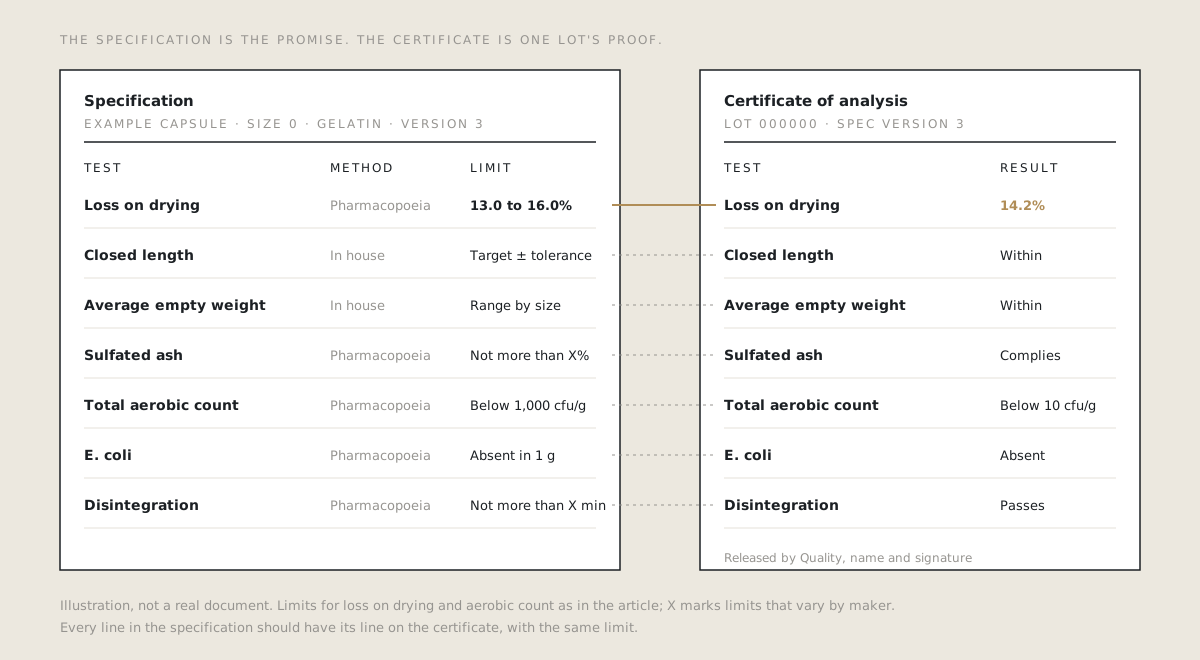
A certificate of conformance that says "complies" with no numbers isn't a certificate of analysis under Part 111 or Part 211 and can't support COA reliance. And a distributor's COA is only as good as its source. The TGA's wording is the one to hold a supplier to, results "transcribed to a broker or agent letterhead" are unacceptable. The COA you file should be the manufacturer's own document, or a distributor document that names the plant and reproduces the plant's batch results unchanged. We've written up what a capsule certificate of analysis should contain, and the specification it's checked against.
Do I need a BSE/TSE certificate for capsules?
For gelatin capsules, yes, and the strength of the evidence depends on your market. For HPMC or pullulan capsules, no TSE requirement exists in any of the five regimes, and what you want instead is a statement that no animal-derived material is used in the product or as a processing aid.
A medicine in the EU, the UK, or Australia is specified against Ph. Eur. general chapter 5.2.8 (which carries the EU note for guidance on TSE risk, EMA/410/01 rev.3) and general monograph 1483, so the evidence is an EDQM TSE Certificate of Suitability for the gelatin (which certifies species, tissue, geographical origin, slaughter controls, and the validated process) plus the capsule maker's statement that only CEP-covered gelatin is used. Australia goes one step further and makes that compliance a statutory condition of listing, in section 6(c) of the Permissible Ingredients Determination, for any animal-origin ingredient. A food supplement in the EU or UK needs a TSE/BSE statement citing species, tissue, country of origin, and compliance with Regulations 999/2001 and 853/2004, and a CEP is a bonus rather than a requirement. In the US, 21 CFR 189.5 expressly excludes gelatin from the list of prohibited cattle materials, but the importer of record has to affirm at entry that any cattle material complies and produce records within 5 days. USDA APHIS, under 9 CFR 94.23, requires bovine gelatin to arrive with an official veterinary certificate. The certificate states whether the gelatin is hide-derived, or bone-derived from a negligible-risk country, or bone-derived and processed at 138 °C for at least 4 seconds. Whether APHIS treats a finished empty capsule as gelatin for that purpose isn't stated in the regulation, and we haven't found a ruling. If you import gelatin capsules into the US, that's a question for your broker before the first consignment.
Hide gelatin and bone gelatin answer differently. Bovine hide is the tissue the rules treat as lowest risk, and the statement is short. Bone gelatin needs the process narrative and the exclusion of specified risk material. Ask which one you're getting.
What about titanium dioxide, halal, kosher, and vegan claims?
Titanium dioxide (E171) is the sharpest split between markets, so an opaque white capsule is two products. The EU banned it in food from 7 August 2022 (Regulation 2022/63), after EFSA concluded in 2021 that it could no longer be considered safe as a food additive, and the ban applies in Northern Ireland. Great Britain kept it, on the Committee on Toxicity's 2024 finding that a health risk from UK dietary exposure was unlikely. The US permits it under 21 CFR 73.575 up to 1% of the food, with a petition to revoke still pending. Australia and New Zealand permit it in food, and Australia permits it in oral and topical medicines. The EU concluded in 2025 that it should stay in medicines. So your specification has to say which grade you're buying, and if you sell into the EU as a food, the titanium-dioxide-free grade (usually calcium carbonate, or no opacifier) is the only lawful one.
Halal, kosher, vegan, and vegetarian have no statutory definition in the US, the UK, or the EU, and rest on private certification everywhere we sell. Each rests on a private certificate naming the site, the product, and the certifier, plus the composition statement. For halal gelatin capsules that means the gelatin maker's slaughter certificate as well as the capsule plant's, and where Malaysia or Indonesia is a market, a certifier recognized by JAKIM in Malaysia or by BPJPH, the Indonesian halal agency. We haven't found a maker advertising kosher bovine gelatin capsules, because the gelatin has to come from kosher animals slaughtered under supervision, and the kosher claims we've seen sit on HPMC, pullulan, or fish gelatin. A vegan claim on an HPMC capsule hangs on the gelling agent and processing aids, which is why the composition statement matters more than the polymer. A plain "no" to "are you certified" goes in the file as a fact. A logo with no certificate behind it doesn't.
How do I know who made my capsules?
Ask for the plant's name and address on the COA and on the questionnaire, and qualify each plant as its own supplier. Roughly half of the fifty-odd Chinese producers named in the 2024 US antidumping petition sit in Xinchang County in Zhejiang, the Indian list runs to 14 names, and a number of the addresses on the list are offices rather than plants. Many of the companies selling capsules internationally are trading offices, brokers, or distributors that source from several factories. A supplier whose factories change under the same brand is a supplier whose gelatin source, colorant supplier, and moisture control change without a notification, and that's the change control failure most likely to show up on your line.
Four regimes require you to know the plant. FSVP defines the foreign supplier as the establishment that manufactures the food, so a trading company is never the foreign supplier on a US import. BRCGS requires you to know the last manufacturer behind any agent or broker. ICH Q7, which is written for active ingredients and applies to excipients only by analogy, says the manufacturer's name and address "should be known" where the supplier isn't the manufacturer. The TGA says the supplier "should normally be the actual manufacturer." The US antidumping and countervailing duty orders on hard empty capsules from Brazil, China, India, and Vietnam set the cash deposit by producer and exporter. The all-others rates, adding the antidumping margin to the countervailing rate, run from about 26% for China and India to around 88% for Brazil, and India's all-others cash deposit at the border is lower, about 19% combined. A US importer who doesn't know the producer doesn't know the landed cost either. Tariffs move, so check the current rates with your broker.
What we'd expect from any distributor, ourselves included, is the plant named on the paperwork for every lot, the plant's certificate numbers, and the plant's own COA passed through unchanged. We name the plant once you've bought from us. Before that we'll tell you the country of origin, the material, and which certificates the plant holds.
How many lots do I test before I trust the COA?
Three, then an identity examination on every lot, then a periodic full test to re-confirm. The three-lot rule is the common thread. ICH Q7, by analogy, says "Full analyses should be conducted on at least three batches before reducing in-house testing." The TGA says "three (or as otherwise justified) different specific manufacturer's lots." The CHPA/SIDI guideline used by US supplement makers scales it to 3, 5, or 10 batches by risk. For a capsule, "full" means appearance, dimensions, average weight, loss on drying, disintegration, microbial limits, colorant identity, heavy metals with chromium for gelatin, sulfur dioxide for gelatin, and any pharmacopoeial identity test the grade claims. Add a machine trial. Separation, brittleness after conditioning, and how the lot runs on your filler are part of quality under BRCGS 3.5 and part of what a change can alter under the IPEC change guide, and no COA reports them.
The comparison of your three results to the supplier's three COAs is what 111.75 means by "confirmation of the results" and what 211.84 means by "validation of the supplier's test results." Write it down with a date and an approval. Then re-confirm by full test on an interval you set by risk, annually for a plant with a checkable GMP certificate and a clean history, more often for a plant without one. The TGA's rule for what happens after a rejection is a sound default anywhere. "A qualified supplier will revert to a non-qualified status if a quality issue results in rejection of any material."
How often should I re-qualify a capsule supplier?
The standards give you very few numbers, and the ones they give are all 3 years. BRCGS reissues the questionnaire at least every 3 years and reviews the raw material risk assessment at least annually. FSVP re-evaluates each foreign supplier at least every 3 years (21 CFR 1.505). EXCiPACT runs a 3-year certificate cycle with annual surveillance. Part 111 says "periodically," Part 211 says "appropriate intervals," ICH Q7 says "regular intervals," and ISO 9001 sets no interval at all. The one place the law names an annual onsite audit is FSVP and Part 117 for a hazard "for which there is a reasonable probability that exposure ... will result in serious adverse health consequences or death," which a capsule hazard would rarely be. So a defensible calendar is an annual risk and vulnerability review, a questionnaire and specification reissue every 3 years, and a factory audit or licensed shared audit report renewed within 3 years for a critical supplier. A shared audit report from a program like Rx-360 licenses for a few thousand dollars, which is a fraction of the cost of sending someone.
The triggers matter more than the calendar. Re-qualify on a change of site, scale, raw material source, gelling system, colorant supplier, process, or specification. Those fall in the categories the IPEC Significant Change Guide tells a supplier to assess, and where the change is significant the guide says it will "always require user notification." Re-qualify on a certificate lapse (one major maker's EXCiPACT certificate for an Indian plant reached its stated end date in September 2026 and the register didn't yet show a renewal when we looked, which is the kind of date an approved vendor list should be watching). Re-qualify on an out-of-specification result, a complaint, a recall, a regulatory action, or a change of ownership. And put the notification duty in writing. IPEC's guide says users "may request additional inventory of excipient produced prior to the change," and EXCiPACT 6.3 says "Customer communication shall occur in advance whenever possible." A quality agreement that carries those two lines, plus recall support with a 24-hour contact, retained samples for at least a year past expiry, and audit rights, puts those duties in the contract.
Where do the regulations disagree?
They agree on the skeleton and disagree on method, frequency, and a few substances. The ones that change what you write on a specification are these.
| Question | US | UK (GB) | EU and Northern Ireland | Australia | New Zealand |
|---|---|---|---|---|---|
| Titanium dioxide in food | Permitted, 1% cap, petition pending | Permitted | Banned since August 2022 | Permitted | Permitted |
| Identity test on every capsule lot | Drug yes, specific test; supplement by examination or qualified COA | Medicine by pharmacopoeial identity; food by your HACCP | Same | On all sampled containers, three full lots first | Supplier assurance |
| Codified re-qualification interval | FSVP 3 years; annual audit only for serious hazards | BRCGS 3-year questionnaire (custom) | Same | Periodic, no number | None |
| Gelatin capsule at the border | APHIS veterinary certificate for gelatin; capsule status open | Food and supplement capsules are listed for veterinary control under 9602 as well as 3503, so a CHED-P; medicine-use capsules are excluded | Food and supplement capsules are listed under ex 9602 in 2021/632 and need a CHED-P; medicine-use capsules are excluded | Import conditions not verified | Import health standard not verified |
| Allergen list | 9, fish gelatin needs the species | 14, sulfites above 10 mg/kg | 14 | Fish declared | Regulations 1985 |
| GMP evidence for the capsule plant | None in law; qualification under 211.84; EXCiPACT as custom | Formalized risk assessment by you | Same | PIC/S Chapter 5; technical agreement "not required" | None for supplements |
| TSE evidence | APHIS certificate; 189.5 records | CEP for medicines; statement for food | Same | Statutory condition of listing | Biosecurity only |
Swipe across to see every column.
The border question is the one we'd settle before anything else if you import gelatin capsules yourself. The EU and Great Britain use the same words. Their lists of goods that must go through a border control post name "empty capsules of unhardened gelatine for food or animal consumption" under heading 9602, and say that empty capsules "if not for food or animal consumption are excluded from official controls" (EU Regulation 2021/632, and the GB copy in assimilated Regulation 2019/2007). So what decides the regime is what the capsule is for, not the tariff code. A capsule for a food supplement is a product of animal origin, and in Great Britain it needs an IPAFFS pre-notification and a CHED-P. The UK tariff line for 9602 carries that veterinary control just as 3503 does. A capsule going into a medicine is declared as outside the list and clears without one. For capsules from outside the EU, DEFRA's general authorization for empty bovine gelatin capsules also asks for the gelatin's EDQM certificate with every consignment. The check rate depends on origin and species, so ask your broker or port health authority to confirm it for your route before the first shipment.
The fastest route to an approved supplier
Request the Capsule Supplier Qualification AI Prompt Pack
Leave your details to request this resource.
The fastest route is a sample lot that arrives with its full paperwork, so you can run your own incoming inspection against the supplier's COA and have the first of your three lots on file the same week. Ask any capsule supplier for that, and for the plant's name, the specification, a specimen manufacturer COA, the composition statement, the TSE or animal-origin statement, the allergen statement, and the certificates with numbers. Any of those that arrives as a logo instead of a document is a gap in your file.
The Capsule Supplier Qualification Pack does the desk work. It's a prompt pack, a set of files you load into whichever AI assistant you already use. It asks which regime you sit under (Part 111, Part 211, BRCGS or FSSC, EU GMP, or TGA) and what you make. It drafts a supplier questionnaire in that shape, with the capsule-specific lines included, and builds the evidence checklist for your file. Then it reads a supplier's completed questionnaire and certificates back against that checklist and tells you what's missing, what can be verified against a register, and what's a statement you're taking on trust. It carries the three-lot testing plan for a capsule and a re-qualification calendar you can drop into your approved vendor list.
If you'd rather talk it through, reply to any email from us or write to quality@capsules.com. The person who answers is the one who signs our own approved vendor list.
Related.
- What a certificate of analysis and a specification contain
- Switching capsule supplier without stopping the line
- How empty capsules are made, and where they come from
- Vegan, halal, kosher, and allergen claims for capsules
- Capsules for clinical trials. Placebo, over-encapsulation, blinding sizes, and the paperwork
- Buying empty capsules. Price per 1,000, MOQ, and lead time
Sources. The main ones, for the reader who wants the text itself.
- 21 CFR 111.70 and 111.75 (component specifications, COA reliance, identity testing): https://www.ecfr.gov/current/title-21/chapter-I/subchapter-B/part-111/subpart-E and https://www.ecfr.gov/current/title-21/chapter-I/subchapter-B/part-111/subpart-E/section-111.75
- 21 CFR 117.5(e), 117.405 to 117.435 (Part 111 exemption, supply-chain program): https://www.ecfr.gov/current/title-21/chapter-I/subchapter-B/part-117
- 21 CFR 1.500 to 1.514 (FSVP), 1.225 to 1.243 (food facility registration): https://www.ecfr.gov/current/title-21/chapter-I/subchapter-A/part-1; 1.243: https://www.ecfr.gov/current/title-21/chapter-I/subchapter-A/part-1/subpart-H/subject-group-ECFR7a5c6c3ea2f40a7/section-1.243; 1.505: https://www.ecfr.gov/current/title-21/chapter-I/subchapter-A/part-1/subpart-L/section-1.505
- 21 CFR 211.84 (components in drug manufacture): https://www.ecfr.gov/current/title-21/chapter-I/subchapter-C/part-211/subpart-E/section-211.84
- 21 CFR 73.575 (titanium dioxide): https://www.ecfr.gov/current/title-21/chapter-I/subchapter-A/part-73/subpart-A/section-73.575; 172.874 (hypromellose): https://www.ecfr.gov/current/title-21/chapter-I/subchapter-B/part-172/subpart-I/section-172.874; 189.5 (prohibited cattle materials): https://www.ecfr.gov/current/title-21/chapter-I/subchapter-E/part-189/subpart-A/section-189.5; 9 CFR 94.23 (gelatin import, BSE): https://www.ecfr.gov/current/title-9/chapter-I/subchapter-D/part-94/section-94.23
- FDA warning letters, Western Herb Products (Dec 2021), MCACO Ltd (Apr 2022), LiquidCapsule Manufacturing (Dec 2025): https://www.fda.gov/inspections-compliance-enforcement-and-criminal-investigations/warning-letters; Western Herb Products: https://www.fda.gov/inspections-compliance-enforcement-and-criminal-investigations/warning-letters/western-herb-products-inc-615439-12072021
- FDA Data Dashboard, inspections and citations: https://datadashboard.fda.gov/oii/cd/inspections.htm
- FDA, list of drug master files: https://www.fda.gov/drugs/drug-master-files-dmfs/list-drug-master-files-dmfs
- Commission guideline 2015/C 95/02, formalized risk assessment for excipient GMP: https://eur-lex.europa.eu/legal-content/EN/TXT/PDF/?uri=CELEX:52015XC0321(02)
- EudraLex Volume 4, Chapter 5 (5.27 to 5.30): https://health.ec.europa.eu/system/files/2016-11/chapter_5_0.pdf
- ICH Q7, Good Manufacturing Practice Guide for Active Pharmaceutical Ingredients (7.13, 7.31; applied to excipients by analogy): https://database.ich.org/sites/default/files/Q7%20Guideline.pdf
- Note for guidance on minimising the risk of transmitting animal spongiform encephalopathy agents via human and veterinary medicinal products, EMA/410/01 rev.3: https://eur-lex.europa.eu/legal-content/EN/TXT/?uri=CELEX:52011XC0305(04)
- FDA, food allergies (FALCPA and the FASTER Act): https://www.fda.gov/food/nutrition-food-labeling-and-critical-foods/food-allergies
- Regulation 178/2002 Art 18 and 19, Regulation 852/2004 Art 6, Regulation 1169/2011 Annex II, as assimilated in GB: https://www.legislation.gov.uk
- Regulation 2022/63 (E171 ban) and the COT 2024 statement: https://eur-lex.europa.eu/legal-content/EN/TXT/PDF/?uri=CELEX:32022R0063 and https://cot.food.gov.uk/node/11291
- EFSA, titanium dioxide (E171) no longer considered safe as a food additive, May 2021: https://www.efsa.europa.eu/en/news/titanium-dioxide-e171-no-longer-considered-safe-when-used-food-additive
- European Commission, SWD(2025) 244 on titanium dioxide in medicinal products: https://health.ec.europa.eu/document/download/34542b69-8507-4fc2-b106-bd15b481e40d_en; EMA feedback on the impact of removing titanium dioxide from medicines, EMA/94330/2024: https://www.ema.europa.eu/system/files/documents/report/final-feedback-impact-removal-tio2-en.pdf
- Regulation 2021/632 (goods subject to official controls; the ex 9602 and 3503 entries): https://eur-lex.europa.eu/eli/reg_impl/2021/632
- Assimilated Regulation 2019/2007, Annex I (GB list of goods subject to border controls): https://www.legislation.gov.uk/eur/2019/2007/annex/I
- DEFRA general authorization IMP/GEN/2016/09 (empty gelatin capsules): https://assets.publishing.service.gov.uk/media/5a815d19e5274a2e87dbd3a1/imp-gen-2016-09-unfilled-gelatine-capsules-bovine.pdf
- UK Trade Tariff, 9602 00 00 90 and 3503 00 10: https://www.trade-tariff.service.gov.uk/commodities/9602000090
- BRCGS, Preventive Controls guidance quoting clause 3.5: https://www.brcgs.com/media/63857/brctag-guidance-document.pdf
- EXCiPACT Standards 2025 and certificate register: https://www.excipact.org and https://www.excipact.org/certificate-holders.html
- IPEC Significant Change Guide (2023): https://www.ipec-europe.org/uploads/publications/2023-ipec-significant-change-guide-f-1684943592.pdf
- CHPA/SIDI Component Supplier Qualification Guideline: https://www.chpa.org/sites/default/files/media/docs/2021-05/Component-Supplier-Qualification-Guideline-SIDI-012013.pdf
- TGA, Assessing suppliers and material used in listed and complementary medicines: https://www.tga.gov.au/resources/guidance/assessing-suppliers-and-material-used-listed-and-complementary-medicines
- TGA, Sampling and testing: https://www.tga.gov.au/resources/guidance/sampling-and-testing-listed-and-complementary-medicines
- Therapeutic Goods (Permissible Ingredients) Determination (No. 2) 2026, s 6(c): https://www.legislation.gov.au/F2026L00707/latest/text
- Medsafe, regulation of dietary supplements in New Zealand: https://www.medsafe.govt.nz/regulatory/DietarySupplements/Regulation.asp
- US antidumping and countervailing duty orders on hard empty capsules, 23 February 2026: https://www.federalregister.gov/documents/2026/02/23/2026-03484/hard-empty-capsules-from-brazil-the-peoples-republic-of-china-india-and-the-socialist-republic-of and https://www.federalregister.gov/documents/2026/02/23/2026-03485/hard-empty-capsules-from-brazil-the-peoples-republic-of-china-india-and-the-socialist-republic-of
- 2012 chromium gelatin capsule case: https://www.chinadaily.com.cn/china/2012-04/19/content_15094353.htm
- Carrageenan-gelled HPMC capsule disintegration, Int J Pharm 2011: https://www.sciencedirect.com/science/article/abs/pii/S0378517311001839
*Capsules.com supplies empty hard capsules in gelatin and HPMC to manufacturers, brands, pharmacies, and research teams. Capsules Direct Ltd, company number 17362490, 26 Rowood House, Bicester OX26 4PP, United Kingdom. UK 020 3905 1989 · US (816) 445-0042 · capsules.com. *