
Formulation and filling
Capsule sizes, volumes, and fill weights
Pick a capsule size from your dose and powder density. Size charts, dimensions, worked examples, and a calculator for the machine you use.
Written by A. Sanderson, CEO, Capsules.com

On this page
One of the hardest things to get your head around in capsule manufacturing is that capsule filling machines (capsule fillers) don't fill to weight (some do, but they're quite rare). They fill to volume. What does that mean in practice?
There's an old school riddle that gets at it. What weighs more, a ton of feathers or a ton of lead? Half the room says lead, because lead is heavy, and the answer is that they both weigh a ton. A ton is a weight, and the feathers just take up a lot more room. A capsule is the same riddle the other way round. A capsule is a fixed amount of room, and what that room weighs depends on what you put in it. Fill a size 00 with a light botanical powder and it holds about 550 mg. Fill the same capsule with a dense mineral and it holds about 910 mg. Same capsule, same volume, nearly twice the weight.
So how do you know what yours is going to weigh, and how do you work out which size capsule you need before you commit to a manufacturing run?
That's what this article is about. The calculator and the AI prompt pack further down do the calculation for you. Here's what you'll find, so you can skip straight to the part you need.
- The size chart. Volume and fill weight for every standard size at four densities, so you can read across at yours.
- Sizes for 500 mg and 1,000 mg. The two doses people ask about most, answered by density.
- Capsule sizes explained. Which way the numbers run, what 00 and 0 mean, and what 00E and 0E are.
- How to work out fill weight from density. The one-line calculation, a ten-minute method for measuring your powder, and a worked example.
- The fill weight calculator. Type in your dose and densities and get the smallest size that fits.
- Tamping, fillers, and swallowing. Why the machine sets what fits, when you don't need a bulking agent, and which sizes are too big to swallow.
- Dimensions, machine lengths, boxes, and per-thousand pricing. The numbers the machine, the checkweigher, and the purchase order need.
- The free AI prompt pack. Load it into ChatGPT, Claude, or Gemini, tell it each ingredient and its dose, and it walks you to the right capsule, builds your batch sheet with weigh-outs for 10,000, 100,000, and 1,000,000 capsules, and works out the production time on your machine.
One honest note before the numbers. The figures on this page are the nominal ones the capsule makers publish, and the makers don't all agree with each other. They're close enough to pick a size and brief a supplier, and the way to get a figure you can rely on is to measure your own, which the density section shows you how to do.
How many mg fits in a size 00 capsule, and in each other size?
A size 00 holds 0.91 ml. Fill it with a light powder at 0.6 g/ml and you get 546 mg. Fill it with a dense one at 1.2 g/ml and you get 1,092 mg. Same capsule, double the weight. The same arithmetic for every standard size is in Table 1.
Table 1. Capsule volume and fill weight by size. Nominal volumes as published by the major capsule makers. Fill weight is volume multiplied by fill density. Find the column closest to your powder's density and read down, or read between two columns if yours falls in the gap.
| Size | Volume (ml) | Fill at 0.6 g/ml (mg) | Fill at 0.8 g/ml (mg) | Fill at 1.0 g/ml (mg) | Fill at 1.2 g/ml (mg) |
|---|---|---|---|---|---|
| 000 | 1.37 | 822 | 1,096 | 1,370 | 1,644 |
| 00E | 1.02 | 612 | 816 | 1,020 | 1,224 |
| 00 | 0.91 | 546 | 728 | 910 | 1,092 |
| 0E | 0.78 | 468 | 624 | 780 | 936 |
| 0 | 0.68 | 408 | 544 | 680 | 816 |
| 1 | 0.50 | 300 | 400 | 500 | 600 |
| 2 | 0.37 | 222 | 296 | 370 | 444 |
| 3 | 0.30 | 180 | 240 | 300 | 360 |
| 4 | 0.21 | 126 | 168 | 210 | 252 |
| 5 | 0.13 | 78 | 104 | 130 | 156 |
Swipe across to see every column.
What the columns mean. The density in each column heading is the fill density, which is how tightly packed the powder ends up inside the capsule. That's not one fixed number for a powder. Poured loosely, a powder has its bulk density. Tapped until it settles, it has a higher tapped density. Pressed by an auger or a tamping pin, it goes higher again. So the same powder can sit in the 0.6 column on a hand plate and the 0.8 column on a machine that compresses it. The five densities, and which one each kind of filler reaches, are explained in the companion article on fill weight from density.
Which column is yours? As a rough guide, light botanical and plant powders sit around 0.6 g/ml when poured loosely. Most amino acids and vitamin blends are nearer 0.8. Dense minerals like magnesium oxide or calcium carbonate can be 1.0 or 1.2. Those are bulk figures, and your fill will land at or above them depending on the machine. They're starting points, not answers. Measure the density of your own blend. It takes ten minutes with a graduated cylinder. We show you how further down.
One more caveat on the table. Makers don't all publish the same volumes. Size 00 is quoted anywhere from 0.90 to 0.95 ml depending on whose sheet you're reading, and size 5 from 0.10 to 0.13 ml. It comes down to where each maker measures the body and how they round. It's also why, when you switch from one manufacturer to another, you should check that the internal dimensions are the same before you assume the fill weight will be.
If you'd rather have the working done for you, the AI prompt pack takes your dose and your densities and returns a size, with the arithmetic shown. Get the AI prompt pack.
Which capsule size do I need for 500 mg? And for 1,000 mg?
For 500 mg you're usually looking at a size 0 or a size 1. For 1,000 mg it's usually a 00E, a 000, or a 00 filled firmly. In both cases the powder's density picks between them.
Table 2. Smallest size for two common doses, by fill density. Loose means the dose fits at or below that density with no compression. Firm means it needs tamping to get there.
| Dose | At 0.6 g/ml | At 0.8 g/ml | At 1.0 g/ml | At 1.2 g/ml |
|---|---|---|---|---|
| 500 mg | 00 (loose) or 0 (firm, needs 0.74 g/ml) | 0 (loose) | 1 (loose) | 1 (loose) |
| 1,000 mg | Needs 1.67 ml. No single size. Split the dose or densify the blend | 000 (loose) | 00E (loose) or 00 (firm, needs 1.10 g/ml) | 00 (loose) |
Swipe across to see every column.
Why can a 500 mg capsule be a size 1 for one product and a size 00 for another? Because 500 mg of a dense mineral takes up half the space of 500 mg of a fluffy plant powder. Anyone who gives you a size for a dose without asking about the powder is guessing.
Capsule sizes explained. Which way do the numbers run, and which is biggest?
Capsule sizes run backwards, which catches most people out the first time. Size 5 is the smallest and size 000 is the largest. A bigger number means a smaller capsule, and each extra zero means a bigger one. From small to large the run is 5, 4, 3, 2, 1, 0, 00, 000.
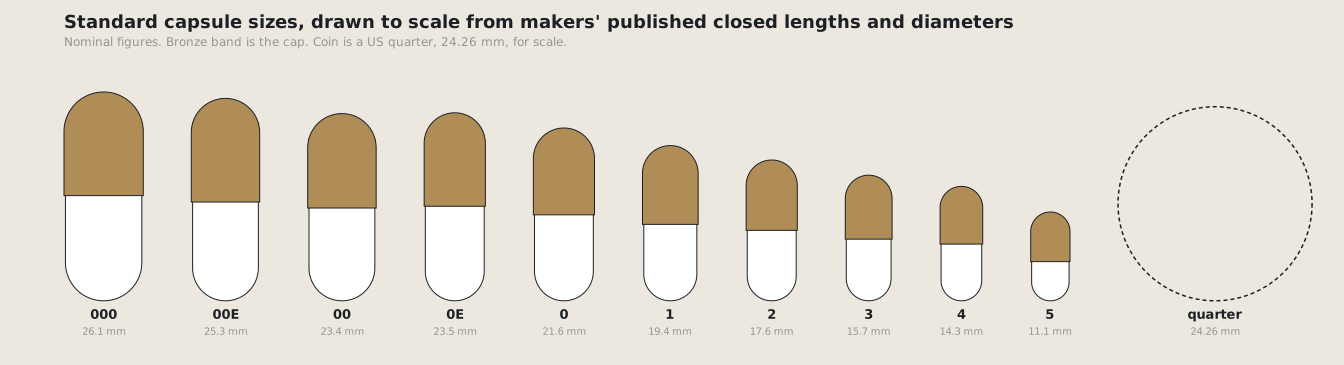
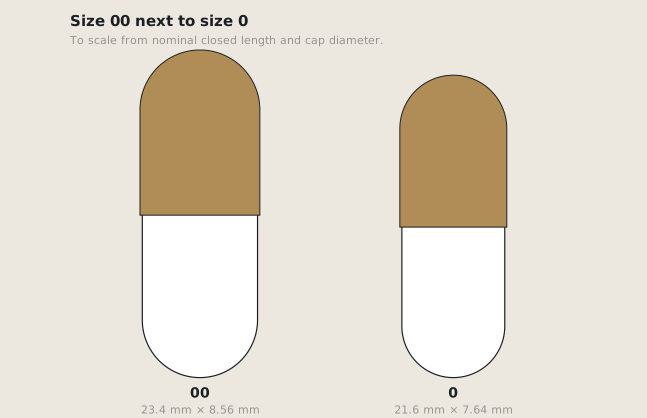
A 00 (say "double zero," or "double aught" in the US) holds 0.91 ml. It's 23.4 mm long when closed (a published nominal, and each maker's own figure differs a little) and 8.6 mm across the cap. It's the most common size in supplements for a simple reason. It holds a useful dose of most powders and most people can swallow it. A 0 (say "single zero" or just "zero") holds 0.68 ml, is 21.6 mm long, and 7.6 mm across. So the difference between 0 and 00 is about a third more volume in the 00, nearly two millimeters of length, and about a millimeter of width. On a filling machine they take different change parts, which is the size-specific tooling a machine is fitted with for one capsule size.
Size 000 is the biggest standard size at 1.37 ml. You'll see it in veterinary products, loading doses, and light powders that won't fit anywhere else. It's 26.1 mm long, which is a lot to swallow. Bigger capsules do exist, but only for animals and outside this numbering. Veterinary makers run a separate scale that starts around 3 ml and goes up to about 50 ml, for horses and cattle, and you'll sometimes see the smallest of those sold as a "0000". No capsule maker publishes that size for people.
Every size is a two-piece hard capsule. The longer, narrower piece is the body, and that's where the fill goes. The shorter, wider piece is the cap, and it slides over the body to close it. The sizes are the same whether the capsule is gelatin or HPMC (hydroxypropyl methylcellulose, the plant-derived material used for vegetarian capsules). The two materials differ in weight and in how they handle moisture, but not in size.
What are 00E and 0E elongated capsules?
An elongated capsule is the same width as its parent size with a longer body, so it holds more without being any harder to fit in a bottle or a throat sideways. A 00E holds 1.02 ml against 0.91 ml for a standard 00, about 12% more, and is 25.3 mm long instead of 23.4 mm. A 0E holds 0.78 ml against 0.68 ml for a 0, about 15% more, and is 23.5 mm long instead of 21.6 mm.
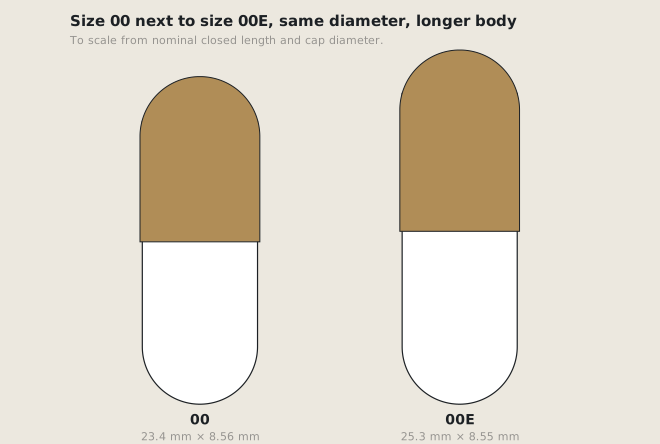
They exist for the dose that's just over what the standard size holds. A 00E takes a dose that would otherwise push you up to a 000, and it's 0.8 mm shorter and 1.4 mm narrower than the 000. Some makers write them as 00el and 0el. Same thing.
One thing to check. Because an elongated size shares a diameter with its parent but not a length, it will likely need its own segments and dosing discs on your filling machine. Ask the machine maker before you order the capsules.
How much powder fits in a capsule, and why is my capsule half empty?
The amount of powder that fits is the capsule's volume multiplied by the density the powder reaches inside it. And a half-empty capsule means one of three things, depending on what you filled it on.

On a hand plate or a bench-top filler, a half-empty capsule is a filling problem, and it will be underweight. Weigh a few and you'll see it. The hopper ran low, the plate wasn't swept evenly, the powder bridged over some of the bodies, or the tamper missed a row (the compounding guide covers how to get even weights on a plate). If the arithmetic was right, the capsule size isn't the problem, because a capsule that's the right size for the dose can't be full and light at the same time. The troubleshooting article works through the causes, including head pressure on a semi-automatic filler.
On a tamping-pin machine, you shouldn't see a half-empty capsule at all. The machine forms a slug that fills the body's bore and pushes it in, so a capsule either gets its slug or it doesn't. If capsules are coming off part-filled, the machine has run out of powder, the dosing disc has a blocked bore, or a slug dropped in transfer. It's a fault, not a sizing question, and the troubleshooting article covers it.
On a dosator machine, a part-filled capsule can be deliberate. A dosator meters a separately adjustable column of powder, which may form a plug depending on the powder and settings, so it can run a capsule a third or a half full if the dose calls for it. If yours are part-filled and you didn't ask for it, check the dosator height setting and the powder bed depth.

The opposite problem is the one that catches people out. A filler is set to a volume, not a weight. You tune the plate, the auger, or the tamping pins until the capsules come off at 400 mg, but what you've actually set is a fill depth. So when a later batch of blend arrives lighter, milled finer or from a different supplier, the machine fills the capsule just as full as before and the weight drops. A denser batch, and the weight climbs. The capsule looks the same either way. You can't see it during production. Your QC finds it, which is why capsule weights get checked at the start of the run, at intervals through it, and at the end, and the end is where I'd pay the most attention, because that's when the hopper is emptying and the head pressure is dropping too. That's also why the first check on a new lot of powder is bulk and tapped density against the last lot, before the machine is touched. A weight drift with no setting changed usually means the powder changed. The troubleshooting article covers the checks, the settings, and what to do when fill weight drifts.
How do I calculate capsule fill weight from bulk density?
Divide your dose in grams by the capsule's volume in milliliters. That gives you the density the fill would need to reach in that size. Now compare it with what your powder can do. The floor is its bulk density, poured loosely. The ceiling is its slugged density, which is how tight a machine can press it, and that's higher than the tapped density you get from a cylinder. Somewhere between bulk and slugged is every weight you can get into that capsule, and where the floor sits depends on the machine. On a hand plate, a bench-top, or a semi-automatic filler the bodies fill full at bulk density, so the floor is bulk, and a dose that needs less than that in a given size means the size is too big. A dosator meters a column of powder, so it's the one filler that can deliver a part fill on purpose. On a fully automatic tamping-pin machine you can't, because the powder has to be pressed into a slug strong enough to survive the transfer into the body, and a slug at bulk density falls apart. The floor on that machine is the lightest slug that holds together, which sits above bulk. There are two ways round it, and neither is a first choice. A few fillers have gates that hold loose powder in place, and they're rare as standard equipment. And a thinner dosing disc makes a shorter slug, which gives you a part-filled capsule with a loose pellet inside it that often breaks up before it reaches the customer. The companion article explains that one, under the least and the most a tamping-pin machine can put in a capsule. So, reading up the scale. At or below bulk, the size is too big for the dose on a hand plate, a bench-top, or a tamping-pin machine, and a dosator can part fill it. Between bulk and tapped, it fits with light tamping, even by hand. Between tapped and slugged, it fits on a machine that compresses the fill. Above slugged, it won't fit without changing the powder or the size.
One caveat. Slugged density has to be measured on a machine or a slug gauge, because a cylinder never applies pressure. Until you've measured it, tapped is a conservative stand-in for the ceiling, and the ceiling is above it. The same section of the companion article shows you how to measure it on your own machine.
If you don't have a machine to measure it on, or you'd rather not tie yours up, send us the powder and we'll measure it for you. We press a slug of your blend in the capsule size you're considering, find the density at which it holds together and the density at which it stops taking more, and send you both figures, in g/ml and as fill weights for that size, so you can put them straight into the calculator. Email us first, through the contact page, with what the powder is, the size, and the dose you're aiming for. Don't post anything until you've heard back, because we need to know what's coming before it arrives. We'll reply with the address of whichever of our offices is nearer, UK or US, and the sample goes there marked for sample testing.
If those terms are new to you, here's what they mean. Bulk density is the weight of your powder divided by the space it takes up when poured loosely. Tapped density is the same weight divided by the space it takes up after you've tapped the container until the powder stops settling, with no pressure applied. Slugged density is the same weight divided by the space it takes up once a machine has pressed it into a plug, and it's higher again. Bulk and tapped come from a cylinder. Slugged comes from the machine. The standard method is USP General Chapter 616, and it's not complicated. Weigh out 25 to 100 g of your finished blend, pour it gently into a dry graduated cylinder, read the volume, and divide. Then tap the cylinder until the level stops falling (usually a few hundred taps), read again, and divide again.

Measure the blend, not the individual ingredients. Density changes when powders are mixed.
A worked example. Say your dose is 650 mg, your bulk density is 0.55 g/ml, your tapped density is 0.72 g/ml, you haven't measured slugged density yet, and you're filling on a tamping-pin machine.
Table 3. Required fill density by size for a 650 mg dose. Band is how hard the fill would need compressing in that size, judged against bulk 0.55 and tapped 0.72, with the slugged ceiling still unknown.
| Size | Volume (ml) | Required density (g/ml) | Band |
|---|---|---|---|
| 000 | 1.37 | 0.47 | Below bulk. Too big for the dose on a hand plate, bench-top, or tamping-pin machine. A dosator can part fill it |
| 00E | 1.02 | 0.64 | Between bulk and tapped. Light tamping |
| 00 | 0.91 | 0.71 | Just under tapped. Firm tamping on a machine |
| 0E | 0.78 | 0.83 | Above tapped. Fits only if your slugged density reaches 0.83, which needs measuring |
| 0 | 0.68 | 0.96 | Above tapped by a long way. Unlikely without densifying the blend |
Swipe across to see every column.
The 00E at 0.64 sits comfortably between bulk and tapped, so it fills with light tamping. The 00 at 0.71 is just under tapped and needs the pins set firmly, but it's inside what bulk and tapped density promise. The 0E at 0.83 is above tapped, and whether it fits depends on a number you don't have yet, the slugged density of this blend on your machine. Some powders press well past tapped and some don't, and twenty minutes on the machine tells you which. So the recommendation is a 00 with firm tamping, a 00E if you'd rather have margin, and a 0E only after you've measured. Whatever you pick, confirm it on the machine with a small batch. Paper density and machine density are not the same thing.
The full working, with the five densities, what each kind of machine does to the fill, the slug floor and ceiling on a tamping-pin machine, and how to size to the dose without a bulking agent, is in the companion article on fill weight from density. The calculator below does the arithmetic for you, and the AI prompt pack does it for a blend with several ingredients.
Capsule fill weight calculator
Type in your dose in milligrams, your bulk and tapped densities (how to measure bulk and tapped density takes ten minutes), and which kind of filler you're using. The calculator returns the fill density every size would need, the band each one falls in, and the smallest size that works for your machine. If you've measured your slugged density, enter it and the calculator uses it as the ceiling. If you've measured the slug floor on a tamping-pin machine, enter that too.
It works from the nominal volumes in Table 1. Pick your filler first, because the bands change with it. A required density at or below bulk is a part fill on a dosator, and on a hand plate, a bench-top, or a tamping-pin machine it means the size is too big for the dose. Between bulk and tapped is light tamping. Between tapped and the ceiling is a compressed fill, or machine tamping on a tamping-pin machine, and the ceiling is the compressed or slugged density you've entered. If you haven't entered one, the calculator says so rather than guessing. Above the ceiling, it won't fit. On a tamping-pin machine, enter your slug floor as well and anything below it is marked too loose to transfer. If you don't know your slug floor, the companion article's section on the slug floor and ceiling shows how to measure it in twenty minutes.
What the calculator can't do is ask you a follow-up question. It doesn't know your blend has six ingredients with six densities, or that you're planning to run 100,000 capsules on a machine that does 40,000 an hour. The AI prompt pack does, because it asks. Get the AI prompt pack.
How do I get more powder in a capsule? Tamping and slugging
Tamping presses the powder into a plug so more fits. It can take the fill from bulk density up past tapped density to the powder's slugged density, which is as tight as a machine can press it. If your dose needs a density above your powder's slugged density, no amount of tamping is going to get it in, and the answer is a denser blend, a split dose, or a different size.
How much tamping adds depends on your powder and your machine. A blend with bulk 0.55 and tapped 0.72 g/ml gains about 30% in fill weight by the time it's tapped, and more again when a machine presses it to its slugged density. A dense, free-flowing granule with bulk 0.80 and tapped 0.85 gains about 6% from tapping; any further gain from machine compression has to be measured. And the machine sets as much of the answer as the powder does. A hand plate and a bench-top fill the bodies full, loosely or with compression; a dosator can meter a partial fill. A tamping-pin machine can't, because the slug has to hold together to be carried over the body, so on that machine every powder has a floor and a ceiling for every size, and bulk and tapped density only bracket them. How the four kinds of filler differ, how hard the pins press, and how to measure your own range are all in the companion article on fill weight from density.

Do I need a filler or bulking agent in my capsule?
Not if the capsule is the right size for the dose. A bulking agent fills space that would otherwise be empty, and empty space usually means the capsule is one size too big.
People mean two different things by "filler." A flow aid, like silicon dioxide at 0.5% to 1%, helps a sticky or fluffy powder run through a machine and gives you more consistent fill weights. That's a processing decision and often a good one. A bulking agent, like microcrystalline cellulose or rice flour at 20% to 50% of the fill, exists to make a small dose look like a full capsule. It costs money, it adds a line to your label, and most of the time a smaller capsule would have done the job.
The exception is a small dose, where a diluent is the practical route because a quarter-filled capsule gives poor weight uniformity. How to size a capsule to the dose without a bulking agent, and what to do when the dose won't fit, is in the companion article.
Which capsule sizes are hard to swallow, and does a small capsule look like poor value?
Sizes 000 and 00E are hard for many adults to swallow. Size 00 is about the biggest most people manage comfortably. And at the other end, a capsule that looks small next to the competition can put your own customers off. So the right size is a commercial decision as much as a technical one.
The physical sizes are these. A 000 is 26.1 mm long and 9.9 mm across. A 00E is 25.3 mm. A 00 is 23.4 mm and 8.6 mm across. A 0 is 21.6 mm. The US Food and Drug Administration's guidance on the size and shape of generic tablets and capsules recommends that the largest dimension of a tablet or capsule should not exceed 22 mm, and that a capsule should not be bigger than a standard 00. That guidance is written for generic medicines, but a throat is a throat.
Now the other direction. A size 2 that's right for a 300 mg dose of a dense mineral can look mean next to a competitor's 00, and a customer paying for a bottle judges by eye. Some brands go up a size and accept a bulking agent for that reason. Others split a large dose into two capsules of a comfortable size and put "take two" on the label. Both are legitimate. Both are easier to decide with the numbers in front of you.
Capsule dimensions by size
If you're specifying a machine, setting up a checkweigher, or just want to know how big these things are, here are the closed length, cap and body lengths, outside diameters, and empty shell weight for every standard size.
Table 4. Capsule dimensions and empty shell weight by size. Nominal figures, compiled from the major makers' published specifications. Length tolerances are typically ±0.3 to ±0.4 mm. Each maker publishes its own nominal closed length and length tolerance, and they differ, so the lengths here are published examples, and the dimension sheet for your own lot is the one that counts. Diameter tolerances are typically ±0.03 mm. Shell weight tolerance is typically ±7% and moves with moisture.
| Size | Closed length (mm) | Cap length (mm) | Body length (mm) | Cap outside diameter (mm) | Body outside diameter (mm) | Shell weight, gelatin (mg) | Shell weight, HPMC (mg) |
|---|---|---|---|---|---|---|---|
| 000 | 26.1 | 12.95 | 22.20 | 9.91 | 9.55 | 158 | 163 |
| 00E | 25.3 | 12.95 | 22.20 | 8.55 | 8.22 | 143 | 152 |
| 00 | 23.4 | 11.80 | 20.20 | 8.56 | 8.23 | 123 | 136 |
| 0E | 23.5 | 11.68 | 20.19 | 7.65 | 7.36 | 107 | 107 |
| 0 | 21.6 | 10.85 | 18.35 | 7.64 | 7.35 | 99 | 105 |
| 1 | 19.4 | 9.85 | 16.40 | 6.96 | 6.63 | 78 | 79 |
| 2 | 17.6 | 8.80 | 15.15 | 6.39 | 6.12 | 61 | 63 |
| 3 | 15.7 | 8.00 | 13.45 | 5.85 | 5.60 | 48 | 50 |
| 4 | 14.3 | 7.21 | 12.10 | 5.33 | 5.08 | 38 | 40 |
| 5 | 11.1 | 6.20 | 9.30 | 4.91 | 4.68 | 28 | 30 |
Swipe across to see every column.
A few notes on reading it. Closed length is the locked length, with the cap fully home on the body. Cap and body lengths are the two pieces measured separately, and they add up to more than the closed length because the cap overlaps the body. Diameters are the outside of each piece. Body diameters in particular get adjusted by each maker to get the fit right, so treat the body figure as a guide. And don't measure diameters with a vernier caliper. The shell deflects and you'll read low. Makers use a ring gauge or an optical method, and the machine compatibility guide explains how to measure a capsule properly.
You need the shell weight when you're setting a target on a checkweigher or doing a weight check on the bench. Gross weight is shell plus fill, so a 00 HPMC capsule with a 700 mg fill weighs about 836 mg. HPMC shells run a little heavier than gelatin at the same size and hold less moisture, so their weight moves less with the room.
What capsule length does my machine need? Pre-lock and locked lengths
Your filling machine needs two lengths from a capsule. The pre-lock length, to feed and open it, and the locked length, to close it. Both are set by the size and the maker, not by the material.
Empty capsules arrive pre-locked, with the cap sitting on the body at a shallow first click so the two pieces stay together in the box and separate cleanly in the machine. The pre-lock length is a few millimeters longer than the closed length in Table 4, and the machine's rectification and separation stations are set for it. After filling, the machine pushes the cap fully home to the locked length, where a ring or dimples on the body hold it shut. Set the closing station from the locked length on the dimension sheet for the lot you're running, not from Table 4.
Pre-lock length isn't published as consistently as closed length, and it varies a little between makers. If a lot from a new maker runs differently in the separation station, pre-lock length is one of the first things to check, along with room humidity and the other machine settings a different maker's capsule can need. Change parts are made to a size, so when you order change parts or switch capsule supplier, specify the size, the material, and the maker, and run a box before you commit a shift to it. Pre-lock length is on the maker's specification sheet (here's what a capsule specification contains). Ask for it by name.
How many capsules per box, and how many on a pallet?
Empty capsules ship in cartons of anywhere from 50,000 to 350,000, with the biggest capsules in the smallest counts. A pallet carries a set number of cartons that depends on the carton and the warehouse.
As a guide, size 000 ships in cartons of about 50,000, size 00 in 70,000 to 75,000, size 0 in 90,000 to 100,000, and the small sizes in 125,000 to 350,000. The counts differ between makers because each packs to its own carton.
A pallet is ten cartons. The standard carton is about 400 × 600 × 730 mm, five go on a layer in a three-plus-two pattern, and two layers make the load, which stands about 1.6 m tall on the pallet. So a pallet of size 00 at 75,000 a carton is 750,000 capsules, a pallet of size 0 at 100,000 a carton is a million, and a pallet of 000 at 50,000 a carton is half a million. Ask for the figure for your size and carton when you order, because the carton count is what changes.
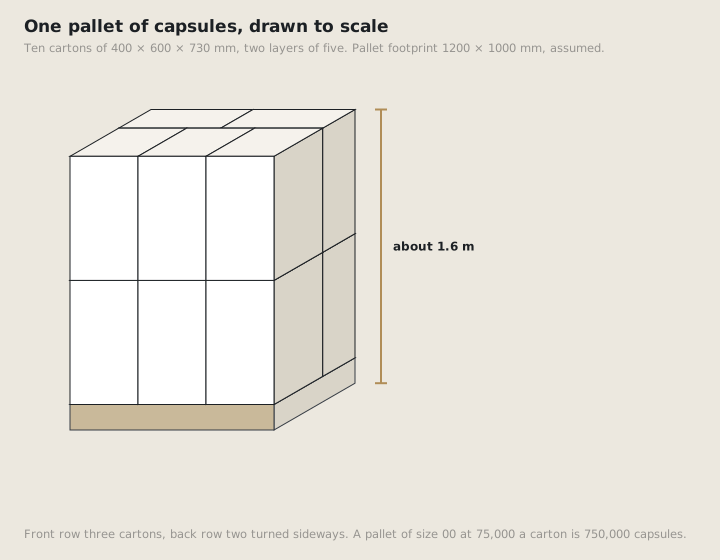
The cartons are light for their size. A carton of 75,000 size 00 HPMC capsules holds about 10 kg of capsules and is mostly air, so a full pallet of ten is roughly 100 kg of capsules plus the packaging. That's why capsules are priced by count rather than weight, and why freight is charged by volume.
What does "per 1,000" mean, and why are capsules sold per thousand?
Empty capsules are priced per 1,000. Nobody wants to talk about a price per capsule when the number is a fraction of a cent, and nobody wants to talk about a price per carton when one maker's carton holds 70,000 and another's holds 75,000. A thousand is a round number that works for every size and every supplier.
So if you're quoted $12.00 per 1,000 and you order a carton of 75,000, you're paying 75 times $12.00. That's also the easiest way to see what the capsule is costing you against everything else. Say your ingredients work out at 8 cents a capsule. At $12.00 per 1,000 the capsule itself is 1.2 cents on top. You'll sometimes get a quote per carton, or per 10,000, or per bag of 500 if you're buying small. Turn them all into per thousand before you compare, and ask whether shipping is in the price, because a carton of empty capsules is big for what it weighs.
Price structure, volume breaks, and minimum order are on our product pages rather than here.
What is an AI prompt pack?
An AI prompt pack is a small set of files you load into the AI assistant you already use. The assistant then asks you the right questions about your project, works through them with you using our reference data, and shows its working as it goes. We think we're one of the first to do this, so here's what's in it.
Inside the Capsule Fill Weight and Formulation AI Prompt Pack is a prompt file that turns your AI assistant (Claude, ChatGPT, Grok, Gemini) into a formulation helper, a spreadsheet the assistant fills in with your figures, and a short guide. Paste the prompt into ChatGPT, Claude, Gemini, or whichever tool you use, and it asks for each ingredient and its dose, the bulk and tapped density of your blend, and how you'll be filling. It gives you back the capsule size, how hard the fill needs tamping, and the alternatives if nothing fits. Then it fills the spreadsheet with the weigh-out for every ingredient at 10,000, 100,000, and 1,000,000 capsules, including overage, and works out your production time from the machine's speed.
Why a pack and not just the calculator? A calculator on a web page does one calculation. An AI prompt pack asks you what you haven't told it yet. It works for the person who doesn't yet know what tapped density is, because it explains as it goes, and it works for the formulation scientist who wants the batch sheet without building a spreadsheet from scratch. The pack is the working we'd do for you on a call, packaged so you can do it at eleven at night with your own numbers and nobody watching.
Email delivery of the prompt pack is not available yet. The calculator above is ready to use.
Get the Capsule Fill Weight and Formulation AI Prompt Pack
Size your capsule and build your batch sheet in ten minutes.
Load the pack into ChatGPT, Claude, or Gemini. Work from dose and density to a capsule size, then fill a batch spreadsheet for 10,000, 100,000, and 1,000,000 capsules with weigh-outs and production time. It is volume, weight, density, and time, not advice about what the contents do.
Email delivery is not available yet. Sign-up is closed for now. You can use the fill weight calculator without signing up.
If we haven't answered your question, or your figures don't fit the table, reply to any email from us or write to us through the contact page. A person who has done this calculation before will get back to you. And if you'd rather try a size than read about it, ask for a sample box. A sample is one box at the single-box price, paid up front, and its value is credited against your first order of the same product.
Related.
- Capsule fill weight from bulk and tapped density, and what tamping actually adds
- Capsule machine compatibility. Which capsule runs on which encapsulator
- Gelatin vs HPMC capsules. Which to use, and why
- Hygroscopic, oily, and low-moisture fills. Which capsule material, and why
- Buying empty capsules. Price per 1,000, MOQ, and lead time
Sources. Volumes, dimensions, and shell weights compiled from the published size charts and technical specifications of the major capsule makers (ACG technical manual on hard capsule dimensions; Lonza Capsugel Coni-Snap size chart), September 2026. Standard dimensions, Indian Pharmacopoeia, general chapter 5.8.1, and Stegemann et al. 2014, "Application of QbD Principles for the Evaluation of Empty Hard Capsules". Density method, USP General Chapter 616, Bulk Density of Powders. Swallowing guidance, US FDA, Size, Shape, and Other Physical Attributes of Generic Tablets and Capsules, 2015.
*Capsules.com supplies empty hard capsules in gelatin and HPMC to manufacturers, brands, pharmacies, and research teams. Capsules Direct Ltd, company number 17362490, 26 Rowood House, Bicester OX26 4PP, United Kingdom. UK 020 3905 1989 · US (816) 445-0042 · capsules.com. *