
Buying and supply
Buying empty capsules. Price per 1,000, MOQ, and lead time
Compare price per 1,000, box and pallet quantities, lead times, and order patterns for your capsule supply.
Written by A. Sanderson, CEO, Capsules.com

On this page
Empty capsules are sold by the thousand, packed in boxes, shipped on pallets, and priced by how many boxes go on one order. Once those four facts are in place the rest of the buying conversation gets easier, because most of the questions a purchasing manager asks (what's the minimum, what's a pallet, why did the price move, how long will it take) are answers to one of them. This page works through the questions in the order they usually come up, with the arithmetic shown, and it ends with a free AI prompt pack that turns your own volumes into an order plan and a request for quotation you can send to any supplier, including us.
Two things this page doesn't do. It doesn't show prices, because our prices sit in the customer portal where a logged-in account sees its own ladder, and it doesn't say what's on the shelf today, because that changes daily and the portal or a reply to any email from us is the place to ask. Where a worked example needs a dollar figure, the figure is illustrative and says so.
- How are empty capsules priced? Per 1,000, and what a box is.
- What's the minimum order? One box. What that means in capsules.
- How many capsules in a box, and how many on a pallet? The counts, and why the box is the unit that matters.
- Where do the volume breaks fall? Courier, half pallet, pallet, five pallets, container, and why the breaks follow freight.
- Why did the price move? Landed cost, and the rule that moves the book price down as well as up.
- What does a pallet tie up in cash? The working capital arithmetic, with the calculator.
- How much should I hold? Weeks of cover, safety inventory, and the lead time you're covering.
- What's the lead time? From inventory and from the factory.
- How does a blanket order work? Fixed price for a year, and the three protections in ours.
- What payment terms should I expect? And what vendor onboarding will ask of us.
- How do I set up a second source? The sample box, the paperwork, and the switching guide.
- Where are capsules made, and what do tariffs do? The short version.
- What goes in a request for quotation? The list, and the pack that writes it.
- The free AI prompt pack. Your volumes in, an order plan and an RFQ out.
How are empty capsules priced?
Per 1,000 capsules. A quote for size 00 gelatin at $5.00 per 1,000 (an illustrative figure, used throughout this page) means half a cent per capsule, and a box of 75,000 costs $375. Every price in our portal, on a quote, and on an invoice is stated per 1,000, and the box price alongside it is that figure multiplied out.
The thousand is the unit because the box isn't a constant. A box of size 00 capsules holds 75,000 in our packaging, a box of size 0 holds 100,000, and some factories pack 00 at 70,000 to a carton. Two suppliers quoting "per box" can be 7% apart on price with the same capsule inside, so the per-1,000 figure is the one to compare. When a supplier quotes per box, per 10,000, or per case, divide back to the thousand before you put the numbers side by side. The prompt pack at the foot of the page does that conversion for you.
The single-box price is a real price. It's what one box costs a new customer with no history, and it's the price a founder pays for a first order. Larger orders earn a lower price per 1,000 at set breaks, and those breaks are the subject of the section on volume breaks below. There is no list price that nobody pays.
Gelatin and HPMC are priced separately, and HPMC is the dearer shell. How much dearer, and whether the gap matters once you've divided it across a bottle of 60, is worked through in the material article, under how much more HPMC capsules cost than gelatin. Colored, printed, and custom capsules are quoted individually, because they're made to order (minimum order and lead time for a custom color), and they carry a deposit.
What's the minimum order for empty capsules?
One box. For size 00 that's 75,000 capsules, and for size 0 it's 100,000. There's no minimum in pallets, no minimum annual commitment, and no account minimum. A new brand filling its first product at 20,000 capsules a month buys one box and reorders in about 4 months.
The box is the minimum because a box is how the factory seals the capsules. Splitting a box means opening a sealed liner in a warehouse, and a capsule that has been out of its liner has been exposed to whatever humidity the warehouse was running that day. Suppliers who sell a few thousand capsules at a time have opened the box for you, and for a hobby quantity that's fine. For anything going through a filling machine, buy the sealed box.
If a box is more than a year's usage for you, and for a size 5 capsule at a hundred a day it might be, the shelf life article covers how to store an open box so the last capsules run as well as the first. For a pharmacy, the compounding guide answers whether you have to buy a full box.
How many capsules come in a box, and how many on a pallet?
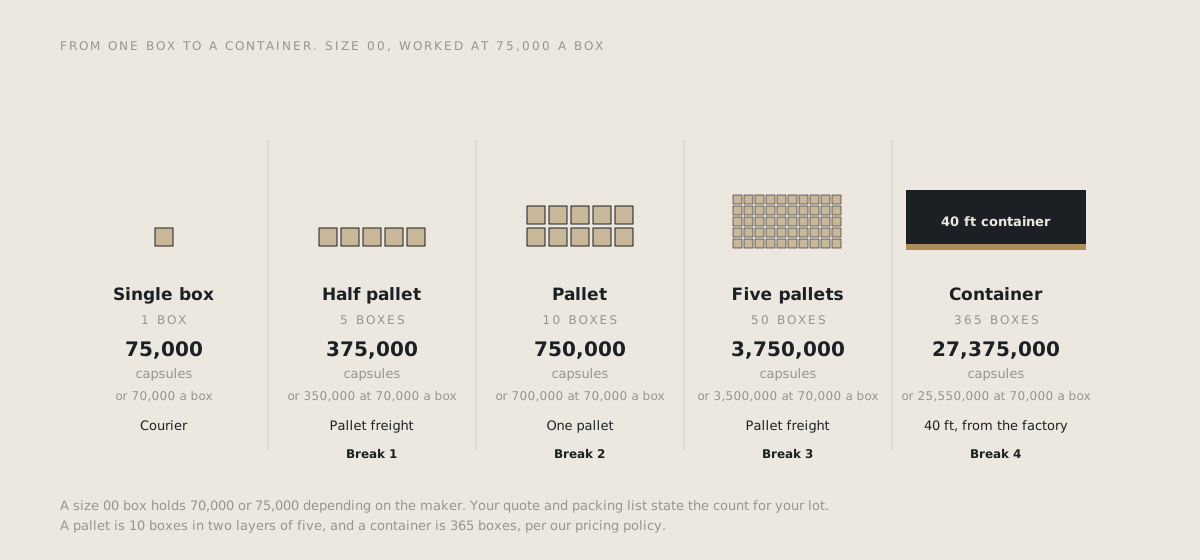
A box of size 00 holds 75,000 capsules, a box of size 0 holds 100,000, a pallet holds 10 boxes, and a 40 foot container holds 365 boxes floor-loaded. Smaller capsule sizes pack more to the box, because the carton is the same carton whatever size is inside it, and the count for each size is on its product page.
Table 1. Capsules per box, pallet, and container for the two most common sizes. Box counts are our packaging. The pallet is 10 boxes, two layers of five, and is the same in the UK and the US.
| Size | Per box | Half pallet (5 boxes) | Pallet (10 boxes) | Five pallets (50 boxes) | Container (365 boxes) |
|---|---|---|---|---|---|
| 00 | 75,000 | 375,000 | 750,000 | 3,750,000 | 27,375,000 |
| 0 | 100,000 | 500,000 | 1,000,000 | 5,000,000 | 36,500,000 |
Swipe across to see every column.
The reason to know the pallet count is that the pallet is where freight changes. Up to four boxes travel by courier, in cartons, at a courier rate. Five boxes is the first order that goes as pallet freight, and from there the cost of moving a box falls with every box you add to the pallet, until the pallet is full and the next saving is a second pallet.
A box of 75,000 size 00 capsules holds about 9 kg of gelatin capsules or 10 kg of HPMC, roughly 20 to 22 lb before the carton, so a pallet of ten is about 100 kg plus the pallet. Capsules are light and bulky, which is why they're priced per thousand and shipped by volume rather than by weight.
Where do the volume breaks fall?
At the points where the cost of moving the order changes. Ours fall at 5 boxes (a half pallet), 10 boxes (a pallet), 50 boxes (five pallets), and 365 boxes (a container), and each break earns a lower price per 1,000 than the one before it. Up to 4 boxes is the single-box price. The prices at each break are on the ladder in the portal.
Table 2. The single-box price and the four breaks, and what moves at each one.
| Order | Boxes of one product | How it ships | What changes |
|---|---|---|---|
| Single box | 1 to 4 | Courier, in cartons | The single-box price. Nothing to earn yet |
| Half pallet | 5 | Pallet freight | First pallet-freight order. First break |
| Pallet | 10 | One pallet | The pallet is full. Second break |
| Five pallets | 50 | Pallet freight, multiple pallets | Third break |
| Container | 365 | 40 foot container, direct from the factory | Fourth break. Factory economics, not warehouse economics |
Swipe across to see every column.
The break is earned by the number of boxes of one product on one order that ships. Five boxes of 00 gelatin earns the half-pallet price. Three boxes of gelatin and two of HPMC is two products at the single-box price, because the two products are two different lines in two different cartons. A customer who takes a pallet every quarter pays the pallet price on each of them. A customer who commits to five pallets over the year and calls them off one at a time pays the pallet price, not the five-pallet price, because five pallets never shipped together. Committing to a volume and calling it off is a contract conversation, and it's covered under blanket orders below.
Why not sum the boxes across products on one order? Because the saving at each break is real. It comes from filling a pallet, and a pallet that's half gelatin and half HPMC is still one pallet, but the two products were bought from the factory, shipped, and stored as two lines with two costs, and the break tracks the cost of the line. Suppliers who offer a break on the total order value are pricing something else, usually the size of the relationship, and there's nothing wrong with that. Ours tracks the boxes of one product.
Beyond the container there's one more layer, an annual rebate for customers taking several containers a year, and that's a conversation with the founders rather than a rule on a page.
Why did the price of empty capsules move?
Because the landed cost moved. The single-box price is computed from what the capsules on the shelf cost to land, meaning the factory price, ocean freight, duty, brokerage, and insurance, and when a new batch is received at a different landed cost the single-box price moves with it, down as well as up.
That's a different rule from the one most buyers are used to, which is a price list that holds until the supplier decides to raise it and then jumps. Under ours, an open quote keeps the price it was issued at for its 30 days, and any new quote reflects the cost of the inventory it'll be filled from. When freight falls, the price falls. When a tariff lands, the price rises by what the tariff added and no more (here's why capsule prices moved in 2025 and 2026). The factory price of a capsule has been stable for over a year at the time of writing; what moves is freight and duty, by small percentages.
For a buyer who needs a price that holds, the answer is a blanket order, covered below, which fixes the price for a term. For a buyer who's happy to track the market, the moving book price means you're never paying last quarter's freight on this quarter's capsules.
Finance will ask how the price will hold or how it will move. The price tracks landed cost with no threshold below which a change is ignored, and a contract fixes it for 12 months with a re-opener at 5%. Put those in the vendor file and the question is answered before the annual review.
What does a pallet of capsules tie up in cash?
At the illustrative $5.00 per 1,000, a pallet of size 00 is 750,000 capsules and $3,750 of inventory. Five pallets is 3,750,000 capsules and $18,750. A container is about 27.4 million capsules and $137,000. Set against most other things in a supplement or pharmaceutical bill of materials, empty capsules are a small line, and the cash they tie up is usually a question of order pattern rather than of price.
Here's the arithmetic for a brand filling 2 million size 00 capsules a month, which is a mid-sized contract manufacturing line or a brand with a few strong products.
Table 3. Order pattern against cash and cover, at 2 million 00 capsules a month and an illustrative $5.00 per 1,000. Weeks of cover is how long one order lasts at that usage.
| Order pattern | Capsules per order | Weeks of cover | Orders per year | Cash per order | Price break earned |
|---|---|---|---|---|---|
| 4 boxes by courier | 300,000 | 0.65 | 80 | $1,500 | Single box |
| Half pallet | 375,000 | 0.8 | 64 | $1,875 | First |
| Pallet | 750,000 | 1.6 | 32 | $3,750 | Second |
| Five pallets | 3,750,000 | 8.1 | 6.4 | $18,750 | Third |
| Container | 27,375,000 | 59 | 0.9 | $136,875 | Fourth |
Swipe across to see every column.
At 2 million a month a pallet lasts 11 days, so a pallet-at-a-time buyer is placing 32 orders a year and receiving a delivery every 11 days, which is a lot of goods-in paperwork for a small saving. Five pallets every 8 weeks is the natural cadence. The order is $18,750, the shelf holds 2 months of capsules at most, and there are six or seven deliveries a year. A container is a year's supply and $137,000 sitting in a warehouse, which is the wrong answer for this buyer unless the price at the container break is worth carrying a year of inventory, and for most it isn't. For this buyer the better route to container economics is a blanket order, which gets the committed-volume price without the warehouse.
The same table for a founder at 20,000 capsules a month reads differently. One box is about 4 months of cover, so the founder buys a box by courier, reorders when the box is half gone, and doesn't think about pallets until the product is doing ten times the volume. Both answers come from the same arithmetic, and the calculator below runs it for your numbers.

How many weeks of capsules should I hold?
Enough to cover the supplier's lead time plus a buffer, and no more than you have to. If your supplier ships from inventory in a week, holding 3 or 4 weeks of capsules covers a late truck and a busy week on the line. If your supplier is bringing your size in from the factory, the lead time is measured in months and the buffer has to cover it.
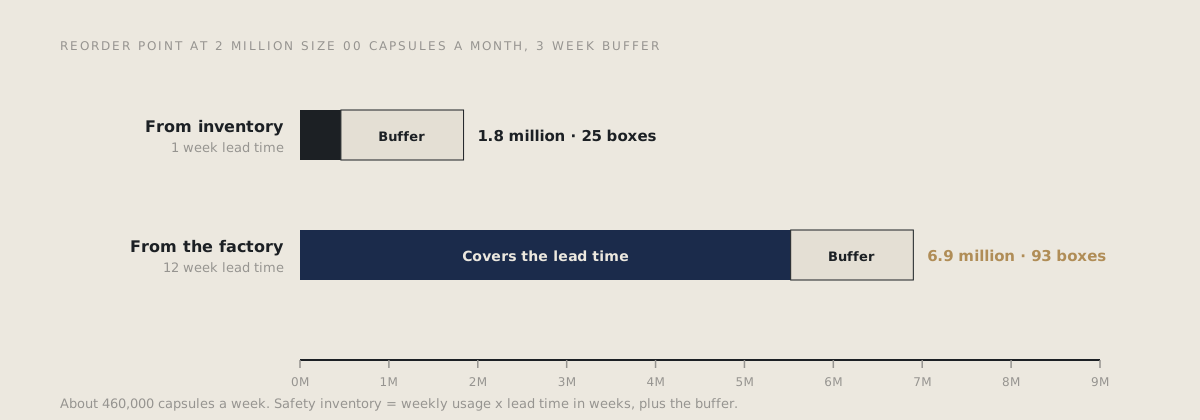
The working rule is safety inventory equals weekly usage multiplied by lead time in weeks, plus 2 to 4 weeks. At 2 million a month, which is about 460,000 a week, a 1 week lead time from inventory with a 3 week buffer means holding about 1.8 million capsules, or 25 boxes of 00, as the floor below which you reorder. A 12 week factory lead time with the same buffer means holding 6.9 million, which is 93 boxes, a little over nine pallets, and that's before the order itself arrives. The difference between those two numbers is the working-capital argument for a supplier who holds inventory in your country in the sizes you run.
A single product that's the whole business, where a stopped line is a stopped company, wants a wider buffer, and so does a size or color that isn't a standard item anywhere, because the factory makes it to order and the lead time is the factory's rather than the supplier's. A supplier who'll hold safety inventory on your behalf and let you call it off as you need it, which is what a blanket order is for, brings the number down. So does a second approved source, because the day the first one fails you're not starting from zero.
What's the lead time on empty capsules?
Days from inventory, months from the factory. A standard size and material held in a supplier's warehouse in your country ships when the order is placed and arrives when the courier or the pallet carrier delivers, which in the UK and the mainland US is 1 to 3 working days for courier and about a week for a pallet. A size, color, or material the supplier has to bring in from the factory is a production slot plus ocean freight plus customs, and that's 10 to 16 weeks from most capsule factories to a UK or US warehouse.
The lead time you should plan around is the factory one, even if you buy from inventory, because inventory runs out. A supplier who says "in stock" is telling you about today. Ask two more questions. How much do you hold in this size, in boxes, and how often does it turn? The answers tell you whether the shelf will still have your size on it the week your own inventory runs low, and a supplier who answers in boxes and weeks rather than adjectives is one you can plan around.
We don't state inventory position on this page, because it changes daily. A logged-in account sees availability in the portal, and a reply to any email from us gets an answer in boxes the same working day.

How does a blanket order for capsules work?
You commit to a volume over a term, the price is fixed for that term, and you call the capsules off as you need them. The supplier plans production and inventory against your commitment, you get a price that reflects the whole volume without taking delivery of it at once, and both sides get a year without renegotiating.
Ours runs for up to 12 months against a committed volume. The price per 1,000 is negotiated against the volume, the size of each call-off, and the inventory we carry to hold it, and it's written into the order. It's normally not as low as the price the whole volume would earn if it shipped as one order, because it's a year of inventory and freight spread out rather than one container landed once, and the difference is the cost of not having to warehouse a year of capsules yourself.
Three protections are written into every one of ours. First, the price re-opens if landed cost or the exchange rate moves by more than 5% in either direction, so neither side is stuck with a price the market has left behind. Second, if you take less than the committed volume over the term, the shortfall is re-priced at the break your actual volume reached, which is the same price you'd have paid ordering as you went. Third, any inventory bought specifically to cover your commitment is yours to take at the end of the term.
A blanket order is the right instrument when your annual volume is a container or more but your warehouse and your cash can't carry a container. It's also the right instrument when you need a price that holds for a budget year, because the moving book price above is the alternative and some finance teams would rather have a fixed number. If your volume is a few pallets a year, ordering as you go at the pallet price is simpler and costs about the same.
What payment terms should I expect from a capsule supplier?
Payment up front on a first order, and an account with terms once you've traded. That's the pattern across the trade. A first order from a new customer is paid by card or against a pro forma invoice before it ships. After the first orders have been paid on time, the supplier runs a credit check and opens an account, commonly at net 30, and the account terms are written down. Larger accounts negotiate further.
Onboarding runs the other way too. Your finance team will want us on your vendor list before a purchase order can be raised, and a vendor form usually asks for the company registration, the registered address, a bank letter or bank details on letterhead, a tax number (a VAT number in the UK, a W-9 in the US), an insurance certificate, and a specimen certificate of analysis and specification for the product. We hold all of those and send them on request. Capsules Direct Ltd is a company incorporated in 2026, so a credit agency will show a short history, and where the vendor form asks for filed accounts we supply management accounts and the founders' details instead. Say so to your finance team before they run the check, and the check goes through faster.
What a certificate of analysis and a specification contain, and what the quality team will ask for beyond them, is the subject of its own article.
How do I set up a second source for empty capsules?
Buy a box, run it, file the paperwork, and keep the supplier on the approved list before you need them. The one that works is a supplier whose capsules have been through your machine and whose documents are already in your quality system on the day the incumbent's lot fails.
The cost of doing that with us is one box. A sample is a single box at the single-box price, paid up front, and its value is credited against your first production order of the same product, so if the trial works the box was free. One sample box per product per account, and anything beyond that goes through the sales team. There's no separate free sample, so the box is the sample, and if you want to check the fit by hand first, take a few hundred capsules out of it before it goes near the hopper. The box arrives with its certificate of analysis, and the specification, allergen statement, and the rest of the approval documents come with it or on request.
The supplier approval article walks through the questionnaire to send a capsule supplier, the documents, and change control. Switching capsule supplier without stopping the line is for the week you actually have to move, and it covers running the new capsule alongside the old one, what to check on the machine, and how to handle the changeover without stopping the line.
Where are empty capsules made, and what do tariffs do to the price?
Most of the world's empty hard capsules are made in a small number of large factories in Asia, Europe, and North America, and the capsule you buy from a UK or US supplier has usually crossed an ocean to get there. Where a given capsule was made is on its certificate of analysis and its specification, and a supplier should be able to tell you the country of origin without being pressed.
Tariffs are one of the five parts of landed cost (factory price, ocean freight, duty, brokerage, and insurance), and duty depends on the country of origin and the tariff schedule of the day (the provenance article sets out the US import duty on empty capsules). Tariff rates have moved a good deal in recent years, and they're different in the UK and the US for the same capsule. Under a moving book price, a tariff change shows up in the price of the next batch received and nowhere else. Under a blanket order, a move of more than 5% in landed cost triggers the re-opener. Either way the tariff is visible and traceable, which is what a finance team wants to know. How capsules are made, where, and what provenance means for the paperwork are covered in the same article.
What goes in a request for quotation for empty capsules?
Size, material, color, annual volume, the order pattern you expect, the documents you need, and the terms you're asking for. A quote request that has those seven things gets a quote back the same day, in your unit, that can be compared with the next one. A request that says "please quote 00 capsules" gets a question back instead of a price.
Written out, the RFQ asks for a price per 1,000 for each size and material, at the order quantities you expect to place, with the box count stated so the per-box figure can be checked. It asks for the lead time from inventory and from the factory, separately. It asks for the documents that ship with a lot and the ones available on request, by name, so the quality team can see them before the box arrives. It asks for payment terms on a first order and on an account. It asks what the supplier will do for a committed annual volume, and on what terms. And it states the country the goods are going to, so that freight and duty are in the quote or clearly excluded from it. Ours are quoted ex works with shipping charged separately, and the quote says so.
The prompt pack below writes that RFQ for you from your own volumes, and it works for any supplier. We'd rather you sent the same request to three suppliers and compared the answers than sent a vague one to us alone.
What is an AI prompt pack?
An AI prompt pack is a small set of files you load into the AI assistant you already use. The assistant then asks you the right questions about your buying, works through them with you using our reference data, and shows its working as it goes. We publish one with each article.
Inside the Capsule Buying Brief AI Prompt Pack is a prompt file that turns your assistant (Claude, ChatGPT, Gemini, Grok) into a buying analyst, a workbook it fills in as you go, and a short reference sheet with the box counts and the arithmetic from this page. Paste the prompt in and it asks about your sizes and materials, your monthly or annual volume by product, how the line is fed, your supplier's lead time, and what you're paying now. It gives you back the order pattern that fits your volume (box, pallet, five pallets, or a contract), the safety inventory to hold and the reorder point, a per-1,000 comparison of up to three supplier quotes converted to the same unit with freight and duty included, and a request for quotation you can send to any supplier as it stands.
Why a pack and not just the calculator? Because the calculator does the cadence arithmetic for one size, and the pack does it for your whole catalog, then writes the RFQ and the second-source plan. It works for the founder ordering a first box who has never seen a capsule quote and wants to know what to ask, and it works for the purchasing manager with six sizes across two materials who wants the order plan and the working-capital number in a form finance will accept. It's the conversation we'd have with you on a call, packaged so you can have it at your desk with your own volumes in front of you.
Use the form below to request this resource. Newsletter updates are a separate, optional choice.
Get the Capsule Buying Brief AI Prompt Pack
Request the Capsule Buying Brief AI Prompt Pack
Leave your details to request this resource.
If we haven't answered your question, or your buying doesn't fit the pattern on this page, reply to any email from us or write to us through the contact page. A person who has bought and sold capsules by the container will get back to you.
Related.
- How empty capsules are made, and where they come from
- Switching capsule supplier without stopping the line
- How to qualify an empty capsule supplier
- What a certificate of analysis and a specification contain
- Gelatin vs HPMC capsules. Which to use, and why
- Capsule sizes, volumes, and fill weights
Sources. Box counts, pallet build, container load, price breaks, the landed-cost rule, blanket order terms, and sample terms are our own commercial terms as published in the Capsules.com pricing policy, September 2026, with prices withheld on this page and shown in the customer portal. Shell weight used in the box weight estimate from the capsule makers' technical literature, as compiled on the capsule sizes page. Courier and pallet transit times are carrier-published UK and mainland US standards. The factory lead time range is our own experience of ocean freight from Asian capsule factories to UK and US warehouses and is stated as a range. Vendor onboarding document list is the common content of UK and US supplier setup forms. Company registration, Companies House record for Capsules Direct Ltd, 17362490. Ex works as defined in the ICC Incoterms rules.
*Capsules.com supplies empty hard capsules in gelatin and HPMC to manufacturers, brands, pharmacies, and research teams. Capsules Direct Ltd, company number 17362490, 26 Rowood House, Bicester OX26 4PP, United Kingdom. UK 020 3905 1989 · US (816) 445-0042 · capsules.com. *