
Compounding
Capsules for compounding. Size for the dose, weights that pass, and the paperwork behind the shell
Work through capsule sizing, plate technique, fill-weight checks, material choice, and the paperwork behind the empty shell.
Written by G. Spooner, COO and RP/QA Lead, Capsules.com
On this page
A compounding technician might fill a hundred capsules of one strength before lunch and two hundred of another after, on a plate, by hand, with a prescription behind each batch and a pharmacist's signature on the record. The capsule shell is the one part of that job that arrives finished. It still has to be the right size for the dose, it still has to close and lock on a plate, the weights still have to pass, and the shell's lot number and expiry still have to be on the compounding record.
It answers the questions in the order they come up at the bench. Which size for this dose, and how much diluent. Punch or plate, and how to get even weights on a plate. What weight check the rules ask for and what passes it. Gelatin or HPMC, and whether a different color per strength is a good idea. Then the paperwork, in the US under USP <795> and in the UK under the General Pharmaceutical Council (GPhC) guidance and the MHRA specials rules, and how the shell's expiry date bears on the beyond-use date. It closes with how pharmacies buy capsules, which fillers take which capsules, and a note on veterinary sizes.
One position up front. In the published studies of compounded capsules that fail a weight or content test, the shell is rarely the reason. Blend homogeneity, filling by volume instead of by weight, and technique on the plate are. So most of the practical advice below is about the powder and the hands, and the part about the shell is about choosing the right one and recording it properly.
- Which capsule size do I need for this dose? Volume times density. The size table, and why the same size holds 300 mg of one powder and 600 mg of another.
- How much diluent do I add, and how do I work it out? The pack stat method, the weigh-and-fill method, and the overage.
- Should I fill by weight or by volume? By weight, when the dose is small. What the hospital studies found.
- Punch method or plate machine? Punch for a few capsules and tight weights. Plate for a hundred. What a 67-student study showed.
- How do I get even weights on a plate? Spread, don't push. Same taps every cycle. Weigh the edges as well as the middle.
- What weight check do I have to do, and what passes? USP <1163> in the US, Ph. Eur. 2.9.5 in the UK. One table with both.
- Gelatin or HPMC for compounding? Both work. HPMC for vegetarian requests and moisture-sensitive fills. What the static evidence says.
- Can I use a different capsule color for each strength? Yes, with the label still doing the work. How to pick a palette.
- What does USP <795> need from my capsule supplier? "Should" be FDA-registered, a certificate of analysis (CoA), six receipt fields, and the shell lot on every compounding record.
- What does a UK pharmacy or specials manufacturer need? GPhC record fields, TSE compliance for gelatin, pharmacopoeial grade, and what an MS holder asks on top.
- How does the capsule shell affect my beyond-use date? The 180-day limit, the shortest-component rule, and a 5-year shell.
- Do I have to buy a full box, and will it fit my filler? Why the box is the natural unit for a working pharmacy. Which fillers take joined capsules.
- What about veterinary capsules? Sizes for cats and dogs, and the labeling and record rules.
- What we measured. Our 100-capsule plate uniformity run, when it's done.
- Capsule size and weight-check tool. Enter the dose and density, get the size and diluent. Paste your weights, get pass or fail under both rules.
- The free AI prompt pack. Load it into ChatGPT, Claude, or Gemini and it sizes the capsule, writes the component lines of your record, and checks your weights with you.
One note before the numbers. The rules quoted here are from USP <795> as revised in November 2023, USP <1163>, Ph. Eur. 2.9.5 and monograph 0016, the GPhC's 2018 guidance, and the MHRA's guidance for specials manufacturers, and each is labeled where it appears. Regulations move, and your board of pharmacy, the GPhC, or your own quality contact has the last word for your pharmacy. Nothing here is advice about what any capsule's contents do for a patient. The shell is an object, and this page treats it as one.
Which capsule size do I need for this dose?
The size that holds the dose at the powder's packed density with a little room to spare, and no bigger. A capsule's number tells you nothing about its capacity in milligrams. It tells you its volume, and the milligrams follow from the density of what you put in it.
Table 1. Standard capsule sizes, volumes, and the fill weight each holds at three densities. Volumes are the nominal figures published by the makers. Makers disagree by a few hundredths of a milliliter, and size 00 is quoted anywhere from 0.90 to 0.95 mL. Fill weights are volume times density and assume the capsule body is filled level, which is what a plate does. The dimensions and the full working are in capsule dimensions by size.
| Size | Volume (mL) | Fill at 0.5 g/mL (mg) | Fill at 0.7 g/mL (mg) | Fill at 1.0 g/mL (mg) | Where you see it in a pharmacy |
|---|---|---|---|---|---|
| 000 | 1.37 | 685 | 960 | 1,370 | Large dogs, bulky fills. Too big for most patients to swallow |
| 00 | 0.90 to 0.95 | 450 to 475 | 630 to 665 | 900 to 950 | Big doses, veterinary |
| 0 | 0.68 | 340 | 475 | 680 | The most common adult size |
| 1 | 0.48 to 0.50 | 240 to 250 | 335 to 350 | 480 to 500 | Adult, most fills |
| 2 | 0.37 | 185 | 260 | 370 | Adult, small doses |
| 3 | 0.30 | 150 | 210 | 300 | Small adult, pediatric, cats and small dogs |
| 4 | 0.20 to 0.21 | 100 to 105 | 140 to 147 | 200 to 210 | Pediatric, cats and small dogs |
| 5 | 0.13 | 65 | 91 | 130 | The smallest. Low-dose pediatric and veterinary |
Swipe across to see every column.
The density that matters is the density of the powder as it sits in the capsule after your filling method, which for a plate is somewhere between bulk density (poured) and tapped density (settled). Lactose monohydrate sits around 0.55 to 0.6 g/mL bulk, microcrystalline cellulose around 0.3 to 0.4, and mannitol around 0.5, so a size 1 holds roughly 250 to 300 mg of any of them poured and level, and a little more once tapped. A dense inorganic like calcium carbonate or magnesium oxide can double that. The old teaching rule, the "rule of sixes" published in 1997, assumed a powder density of about 0.6 g/mL and gave a size 0 about 390 mg and a size 1 about 325 mg. The rule is a fair first guess for a typical organic powder and wrong for anything dense or fluffy, which is why compounders moved to measuring.
Pick the size from the patient, not just the arithmetic. If a dose fits in a size 2 and the patient is a child or an older adult who struggles with capsules, a size 3 with less diluent is the better answer, and if the dose fits in a size 3 with room to spare, a size 4 with no diluent at all is better still. The WHO's view is that children under about six generally can't manage a capsule swallowed whole, and the EMA's pediatric formulation guideline says the data on which sizes older children accept is thin, so pediatric compounders tend to use the smallest size the dose allows and expect the capsule to be opened. For animals, a compounding pharmacy's own guide puts size 4 as the working size for cats and small dogs and 00 or 000 for a large dog, and the veterinary section below has the rest.
How much diluent do I add, and how do I work it out?
Enough to fill the chosen capsule level after the active is in it, worked out by weight from a measured capacity, not guessed from a chart. There are two ways to get the number and both start with the same question, which is how much of your powder this capsule actually holds.
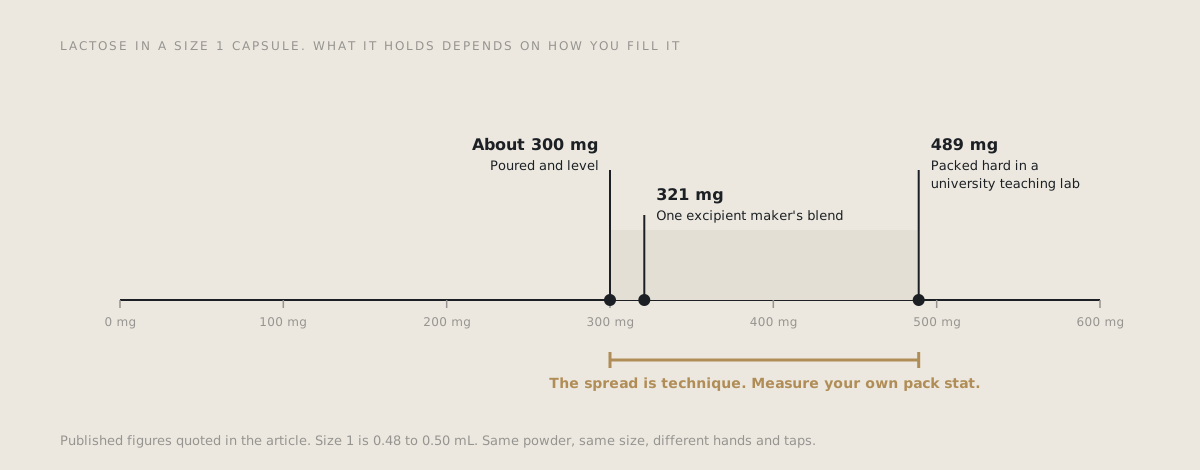
The first way is the pack stat. Fill 10 or 20 capsules of the chosen size with your diluent alone, using the method you'll use for the batch (punch, or plate with your usual taps), weigh them, subtract the empty shell weight, and take the mean. That mean is the capsule's capacity for that diluent under your technique. For lactose in a size 1 the published figures run from about 300 mg poured and level to 489 mg packed hard in a university teaching lab, and one compounding-excipient maker publishes 321 mg for its own blend in a size 1. The spread between those figures is your technique, which is why you measure it. If you change the diluent, the size, the machine, or the number of taps, the pack stat changes, so measure it again. The Fagron Academy teaches this as the core capsule calculation, and it's the number the tool at the foot of the page asks you for.
Once you have the pack stat, the diluent per capsule is the pack stat minus the active per capsule, adjusted for the active's density if it's very different from the diluent's. For a small dose the adjustment is negligible and most pharmacies ignore it. For a dose that's a third or more of the fill, the German DAC/NRF method handles the difference by measuring the bulk and tapped density of the whole blend and taking a weighted average, three parts bulk to one part tapped, times the capsule volume.
The second way is older and needs no density at all. Weigh out the active for one capsule, put it in a body of the chosen size, weigh, then fill the body level with diluent and weigh again. The difference is the diluent for one capsule, and you multiply by the batch. This is the method in the standard American compounding texts and it works because it measures the real capsule with the real powders. Its weakness is that one capsule is a small sample, so do three and average them.
Then add an overage. Powder is lost on the plate, in the mortar, and on the spatula, and a batch of 100 that comes up 4 capsules short is a batch you have to make again. The teaching rule is 5% to 10% extra of the whole blend. The DAC/NRF method suggests a 10% overage on the active and sets a 3% limit on total mass loss during filling, and in a published test of that method the microcrystalline cellulose batches lost up to 7% and the mannitol batches with the smallest dose lost nearly 11%. Weigh what's left on the plate at the end of a batch once, and you'll know your own loss figure.
Two habits make the diluent step reliable. Reduce the active and the diluent to the same particle size in the mortar before mixing, and mix by geometric dilution, doubling the mass each time, so a 20 mg active in a 300 mg fill ends up in every capsule and not in half of them. For a potent active where the dose per capsule is below what your balance can weigh, make a trituration first, 1 part active to 9 or 99 parts diluent, and weigh an aliquot of that. A flow aid helps a sticky or static-prone blend, and the compounding suppliers sell capsule bases with the flow aid already in, but keep magnesium stearate below about 1% because it's hydrophobic and can slow the capsule's contents dissolving.
Should I fill by weight or by volume?
By weight, and the smaller the dose the more that matters. Filling by volume means spreading the blend on the plate and letting the capsules take what they take. Filling by weight means calculating the blend from a measured pack stat and checking capsules against a target as you go. The two sound similar and give different results.
A hospital pharmacy team tested the two head to head on spironolactone 10 mg capsules, six batches each way. The weight-based method was better on content homogeneity, total weight homogeneity, batch reproducibility, and batch conformity, and the volume-based method showed a trend to under-weighing the excipient. A Finnish hospital study on low-dose nifedipine capsules in sizes 3 and 4 found the same direction. Both methods passed uniformity of mass, but the gravimetric method gave better capsules, at the cost of more powder lost during preparation.
The failures in the literature cluster where the dose is small. A German group tested 56 real batches of pediatric hydrocortisone capsules from pharmacies, 1,125 capsules in all, and found 21% of the batches failed uniformity of net mass or drug content, with a further 4% not containing the labeled drug at all. A 1994 study of captopril 1 mg capsules made from crushed tablets on a hand-operated filler passed the weight variation test and still had a 24.5% coefficient of variation on content, because the weights were even and the blend wasn't. Two veterinary studies of compounded lomustine capsules found potency from 50% to 115% of label across the pharmacies sampled, and 59% to 95% in the other, against 90% to 110% for the licensed product. Those authors concluded that even weights are necessary and not sufficient, and that homogeneity of the blend is the harder half.
Where the dose is large, the picture is kinder. A 2022 validation of 20 identical 24-hole plate machines, filling 81 mg acetaminophen in lactose, put every machine through the USP content uniformity test and every one passed, with a mean of 98.9% of label. Aspirin capsules at 40 mg and 10 mg held potency within a few percent; at 1 mg the spread widened to 7%. Small errors in technique cost a large fill very little and a very small fill a lot, which is one reason to prefer crushed tablets over pure powder for a very low dose, since the tablet excipient bulks the fill and reduces the variability.
Punch method or plate machine?
Punch for a handful of capsules where each weight has to be right, and a plate for a batch of 50 to 300. The punch method is slow and accurate. The plate is fast and only as accurate as the hands and the powder.
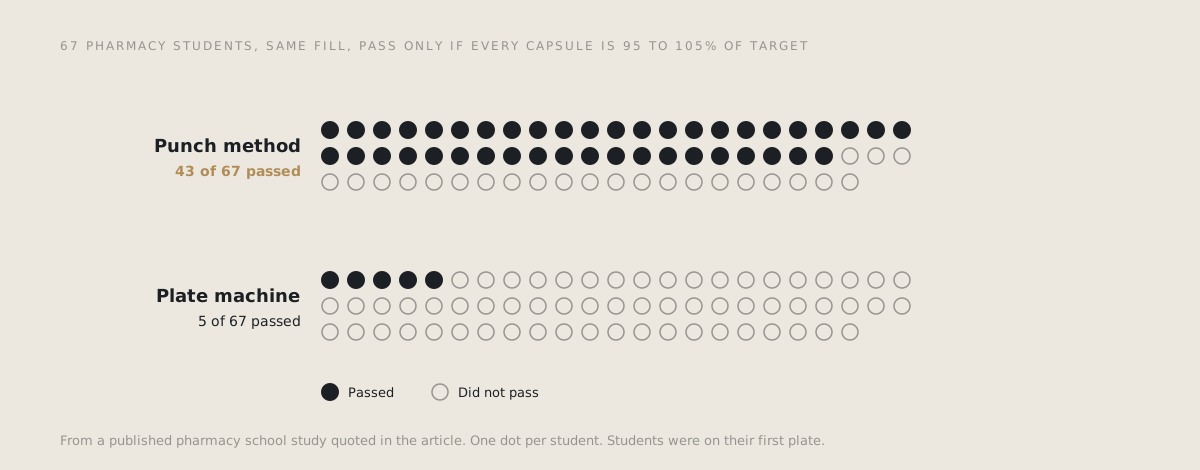
In the punch method you spread the blend on a clean surface to a depth of about a third to a half of the capsule body's length, hold the body upright, and press it into the powder with a slight twist until it's full and you feel the resistance. You weigh each one against an empty capsule as the tare, add or take out powder, tap it so no air pocket shows, and put the cap on. The method is slow, and the weights don't drift. A pharmacy school study set 67 students the same job, 81 mg aspirin capsules, by punch and then by a tamping plate machine, and passed a student only if every capsule landed within 95% to 105% of target. By punch, 43 of 67 passed. By machine, 5 of 67 did. Two thirds of the students preferred the punch method because they could control the weight, and those were students on their first plate.
The plate exists because a pharmacy filling 300 capsules a day can't punch them. A plate machine holds 24, 50, 100, 120, or 300 capsule bodies upright in a tray, you spread the blend across, tamp or tap it down, spread again until the bodies are full and level, then bring the caps down over all of them at once and lock. Throughput on a 100-hole plate is quoted by one maker at 2,000 to 3,200 capsules an hour, and 4,500 to 6,900 on a 300-hole. The trade is that the plate fills every capsule the same way, so a mistake in the spreading or the tapping is a mistake in a hundred capsules, and the studies above show how easily that happens.
So the working answer in a pharmacy is both. Punch for the one-off prescription of 10 or 20 capsules, for a potent low-dose active where each capsule matters, and for checking a plate batch by hand. Plate for anything repeated, with the pack stat measured on that plate, the weights sampled during the run, and the technique below.
How do I get even weights on a plate?
Spread the powder and let it fall in, don't push it, tap the plate the same number of times every cycle, and weigh capsules from the edge of the plate as well as the middle. Those three habits fix most of the variation that shows up in a plate batch.
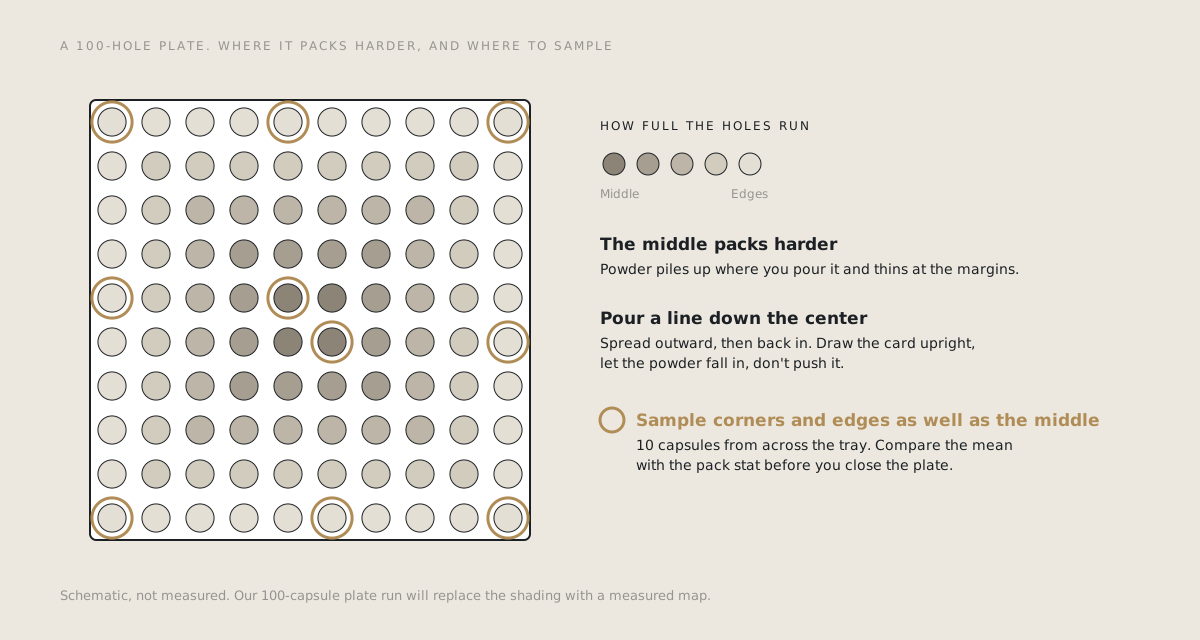
The first habit is about the scraper. Hold the leveling card or scraper upright and draw it across so the powder falls into the bodies under its own weight. Pushing powder down into the bodies with the card packs the ones under your hand harder than the ones ahead of it, and one pharmacy training course names this as the main cause of inconsistent quantities on a plate. The same goes for the tamper if you use one. The same number of strokes and the same pressure each pass, across the whole tray.
The second habit is about where the powder ends up. A plate tends to pack the capsules in the middle harder than the ones round the edge, because the powder piles up where you pour it and thins at the margins. One university compounding lab notes this directly. Pour in a line down the center and spread outward, then spread back in, and when you sample for the weight check take capsules from the corners and the edges, not the easy ones in the middle.
The third habit is to measure, not assume. Fill your first plate, weigh 10 capsules from across the tray, and compare the mean to the pack stat you measured. If the batch is running light, add a tap and spread again before you close. If it's running heavy, you've packed it harder than when you measured the pack stat, and the diluent calculation was for a lighter fill. One machine maker says it plainly on its data sheet. Because the filling is manual, results vary with the user, the powder, the number of tamps, and the vibration, and the numbers you get are yours.
Two environmental things matter. Relative humidity in the room between about 40% and 60% is where gelatin and HPMC shells both behave, close cleanly, and don't crack or cling. Below that, gelatin dries and splits when the caps go on, and static makes both materials cling to the plate and to each other. The suppliers' fixes for static are to raise room humidity a little within that band, use an anti-static excipient blend or weigh boat, and keep a grounded metal spatula handy. The full humidity story is in what happens to capsules in a dry room. And clean the plate between strengths. Powder in the join between cap and body is the usual reason a cap won't lock, and powder from the last strength in this batch is a cross-contamination finding.
After closing, roll the capsules in a clean cloth to take the dust off, or roll them in salt or sugar and sieve, then lay them on white paper and look for leakers before you count them into the bottle. The old texts all say this and it still catches the capsule that didn't lock.
What weight check do I have to do, and what passes?
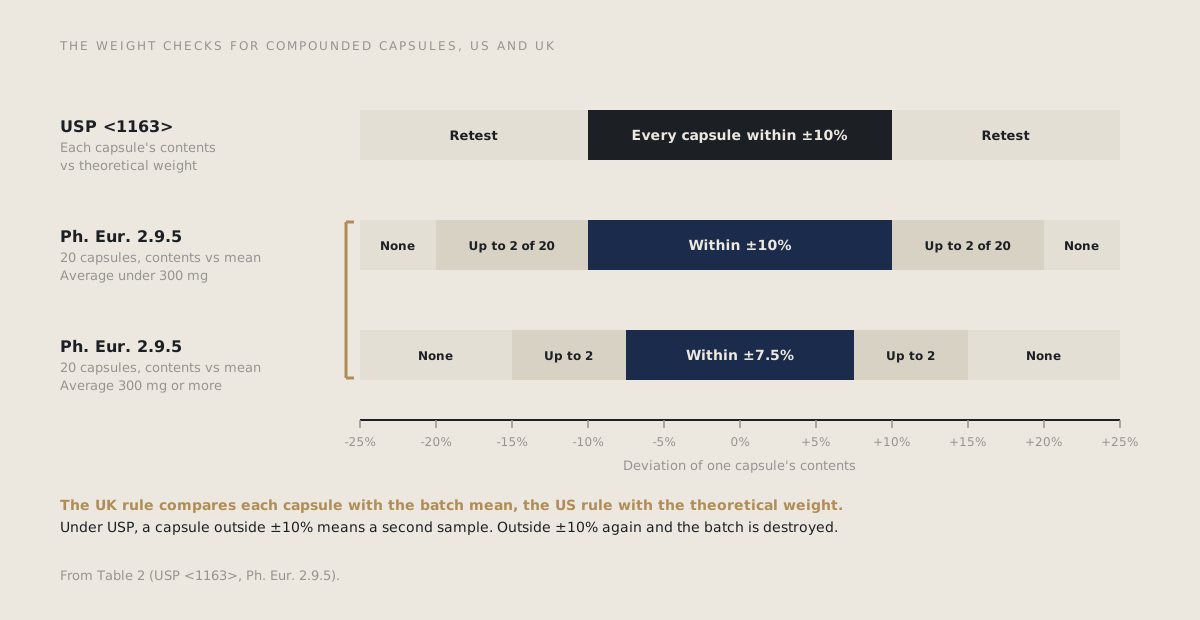
In the US, weigh a sample of finished capsules and compare each capsule's contents to the theoretical content weight; any capsule outside ±10% triggers a bigger sample, and a failure in the second sample means the batch is destroyed. In the UK, weigh 20 capsules' contents and apply the pharmacopoeial uniformity of mass limits. Both rules are in the table, with the citations, because they're not the same and people quote them as if they were.
Table 2. The weight checks for compounded capsules, US and UK. Quoted from USP <1163> Quality Assurance in Pharmaceutical Compounding and Ph. Eur. 2.9.5 Uniformity of Mass of Single-Dose Preparations (the same text is BP Appendix XII C1). The old USP <795> sentence is included because several state rules still carry it.
| Rule | Who it applies to | Sample | Limit | If it fails |
|---|---|---|---|---|
| USP <1163> weight assessment, hard capsules | US compounders; <795> refers QC to <1163>, and accredited pharmacies are surveyed against the quality control declared in their own Master Formulation Record (MFR) | A representative sample, "a minimum of 5% of total capsules or 10 individual capsules, whichever is less." Tare with an empty capsule and compare each capsule's contents to the theoretical content weight | No capsule's contents deviate more than ±10% from theoretical | Review the record for omitted steps, then retest "10% of total capsules or 20 individual capsules, whichever is less," not mixed with the first sample. A ±10% deviation in the second sample and "destroy the batch" |
| Old USP <795> sentence (pre-2019 text), still in Texas 22 TAC 291.131 and quoted in several university lab manuals | Where a state rule retains it | Each unit | Each capsule "not less than 90% and not more than 110% of the theoretically calculated weight" | Adjust and reweigh (punch), or reject |
| Ph. Eur. 2.9.5 uniformity of mass, capsules | UK and EU pharmacies preparing to a BP or Ph. Eur. general monograph; MS licence holders; the Australian default standard | 20 capsules. Weigh each intact, empty it, weigh the shell; contents are the difference | Average contents under 300 mg, no more than 2 of 20 deviate from the mean by more than 10%, none by more than 20%. Average 300 mg or more, no more than 2 beyond 7.5%, none beyond 15% | The batch does not comply |
| USP <905> and Ph. Eur. 2.9.40 uniformity of dosage units | Licensed manufactured products, and any pharmacy that adopts them; hospital studies use them | 10 units, then 20 more | Acceptance value not more than 15.0 | Second stage of 20, then fail |
Swipe across to see every column.
Three things about the US rule are worth knowing. USP <1163> is an informational chapter, so its language is "should," and the mandatory part sits in <795>, which requires the Master Formulation Record to state the QC procedures and expected results and the Compounding Record to hold the results. In practice the weight assessment above is what the MFR says for capsules, and an inspector or an accreditation surveyor checks the record against it. Second, the theoretical weight is the contents, not the whole capsule, which is why you tare with an empty shell. Third, USP posted a notice about <1163> in April 2026 that we haven't been able to read in full, so check the current text before you copy the sampling numbers into an SOP.
The UK rule is stricter on the arithmetic and gentler on the consequence. A pharmacy weighing 20 capsules with an average fill of 250 mg can have 2 of them 11% off the mean and still comply, and none may be more than 20% off. Above 300 mg the bands tighten to 7.5% and 15%. The same limits sit in the BP, and the Pharmacy Board of Australia's default standards point to the same pharmacopoeial text.
One reassurance about the shell itself. Empty gelatin shells vary in weight by up to about 10% within a lot by the makers' own tolerance, which sounds like a lot until you do the sum. A size 0 shell weighs roughly 90 to 102 mg, so the spread is about 12 mg on a filled capsule of 600 mg or so, which is 2%. Taring with one empty capsule removes most of that, and weighing contents rather than whole capsules, as the Ph. Eur. method does, removes all of it. The shell isn't where your weight variation comes from. To see where the shell's weight and its tolerance sit on the maker's paperwork, read what a capsule specification contains.
Gelatin or HPMC for compounding?
Both, and most pharmacies keep both. Gelatin is the default and the cheaper of the two. HPMC (hypromellose, the plant-derived cellulose shell) answers a vegetarian request, and a halal or kosher one without a certificate on the gelatin, and it suits a fill that doesn't like moisture. The full comparison with the measured data is in gelatin or HPMC, which should I use. The compounding-specific points are these.
A gelatin shell carries about 13% to 16% water and needs it. Below about 10% the shell goes brittle and cracks when the cap is pushed on, which is the winter problem in a dry pharmacy. An HPMC shell carries about 3% to 8% and doesn't go brittle when it dries, which is why hospital pharmacies making low-dose aspirin or other moisture-sensitive capsules have chosen it. Neither shell keeps moisture out of the fill on a shelf at high humidity; the container and a desiccant do that job, as whether the finished product needs a desiccant or foil explains.
On static the evidence points both ways. Makers describe HPMC as low in static, and a 2025 study of filled capsules found gelatin carried less charge after filling than HPMC, with the difference shrinking at 51% room humidity against 22%. What that means on a plate is that whichever material you use, the room humidity matters more than the shell, and an anti-static blend helps both. One industrial study on a tamping machine found more split caps and poorly closed capsules with size 00 HPMC than gelatin, so if you run HPMC on a plate, check the locks on the first batch by hand.
One composition point matters to some patients. Some HPMC capsules are set with a gelling agent such as carrageenan or gellan gum, and at least one pharmacy supplier's HPMC page carries a carrageenan notice for that reason. The HPMC we supply is predominantly the kind made without a gelling agent, set by heat instead, and the specification says which kind a lot is.
On paperwork the two differ in one place. Gelatin is of animal origin, so a UK pharmacy following the GPhC guidance records TSE compliance for it (TSE is transmissible spongiform encephalopathy, the family of risks that includes BSE) and an MS holder needs the TSE statement on file, and a US pharmacy asked by a patient about the source wants the bovine or porcine origin on the CoA. HPMC has no TSE question. Our gelatin is bovine, from hide or bone, and the difference between a statement and a certificate covers what the shell's paperwork lets a label say.

Can I use a different capsule color for each strength?
Yes, and it's common practice, as long as the label still identifies the strength and the color is a second check rather than the first. Nothing in USP <795> or the GPhC guidance mentions shell color. The regulators' guidance to licensed manufacturers is the nearest thing to a rule, and it cuts two ways.
The FDA's labeling design guidance for manufacturers says color may be used to "differentiate strengths within a manufacturer's product line," and warns in the same passage that people perceive colors differently, that some have color vision deficiency, that colors look different under different light, and that identifying a product by color "might replace reading the label." The MHRA's 2026 best practice guidance for licensed packs encourages "the judicious use of colour" to identify a medicine and says colour-coding as a system isn't supported; colours should be assigned to highlight strength, with look-alike names and co-prescribed medicines in mind. Neither document applies to a compounded preparation, and both describe the sensible practice for one.
For a pharmacy that means a small palette used consistently. One color per strength of a product for a patient who takes more than one strength, and the same mapping every time that patient's prescription is refilled, so the person at home learns that the 5 mg is the blue one. A body color that stays the same across the product with the cap color changing per strength keeps the inventory down, which is what several manufacturers do for the same reason. An opaque shell for an active that's light-sensitive, since a clear shell gives no light protection and an iron oxide colored one gives a good deal; whether opaque capsules protect a light-sensitive fill has the ranking. And a clear shell where the fill is meant to be seen, which for a compounded capsule usually means the pharmacist wants to check the fill.
There's a second use of color in compounding that has nothing to do with the shell. Some pharmacies add a trace of a colorant to the blend, a quarter of a milligram of riboflavin per capsule in one published account, so that uneven mixing shows as streaks before the plate is loaded. It's a mixing check, not a product feature, and it works with clear shells.
Whatever palette you choose, record the shell's color and the maker's color code on the Master Formulation Record. A color arriving as "blue" from two different lots may not be the same blue, and a patient notices. If your supplier's color range matters to you, ask for the colorant declaration with the CoA, because in the US a colorant is an ingredient the label may need to name.
What does USP <795> need from my capsule supplier?
A certificate of analysis, a lot number and an expiry date on the pack, and a supplier who can say where the shell was made, because the chapter says non-API components "should be manufactured by an FDA-registered facility." Then six things recorded on receipt, and the shell's name, supplier, lot, and expiry on every compounding record that uses it.
Table 3. What USP <795> (official 1 November 2023) asks for a capsule shell as a component. Quoted from the chapter. APIs are held to "must"; everything else, capsule shells included, to "should," and USP's own FAQ explains the difference is that the Food, Drug, and Cosmetic Act mandates the API source and the Expert Committee recognized that some other components can't be got from an FDA-registered facility.
| Section | What it says | What to ask your capsule supplier for |
|---|---|---|
| 6.2.1 Component selection | Components other than APIs "should be manufactured by an FDA-registered facility (If a component cannot be obtained from an FDA-registered facility, the designated person(s) must select a component that is suitable for the intended use.)" and should be accompanied by a CoA that verifies compliance with the USP-NF monograph, if one exists | The maker's FDA establishment registration number, or a statement that the plant is registered. A CoA for the lot |
| 6.2.2 Component receipt | "receipt date, quantity received, supplier name, lot number, expiration date, and results of any in-house or third-party testing performed" must be documented | Lot number and expiry printed on every carton and inner bag, so your receiving log can be filled from the box |
| 6.2.2 Components without an expiry | Mark the receipt date on the pack; "must not be used by the compounding facility after 3 years from the date of receipt" | An expiry date on the pack, so this rule never applies. Ours carry a 5-year shelf life on the CoA |
| 6.2.3 and 6.2.4 Evaluation and handling | Visual re-inspection before use for container damage or deviation from expected appearance; handle per manufacturer's instructions; "the lot must be examined for evidence of deterioration" at each use | The maker's storage conditions on the pack and the CoA, so "per manufacturer's instructions" has something to point at |
| Box 3 Compounding Record | "Name, vendor or manufacturer, lot number, and expiration date of each component" | Nothing extra. The point is that the shell lot goes on every compounding record, so the lot has to be legible on the inner bag, not just the outer carton |
| 14 Documentation | Retain "COAs and all documentation required for components not conventionally manufactured" and "receipt of components" | A CoA you can download as a PDF by lot, not one you have to request by email each time |
Swipe across to see every column.
Two developments change what a supplier can put on that CoA. USP has published a monograph titled Hard Gelatin Capsule Shells (in the 2024 to 2025 compendial cycle; the official date is on USP's site behind a login, so confirm it). Because both 503A and <795> key a non-API component to "the USP-NF monograph, if one exists," a compounder can now ask whether the gelatin shells conform to that monograph, and a CoA that cites it tells you more than the phrase "pharmaceutical grade" does. A Hard Hypromellose Capsule Shells monograph was proposed in 2016 and, as far as we can find, isn't official yet, so an HPMC shell is still described against the Hypromellose ingredient monograph and the maker's own specification.
The phrases "pharmaceutical grade" and "USP grade" on a capsule seller's page have no regulatory definition for a finished shell. What they can honestly rest on is three things. The gelatin or hypromellose raw material meets the NF or USP ingredient monograph, the plant is FDA-registered and operates under a GMP certificate, and now, for gelatin, the shell conforms to the shell monograph. Ask for those three and ignore the adjective. What a capsule supplier questionnaire should ask puts them in order.
If you're a 503B outsourcing facility, the bar is cGMP under 21 CFR 211 and it reaches every component. Each lot of shells is quarantined until quality control releases it, there's at least one identity test or a validated reliance on the supplier's CoA plus one specific identity test, supplier qualification is refreshed no less than every two years under FDA's draft guidance, and there's a written quality agreement. That's a different relationship with a capsule supplier, and it starts with the approval pack rather than a box.
Some states add to the chapter. Texas requires QC procedures "such as capsule weight variations" and keeps the 90% to 110% rule. California requires the compounding record to show the manufacturer, lot, and expiry of each component and the pharmacy to retain certificates of analysis for chemicals used in compounding for at least three years. Washington's inspectors work from an addendum that audits the 6.2.2 receipt fields directly. Your board's checklist is the one to read.
What does a UK pharmacy or specials manufacturer need?
For a pharmacy preparing under Section 10, the GPhC's record set, which for each starting material means the source, a certificate of conformity or analysis if applicable, the batch number, the expiry date, and TSE compliance where the material is of animal origin. For a specials manufacturer holding an MS licence, the same plus a vendor qualification file, pharmacopoeial grade, and a TSE statement for each gelatin lot. The document names differ from the US ones and the substance is the same.
The GPhC's guidance for registered pharmacies preparing unlicensed medicines (2018) lists, for each ingredient or starting material, "the source: manufacturer, brand and the wholesaler or distributor; certificate of conformity (if applicable); certificate of analysis (if applicable); batch number; expiry date (if available); quantity used" with the person measuring and the person double-checking, and "TSE guidance should be followed (if applicable, that is, where an ingredient or product contact material is of animal origin)." It defines a certificate of conformity as confirmation the product meets a specification with no test results, and a certificate of analysis as the test results against the specification. A gelatin capsule shell is a product contact material of animal origin, so the TSE line applies to it. The same guidance asks that starting materials come from "a reputable source: for example, a licensed manufacturer or distributor," and it names "a change in the form, or source, of ingredients" as a trigger to redo the risk assessment. Switching capsule supplier is that trigger, and what your quality system requires when you change capsule supplier covers the rest of it.
For an MS licence holder the MHRA's guidance for specials manufacturers goes further. The manufacturer should run "a vendor/starting material qualification programme based on the principles of risk assessment," record evidence that materials "are fit for purpose," and for excipients of lesser risk may establish compliance "through remote assessment, C of A and analysis on receipt." Every starting material should have "an assurance of the absence of TSE risk agents," re-verified at a frequency based on risk "unless specified on the individual batch Certificates of Analysis." Each material gets a unique code, with a different code for a different grade of the same material. And the guidance warns against a CoA that says the material "would comply if tested" rather than reporting a test. Read your capsule CoA for that phrase, and see how to check a COA against the specification for the rest.
Pharmacopoeial grade in the UK means the gelatin meets Ph. Eur. monograph 0330 and the hypromellose meets 0348, and the finished capsule, once filled, is tested against the Capsules monograph 0016 (uniformity of mass as above, disintegration within 30 minutes in water). There's no Ph. Eur. monograph for the empty shell as far as we can find, so the UK CoA describes the shell against the ingredient monographs and the maker's specification, and the shell's own disintegration figure on the CoA is the maker's test, not a pharmacopoeial requirement on you. The BP's Unlicensed Medicines general monograph requires excipients to comply with their monographs and with the general monograph on TSE risk, and lists 14 label items, of which the batch number and the expiry date are the two that come from your compounding record.
The UK compounding picture is smaller than the American one and worth stating honestly. Primary care spend on specials in England fell from £109 million in 2012 to £41 million in 2020, oral liquids make up most of it, and the MHRA's register shows 44 licence holders authorized for hard-shell capsules, 15 of them NHS trusts. The Specialist Pharmacy Service's current position is that Section 10 preparation is for "a limited quantity of a custom-made medicine for a specific patient" and that alternatives should be considered first. So the UK reader of this page is more often a hospital production unit or a specials manufacturer than a community pharmacist, and the MS guidance above is the one that applies.
How does the capsule shell affect my beyond-use date?
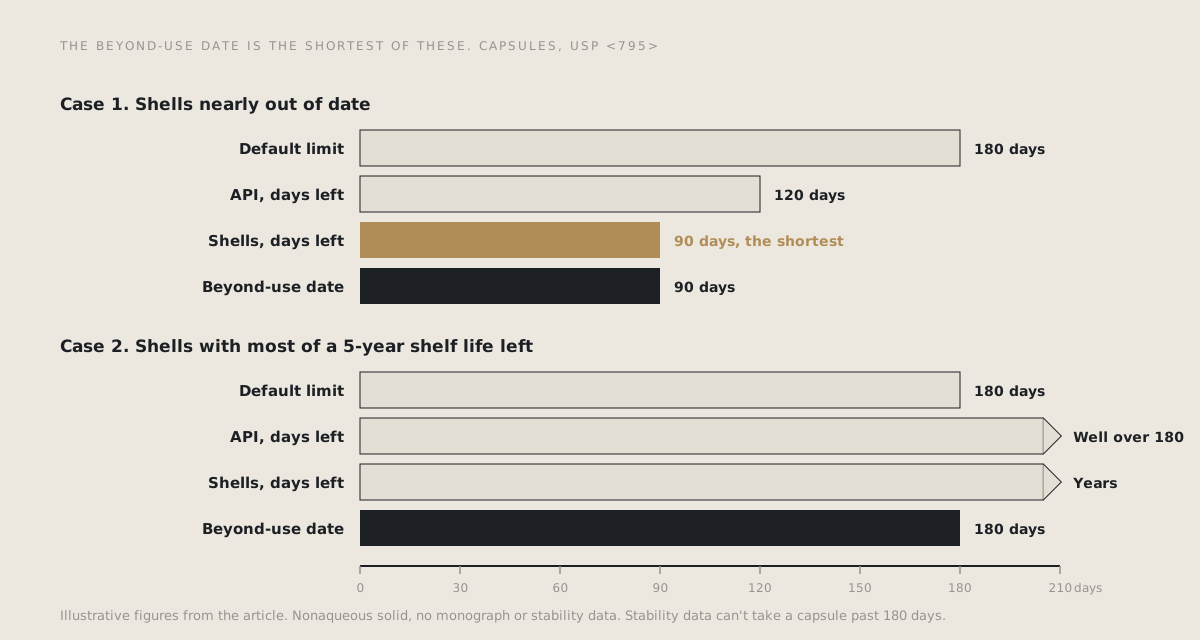
It caps it. USP <795> says the beyond-use date (BUD) of a compounded preparation "must not exceed the shortest remaining expiration date of any of the commercially available starting components," and the shell is one of those components. In practice the 180-day limit for capsules binds first, unless the shells on your shelf have less than 180 days left.
Under the 2023 chapter, a nonaqueous solid dosage form such as a capsule gets a default BUD of 180 days at controlled room temperature or in a refrigerator, in the absence of a monograph or stability data. Stability data can justify the full 180 days where a shorter date would otherwise apply, and can't take a capsule past 180 days. If the API has 120 days left, the BUD is 120 days. If the shells have 90 days left, the BUD is 90 days, however fresh the API. USP doesn't require you to measure water activity to use the nonaqueous category; powder-filled capsules fall in it.
That's the reason to look at the expiry date on the capsule carton at receipt and again at use, and the reason a long-dated shell is worth having. Our capsules carry a 5-year shelf life on the maker's certificate of analysis for both gelatin and HPMC, and the date is printed on the pack, so the shell is rarely the shortest-dated component on a compounding record. It stops being true if the carton has been open on a humid shelf for two years, which is a storage question, and how to store an opened carton has the rule.
In the UK the GPhC asks for the expiry date of the prepared medicine with "reasons or validation in support," and the MHRA expects an MS holder to justify expiry dating with stability data. There's no fixed 180-day rule; the shell's expiry is one of the reasons in the file.
Published stability on compounded capsules, where it exists, tends to support the 180 days for a dry powder in a dry capsule and to shorten it for very low doses. One study found a low-dose active in microcrystalline cellulose capsules held within 90% to 110% for 360 days at room temperature; another found levothyroxine capsules stable 180 days when made from a fresh trituration and only 14 days when made from a 120-day-old one, which is about the powder, not the shell. Aspirin in HPMC shells held 90 days at 40 mg and 10 mg and 31 days at 3 mg and 1 mg. None of those figures transfer to your formulation; they show the shape of the answer.
Do I have to buy a full box, and will it fit my filler?
From us, yes, a full box per size and color, and for a working pharmacy the box is the right unit anyway. A pharmacy filling 10 prescriptions a day of 50 to 100 capsules each is using 500 to 1,000 capsules a day. A box of 75,000 size 00 lasts that pharmacy about 75 to 150 working days, a box of 100,000 size 0 about 100 to 200. Buying in 1,000-packs means ordering every day or two, and on the open-web prices we found, paying three to four times the per-thousand price of a full box. The box counts by size and the price structure are in how many capsules come in a box, and how many on a pallet.
We sell every standard size, 000 through 5, in gelatin and HPMC, clear and colored, in the maker's carton of joined capsules with the lot number and expiry on the carton, a certificate of analysis for the lot, and the supporting statements (TSE, origin, allergen, halal and kosher where certified) as a document pack that travels with the lot. We don't sell separated caps and bodies, and we don't sell in hundreds. If you're a hobbyist filling a 24-hole hand press with pre-separated capsules, the open-web sellers serve you better than we do, and that's fine.
Joined capsules suit a pharmacy plate. The 100-, 120-, and 300-hole fillers made for pharmacies load joined capsules through an orienting tray, seat them body-down, and separate the caps on the plate by lifting the top plate, then bring the caps back down to close. They take joined capsules because a pharmacy can't spend the morning separating 300 capsules by hand. Each size needs its own set of plates or change parts, and one of those makers lists change parts for 000 to 5 and the elongated 00el to 2el. The 24- and 50-hole hobby presses are the ones that take pre-separated halves. Check the closed length and body diameter of the size you run against your plate's change-part specification, using the actual dimensions of each capsule size, maker by maker, or ask us for them.
If you run several strengths of the same size in different colors, order the colors as separate boxes and store them apart. A mix of two colors in one bin is how the wrong color reaches a patient.
What about veterinary capsules?
For cats and dogs the sizes are the human ones, and the paperwork has its own rules on both sides of the Atlantic.
A veterinary compounding pharmacy's own guide puts size 4 as the working size for cats and small dogs, since a size 1 or larger is hard to get into a cat, and 00 or 000 for a large dog.
In the US, FDA's guidance on compounding animal drugs from bulk substances (GFI #256) asks that inactive ingredients meet any applicable USP-NF monograph, lists "flavorings, dyes, diluents, or other excipients" as the usual inactive ingredients, and sets the label. Species of the patient, a beyond-use date, the statement "This is a compounded drug. Not an FDA approved or indexed drug," the adverse event reporting line, and for office stock, "Not for use in food-producing animals." In the UK, an extemporaneous preparation is the last step of the veterinary cascade, may be prepared by a pharmacist or a vet or an authorized manufacturer, and the supplier must label it with 12 items set out in the Veterinary Medicines Regulations, including the species, the withdrawal period if relevant, and "For animal treatment only." Records are kept five years. Neither regime says anything about the capsule shell beyond the general expectation that it's a fit starting material with its lot recorded, which is the same as the human side.
What we measured
Nothing yet on this page is our own bench data, and the piece will say so until the run below is done. The measurement worth making for a compounding pharmacy is the one the studies above keep pointing at, which is how even the fill weights are across a full plate of 100 capsules filled the way a pharmacy fills them.
Our COO will fill 100 size 0 and 100 size 1 capsules on a 300-hole plate filler with lactose monohydrate at a measured bulk density, level and tapped, by one operator following the technique above, and weigh every capsule's contents individually. The results will appear here as the mean, the standard deviation, the coefficient of variation, the number outside ±10% of the mean, the pass or fail under USP <1163> and under Ph. Eur. 2.9.5, and a map of where on the plate the light and heavy capsules sat. The same run repeated with the scraper pushed instead of drawn will show what that habit costs. The protocol is written and the results will be published with the method, so you can repeat it on your own plate and compare.
Capsule size and weight-check tool
Enter the dose, the number of capsules, and the density of your blend, or your own measured pack stat, and the tool gives you the capsule size, the diluent per capsule and per batch, and the overage. Then paste the weights from your first plate and it tells you the mean, the spread, and whether the batch passes under USP <1163> and under Ph. Eur. 2.9.5, with the retest rule if it doesn't. Nothing you enter leaves the page. The prompt pack below does the same work in your AI assistant, and adds the component lines for your records. Get the AI prompt pack.
What is an AI prompt pack?
An AI prompt pack is a small set of files you load into the AI assistant you already use. The assistant then asks you the right questions, works through them with you using our reference data, and shows its working as it goes. We publish one with each article. We did the prompt engineering so you don't have to. Each prompt has been engineered so it asks the right questions in the right order, carries the reference data it needs, and says plainly what it doesn't know.
Inside the Compounding Capsule AI Prompt Pack is a prompt file that turns your assistant (Claude, ChatGPT, Gemini, Grok) into a capsule sizing and records assistant for a compounding pharmacy, a workbook it fills in as you go, and a reference sheet with the size table, the two weight-check rules, and the component record fields from USP <795> and the GPhC guidance. It walks you from the dose and the number of capsules to the size, the diluent and overage, the pack stat to measure, the weight check on your first plate with pass or fail under both rules, the component lines for your receipt log and compounding record, the beyond-use date against the shortest component expiry, and a color-per-strength scheme for a patient on more than one strength.
Why a pack and not just a calculator? Because the right answer depends on your patient, your powder, your plate, and which rules your pharmacy works under, and a calculator can't ask which. It's the conversation we'd have with you on a call, packaged so you can have it at the bench with your balance and your Master Formulation Record in front of you.
Use the form below to request this resource. Newsletter updates are a separate, optional choice.
Get the Compounding Capsule AI Prompt Pack
Request the Compounding Capsule AI Prompt Pack
Leave your details to request this resource.
If you'd rather talk it through, reply to any email from us or write to us through the contact page. A person who has filled plates, weighed the contents, and written the SOP will get back to you. If you want the paperwork before the capsules, ask for the specimen document pack.
Related.
- Capsule sizes, volumes, and fill weights
- Capsule fill weight from bulk and tapped density
- Capsule machine compatibility
- What a certificate of analysis and a specification contain
- How to qualify an empty capsule supplier
- Capsules for clinical trials
Sources.
- US compounding rules. USP <795> Pharmaceutical Compounding, Nonsterile Preparations (official 1 Nov 2023), https://www.usp.org/compounding/general-chapter-795, text as reproduced in Washington State DOH inspection addendum 690-326 (Jan 2026), doh.wa.gov, and the USP <795> FAQs (1 Nov 2022); USP <795> 2019 text (USP 42-NF 37 second supplement reprint); USP <795> pre-2019 text (USP 29 and 31); USP <1163> Quality Assurance in Pharmaceutical Compounding (USP 35 text, official 1 Dec 2012) and the USP-NF notice of 24 Apr 2026 (not readable); USP <905> Uniformity of Dosage Units (Stage 4, official 1 Aug 2023); USP <1151> Pharmaceutical Dosage Forms; USP monograph Hard Gelatin Capsule Shells, https://doi.usp.org/USPNF/USPNF_M9475_02_01.html; Pharmacopeial Forum 42(4) proposed Hard Hypromellose Capsule Shells, via ijdra.com and gmp-compliance.org. 21 U.S.C. 353a and 353b; 21 CFR 207.1, 210.3, 211.84 (https://www.ecfr.gov/current/title-21/chapter-I/subchapter-C/part-211/subpart-E/section-211.84), 211.184, ecfr.gov; FDA draft guidance, cGMP for 503B outsourcing facilities, Rev. 2, Jan 2020, https://www.fda.gov/regulatory-information/search-fda-guidance-documents/current-good-manufacturing-practice-guidance-human-drug-compounding-outsourcing-facilities-under. FDA, CVM GFI #256, Compounding Animal Drugs from Bulk Drug Substances, https://www.fda.gov/regulatory-information/search-fda-guidance-documents/cvm-gfi-256-compounding-animal-drugs-bulk-drug-substances. Texas 22 TAC 291.131 (eff. 10 Jun 2024); California 16 CCR 1735.2 and 1735.3; Massachusetts Board USP 795 inspection tool; ACHC PCAB page. FDA, Safety Considerations for Container Labels and Carton Labeling Design to Minimize Medication Errors, May 2022, https://www.fda.gov/regulatory-information/search-fda-guidance-documents/safety-considerations-container-labels-and-carton-labeling-design-minimize-medication-errors. Pharmacy Times Compounding Hotline, Erickson, 1 Aug 2008 (shell weight tolerance).
- UK, EU, Australia. Medicines Act 1968 s10 and Human Medicines Regulations 2012 regs 3, 4, Sch 26, legislation.gov.uk; GPhC, Guidance for registered pharmacies preparing unlicensed medicines, Aug 2018, https://assets.pharmacyregulation.org/files/document/guidance_for_registered_pharmacies_preparing_unlicensed_medicines_august_2018_0.pdf; MHRA Guidance Note 14 (2023) and Guidance for specials manufacturers Rev. 2 (Jan 2021), https://www.gov.uk/government/publications/guidance-for-specials-manufacturers/guidance-for-specials-manufacturers; SPS, Making unlicensed medicines (updated Jan 2026), Purchasing Specials (Feb 2025), Evaluating the quality of UK manufactured Specials (Jun 2024); RPS, Professional Guidance for the Procurement and Supply of Specials, Dec 2015; Ph. Eur. monograph 0016 Capsules, 2.9.5 and 2.9.6 (Ph. Eur. 6.0 and 7.0 texts; confirm against the current edition); BP general monograph Unlicensed Medicines (BP 2012 text); MHRA Best Practice Guidance on Labelling and Packaging of Medicines, Jun 2026, https://assets.publishing.service.gov.uk/media/6a4770118effd97622f53be5/Best_practice_guidance_labelling_MHRA_Final_July_2026.pdf; Veterinary Medicines Regulations 2013 Sch 3 and 4 (as amended 2024), https://www.legislation.gov.uk/uksi/2013/2033/schedule/4; VMD, The cascade (updated May 2026) and Specific Manufacturing Authorisations (updated Sep 2026); Directive 2001/83/EC Art 3 and 5; Council of Europe Resolution CM/Res(2016)1; Pharmacy Board of Australia, Guidelines on compounding of medicines, Oct 2024, https://www.pharmacyboard.gov.au/News/2024-09-30-Compounding-guidelines-take-effect.aspx. MHRA MS register, Sep 2026 (44 holders authorised for hard-shell capsules, our count). O'Donovan et al., Int J Pharm 2023 (specials spend in England 2012 to 2020).
- Technique and calculation. Allen, Secundum Artem 4(4), padagis.com; Allen, IJPC 1999 and 2016 (abstracts); Nash, IJPC 1997 (rule of sixes), https://ijpc.com/Abstracts/Abstract.cfm?ABS=169; UNC Eshelman Pharmlabs, Capsules and Triturations; RxCe, Compounding Nonsterile Oral Dosage Forms (2024) and rjp213 (2026); Klinger and Daniels, Pharmacy 2021, 9(1):56 (DAC/NRF method, overage, loss), https://doi.org/10.3390/pharmacy9010056; Compound Direct pack stat calculator; Torpac Dosing Guide (volumes, large-animal sizes, species) and interpack 2026 brochure (plate capacities, throughput, change parts); Medisca ProFiller 1100 listing and compounding tips; Feton Universal Filler 120 data sheet, Sep 2022; Capsule Connection technique notes (Nov 2025); Fagron Academy course outline (pack stats); PCCA LoxOral, Medisca CapsuBlend, Fagron DiluCap (Ferreira and Polonini, IJPC 2022), SpecializedRx CapsOral technical data. WHO TRS 970 Annex 5 (2012), https://www.who.int/publications/m/item/trs970-annex-5-development-of-paediatric-medicines-points-to-consider-in-formulation; EMA paediatric formulation guideline (2013), https://www.ema.europa.eu/en/pharmaceutical-development-medicines-paediatric-use-scientific-guideline; Northwest Compounders veterinary technicians' guide (2022); Capsuline PET-CAPS page.
- Weight and content uniformity studies. Colucci et al., Int J Clin Pharmacol Ther 1994;32:24; Capehart, Am J Pharm Educ 2008;72:119; Zhao, Birnie and Budukh, St John Fisher 2010 (punch vs machine); Markman et al., Rev Saude Publica 2010;44:1055; Boulas, Drug Res 2016;66:275; Burton et al., J Vet Intern Med 2016;30:242; KuKanich et al., JAVMA 2017;250:322; Neumann et al., Eur J Endocrinol 2017;177:239, https://doi.org/10.1530/EJE-17-0248; Sivén et al., J Pharm Pharmacol 2017;69:593; Klinger and Daniels 2021; Wasilewski et al., Eur J Hosp Pharm 2022 (weight vs volume), https://pubmed.ncbi.nlm.nih.gov/35105603/, and J Pediatr Pharmacol Ther 2022;27:625; Al-Achi et al., IJPC 2022;26:58 (20 plate machines); Messenger et al., IJPC 2024;28:82; Pajula et al., Eur J Hosp Pharm 2026; Nair et al., AAPS PharmSciTech 2004;5:e57 (HPMC on a tamping machine); Stankovic-Brandl et al., J Pharm Sci 2025 (static); Missouri Board of Pharmacy compounding report FY2005; FDA limited survey of compounded drug products (2001).
- Stability. Fortner et al., IJPC 2015;19:414 (levothyroxine); Cote et al., IJPC 2018;22:252; Zaid et al., IJPC 2012; Messenger 2024 (aspirin in HPMC); USP BUD fact sheet, Jun 2019.
- Color. The Compounder, Replacing colors in capsules (May 2017); FDA labeling design guidance (2022) III.E; MHRA labelling best practice (2026) 4.5.
- Market. Capsuline, Capsule Depot, Total Pharmacy Supply, SpecializedRx, Pasteur Pharmacy, Capsuline UK, Pure Capsules UK product pages (26 Sep 2026); Medisca and Fagron US capsule category pages; APC Snapshot of Pharmacy Compounding in America 2023-24; NHSBSA Top 500 special order products, quarter to Jun 2026.
*Capsules.com supplies empty hard capsules in gelatin and HPMC to manufacturers, brands, pharmacies, and research teams. Capsules Direct Ltd, company number 17362490, 26 Rowood House, Bicester OX26 4PP, United Kingdom. UK 020 3905 1989 · US (816) 445-0042 · capsules.com. *