
Machines and production
Capsule machine compatibility. Which capsule runs on which encapsulator, and what changes with size
Compare capsule dimensions and change parts, check machine fit, and plan a trial before changing size, material, or supplier.
Written by A. Sanderson, CEO, Capsules.com
On this page
Somebody sends you a box of size 0 capsules from a maker you haven't run before, and the question on the floor is whether they'll go through the machine on Monday or whether you'll spend Monday clearing the rectifier. The catalog says size 0. Your tooling says size 0. Those two facts are related, and they're not the same fact.
This page is about the gap between them. Which capsule sizes a machine takes and what has to change when the size changes. Whether a size 0 from one maker fits tooling set up for another, with the published dimensions from nine makers laid side by side so you can see how far apart they are. The parts of the machine that touch the capsule and the dimension each one cares about. How much play there is between a capsule and a bore, what the makers publish about tolerance and what they don't. How to measure a capsule so the number means something. And what changes for HPMC, for elongated sizes, and for the small plate fillers where most of the complaints on the internet come from.
One position up front. Before you commit to an order, buy one sample box of any standard size and run it on your machine. It's credited against your first order of the same product, and we'd rather you ran it than took our word or anyone else's. The dimensions are in the tables. The machine is yours. Put the two together before the order, not after.
- Which capsule size fits my machine? Any size the machine has parts for. On a plate filler the whole plate is the size. On an automatic it's a set.
- Will a size 0 from a different maker run on my size 0 tooling? Usually. Diameters agree across makers to within 0.07 mm. Lengths differ by up to 0.6 mm, and length is what you set up for.
- What are the actual dimensions, maker by maker? Cap and body diameter and closed length from every maker that publishes them, sizes 000 to 5, with the spread.
- Is there a standard for capsule dimensions? No international one. A voluntary Chinese standard and an Indian guidance table, both reference only.
- Which parts of the machine change with capsule size? Rectifier, magazine, segments, disc, pins, closing pins, and on a dosator machine the nozzles. One table.
- Which parts should I check against my capsule's dimensions? The segment bores against the outer diameters, the pin or nozzle against the body's inner diameter, the closing station against closed length.
- How much play should there be? Thousandths of an inch, and the number isn't published. What is published, and why room humidity moves the capsule more than the tolerance does.
- How do I measure a capsule properly? A ring gauge, not calipers. Twenty capsules, at a stated humidity.
- How do I check my tooling for wear? Plug gauges in the bores, alignment pins in the segments, and the closing gap.
- Do HPMC capsules run on the same tooling as gelatin? The two largest makers say yes. Static, humidity range, and pre-lock feel differ.
- Do elongated sizes need different change parts? Same diameters, longer body. Some parts change. And there are two different "0el."
- What dosing disc thickness goes with each size? A disc is a size plus a fill depth. The published range.
- What does each machine family accept? Sizes, dosing principle, and changeover claims from the machine makers' own pages.
- Why do capsules from a new supplier crush or not seat on my plate filler? Ovality, moisture, and a box that measured differently. What the reviews say.
- What should I do before switching supplier on a running machine? A sample box, a measured comparison, and a trial run with the settings written down.
- Machine fit checker. Enter the size and what you measured, get the maker envelope, the body inner diameter, and the parts to inspect.
- The free AI prompt pack. Load it into ChatGPT, Claude, or Gemini and it builds the fit check, the trial protocol, and the change record with you.
One note before the numbers. Every figure on this page comes from a capsule maker's own specification sheet, a machine maker's page or brochure, a patent, or the pharmaceutics literature, and each one is labeled where it appears. We don't yet have our own measured dimension table for the capsules we sell. When we do, it goes in the tables and the published figures move to the footnotes. Nothing here is advice about what a capsule's contents do for anyone. The shell is an object, and this page treats it as one.
Which capsule size fits my machine?
Any size the machine has parts for, and no size it doesn't. On a hand plate filler the plate is the size, so a size 00 machine fills size 00 and nothing else. On a bench-top or semi-automatic machine the plates, ring, or tooling set change with the size. On an automatic encapsulator a size is a complete set of change parts, and switching sizes is a changeover measured in minutes on a modern machine and in an hour or two on an older one.
The sizes themselves run from 000, the largest, to 5, the smallest, with elongated versions of the common ones (00el, 0el, 1el, 2el) that keep the diameter and add length. Machine makers publish which of those their machines take, and the lists differ. One Italian dosator machine lists "000-5, supro A-E, DB, DBAA," another lists "5-00EL (000*)" with the 000 as an option, a German tamping machine lists "000 to 5," a Korean one lists "#00~#4" with 000 and 5 as options, and one Italian line lists "00 - 0 - 1 - 2 - 3 - 4 - 5" with no 000 at all. The families section further down has the table. If your machine is older or the manual is gone, the aftermarket tells you what exists. Change part sets for the common German tamping machines are stocked in every size from 000 to 5 by the used-equipment dealers, and a used set for one of those machines runs about $3,500 to $5,000 in 2026 listings, with a single dosing disc at $750 to $1,500.
The small machines are the ones that catch people. Every hobby and small-batch plate filler we could find is built for one size, and the vendors say so on the product page. One vendor's own words are "every plate on each machine is specific to that capsule size diameter." A reviewer of another wrote "I received 2 '00' trays and 1 '0'... did not fit." That's a wrong plate, not a bad capsule, and it's the first thing to check when a box "doesn't fit."
Will a size 0 from a different maker run on my size 0 tooling?
Usually, yes, and the reason is in the numbers. Across nine capsule makers' own specification sheets, the cap and body outer diameters for any given size differ by at most 0.03 to 0.07 mm from the largest to the smallest published figure. That's about the same as one maker's own tolerance on the dimension. Closed length is where the makers differ. For size 00 the published closed lengths run from 23.0 to 23.6 mm, a spread of 0.6 mm, which is one to two times a single maker's tolerance.
So the diameters are a de facto standard even though nobody wrote one, and the same segments, disc, pins, and nozzles serve any maker's size 0. The length is what you set up for. Closing depth, the gap under the separation pins, the rectifier's finger position, and on a semi-automatic the locking stroke are all length settings, and a capsule technical manager at one North American maker puts it plainly. "The cap length specifications differ between capsule vendors, and may require slight set-up adjustments to account for these differences." His separation-pin note says the same thing about supplier changes. Adjustment is "required when changing capsule sizes and sometimes when switching capsule suppliers."
Two other things move between makers and don't show up on the dimension sheet. The pre-lock, the light friction fit that holds an empty capsule together in the hopper, is a geometry each maker patents and tunes, and the force needed to pull the body off the cap changes with the maker. In that technical manager's words, "the force required to open capsules... will change from one capsule supplier to another, because of differences in capsule pin design." The vacuum at the separation station has to overcome that force, so the first setting to revisit with a new maker's capsule is the vacuum, and the direction is down, not up. His rule is to reduce vacuum until you see non-separation and then ease it back up until separation is consistent. The other variable is wall thickness, which sets the body's inner diameter and the friction between cap and body. Wall thickness is published by a handful of makers and it's in the tables below.
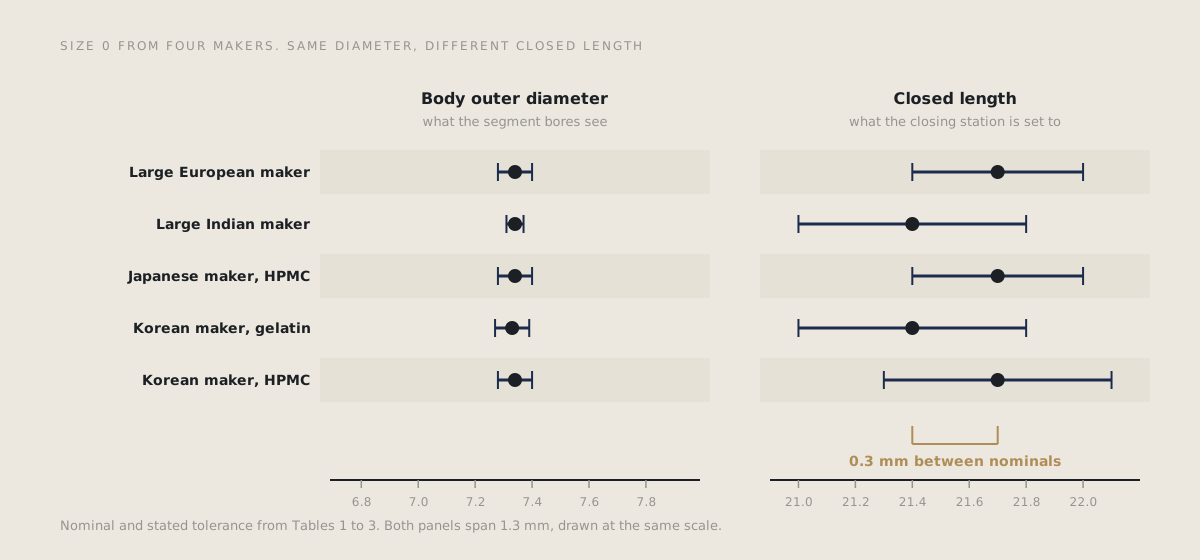
A worked example, with maker figures. A size 0 body from one large European maker has a published outer diameter of 7.34 mm and a tolerance of ±0.06 mm. The same size from a large Indian maker is 7.34 mm ±0.03 mm. From a Japanese maker's HPMC line, 7.34 mm ±0.06 mm. From a Korean maker, 7.33 or 7.34 mm depending on material. The closed lengths for those same four are 21.7, 21.4, 21.7, and 21.4 or 21.7 mm. The body passage in your lower segment doesn't know which maker's 7.34 mm body is in it. The closing station knows the difference between 21.4 and 21.7 mm, because you set it.
What are the actual dimensions of each capsule size, maker by maker?
The tables below are the published nominal figures from the makers that publish them, copied as printed. Where a maker prints a range rather than a nominal value we show the range. The last column is the spread from the lowest to the highest published nominal figure in the row, which is the number to hold in your head when someone asks whether size 0 is size 0.
Table 1. Cap and body outer diameter by size and maker, mm. Nominal figures from each maker's own specification sheet. Cap over body. Tolerances are in Table 3. "Not published" where the maker's sheet omits the size or the figure.
| Size | Large European maker (gelatin) | Large Indian maker (gelatin) | Japanese maker (gelatin / HPMC) | Korean maker (gelatin / HPMC) | North American maker (HPMC) | Indian Pharmacopoeia range | Spread, cap / body |
|---|---|---|---|---|---|---|---|
| 000 | 9.91 / 9.55 | 9.96 / 9.61 | not published | 9.91 / 9.55 (both) | 9.91 / 9.55 | 9.89 to 10.01 / 9.54 to 9.66 | 0.06 / 0.06 |
| 00 | 8.53 / 8.18 | 8.55 / 8.22 | 8.56 / 8.21 and 8.57 / 8.23 | 8.52 / 8.16 and 8.53 / 8.18 | 8.56 / 8.23 | 8.49 to 8.61 / 8.16 to 8.28 | 0.06 / 0.07 |
| 0 | 7.64 / 7.34 | 7.66 / 7.34 | 7.66 / 7.36 and 7.68 / 7.34 | 7.64 / 7.33 and 7.64 / 7.34 | 7.65 / 7.35 | 7.60 to 7.72 / 7.28 to 7.40 | 0.05 / 0.04 |
| 1 | 6.91 / 6.63 | 6.93 / 6.63 | 6.95 / 6.65 and 6.92 / 6.61 | 6.91 / 6.63 (both) | 6.96 / 6.63 | 6.87 to 6.99 / 6.57 to 6.69 | 0.05 / 0.04 |
| 2 | 6.35 / 6.07 | 6.37 / 6.08 | 6.38 / 6.08 and 6.36 / 6.07 | 6.35 / 6.07 (both) | 6.39 / 6.12 | 6.31 to 6.43 / 6.02 to 6.14 | 0.05 / 0.05 |
| 3 | 5.82 / 5.57 | 5.85 / 5.57 | 5.85 / 5.60 and 5.83 / 5.56 | 5.83 / 5.57 and 5.82 / 5.56 | 5.85 / 5.60 | 5.77 to 5.89 / 5.50 to 5.62 | 0.04 / 0.04 |
| 4 | 5.32 / 5.05 | 5.33 / 5.06 | 5.34 / 5.07 and 5.33 / 5.06 | 5.32 / 5.05 and 5.31 / 5.05 | 5.33 / 5.08 | 5.27 to 5.39 / 5.01 to 5.13 | 0.03 / 0.03 |
| 5 | 4.91 / 4.68 | 4.91 / 4.65 | not published | 4.91 / 4.68 (both) | 4.91 / 4.68 | 4.85 to 4.97 / 4.59 to 4.71 | 0.00 / 0.03 |
Swipe across to see every column.
Table 2. Closed (locked) length by size and maker, mm. The dimension that differs between makers, and the one your closing station is set to. The Korean maker is the only one that also publishes the pre-lock (empty, joined) length, shown in parentheses for its gelatin line.
| Size | Large European maker | Large Indian maker | Japanese maker (gelatin / HPMC) | Korean maker (gelatin / HPMC) | North American maker | Second Indian maker | Spread |
|---|---|---|---|---|---|---|---|
| 000 | 26.1 | 25.9 | not published | 26.1 (28.1) / 26.1 | 26.1 | not published | 0.2 |
| 00 | 23.3 | 23.5 | 23.5 / 23.6 | 23.3 (25.5) / 23.3 | 23.4 | 23.0 | 0.6 |
| 0 | 21.7 | 21.4 | 21.8 / 21.7 | 21.4 (23.4) / 21.7 | 21.6 | 21.3 | 0.5 |
| 1 | 19.4 | 19.3 | 19.5 / 19.4 | 19.1 (20.9) / 19.4 | 19.4 | 19.2 | 0.4 |
| 2 | 18.0 | 17.8 | 17.8 / 18.0 | 17.6 (19.2) / 18.0 | 17.6 | 17.6 | 0.4 |
| 3 | 15.9 | 15.8 | 15.8 / 15.9 | 15.7 (17.2) / 15.9 | 15.7 | 15.6 | 0.3 |
| 4 | 14.3 | 14.4 | 14.5 / 14.3 | 14.2 (15.6) / 14.3 | 14.3 | 14.4 | 0.3 |
| 5 | 11.1 | 11.4 | not published | 11.1 (12.8) / 11.1 | 11.1 | not published | 0.3 |
Swipe across to see every column.
Two things in Table 2 are worth a second look. The Korean maker's gelatin closed lengths for sizes 0 to 4 are 0.1 to 0.4 mm shorter than its own HPMC closed lengths, and its HPMC line reproduces the European maker's figures to the decimal. Whether that's a different lock geometry or a different measuring convention isn't stated on the sheet. And the closed length a maker prints is a setup recommendation, not a pass or fail limit. The Japanese maker says so in its manual. The closed joined length "is given as a filling machine set-up recommendation and not as an approval/rejection criterion for empty capsules," and if the machine closes shorter than that "the cap or body may be damaged and the locking mechanism may fail; if longer, they may come apart."
Table 3. Tolerances as each maker states them. Copied from the specification sheets. The diameter tolerances are an order of magnitude tighter than the length tolerances at every maker.
| Maker | Cap and body outer diameter | Cap and body length | Closed length | Shell weight | Note on the sheet |
|---|---|---|---|---|---|
| Large European maker | ±0.06 mm (±0.002 in) | ±0.46 mm; size 5 ±0.40 | ±0.3 mm; 2el and size 5 ±0.4 | ±2 to ±10 mg by size | "Specifications are subject to change without notice" |
| Large Indian maker | ±0.03 mm, on an average of 20 | ±0.4 mm | ±0.4 mm | ±7%, at 14% moisture, 99.7% confidence | "Body diameters are indicative only. Body diameters are adjusted to achieve correct fit, oriented towards better machinability. Outside diameters should not be measured by vernier caliper." |
| Japanese maker, gelatin | ±0.04 mm | ±0.3 mm | ±0.3 mm | limits per size, about ±8% | Outer diameter "should never be considered as an approval/rejection criterion" |
| Japanese maker, HPMC | ±0.06 mm | ±0.30 mm | ±0.30 mm | ±10%, batch average | Same wording |
| Korean maker | ±0.06 mm | ±0.4 mm; open length ±0.5 | ±0.4 mm | ±10% gelatin, ±11% HPMC | Volume ±3% |
| North American maker | not printed on the reachable page | ±0.35 mm | ±0.3 mm; size 5 ±0.4 | ±3 to ±7 mg by size | |
| Second Indian maker | ±0.06 mm as a range | ±0.5 mm as a range | not published; pre-lock length ±0.4 mm as a range | ±5% on an average of 20 | Ranges match the Indian Pharmacopoeia guidance table |
| Third Indian maker | not published | ±0.4 mm | ±0.4 mm | ±7% gelatin, ±10% HPMC | Single wall thickness ±0.018 mm |
Swipe across to see every column.
Table 4. Wall thickness, where anyone publishes it. Single wall, mm. The makers that quote around 0.2 mm are measuring two walls together with a micrometer; divide by two.
| Source | Figure |
|---|---|
| Large European maker, technical white paper | Side wall 0.1 mm. Top wall over 0.12 mm. Shoulder over 0.07 mm. Gap between body and cap over 0.05 mm |
| Same maker's figures as reproduced in a 1990s HPMC patent, by size | Body 0.086 to 0.107 mm ±0.020 to 0.023; cap 0.091 to 0.112 mm ±0.025 to 0.030, thicker on the larger sizes and on the cap |
| Third Indian maker, gelatin, by size | Cap 0.097 to 0.110 mm, body 0.091 to 0.105 mm, ±0.018 |
| Indian Pharmacopoeia 5.8.1 | 0.082 to 0.125 mm by size and part |
| Chinese group standard T/CNPPA 3008-2020 | 0.070 to 0.120 mm by size, ±0.020 |
| Aulton's Pharmaceutics | "about 100 µm" |
Swipe across to see every column.
If you want the full published sheets, with cap and body lengths, volumes, and weights, the sizes article carries the standard table of capsule dimensions by size and the research file behind this page lists every source. Capsules.com supplies gelatin and HPMC in the standard sizes, and the specification sheet for the capsules you buy from us comes with the lot, which is the sheet to set the machine to rather than any table on the internet, ours included. The certificate article explains what a capsule specification contains, line by line.
Is there a standard for capsule dimensions?
No. There's no ISO, DIN, ASTM, USP, or European Pharmacopoeia standard that fixes the dimensions of a size 0 capsule or any other size. The pharmacopoeial capsule monographs cover the filled dosage form, uniformity, disintegration, and dissolution, and say nothing about the shell's diameter.
What exists is a guidance table and a voluntary standard. The Indian Pharmacopoeia carries a chapter, 5.8.1, with outer diameter, length, and wall thickness ranges for sizes 000 to 5, "provided... for the guidance of users," and recommends measuring at 20 to 25°C and 45 to 55% relative humidity because "any measurement of reasonable accuracy can be made only under controlled conditions of temperature and humidity." China's pharmaceutical packaging association published a group standard in 2020, T/CNPPA 3008, with length, wall thickness, and diameter ranges for sizes 00 to 5, and it says its own values are "for reference only, and should not be considered as an accept/reject criteria." Two of the largest makers say the same about their own sheets. Outer diameter is a guideline for packaging and machine setup, "never... an approval/rejection criterion."
So the standard is the one the machines enforce. The segment bores, disc bores, and nozzles on the automatic encapsulators were cut to the diameters the big makers settled on decades ago, and any maker who wants their capsules to run on those machines makes them to the same diameters. That's why Table 1 agrees so closely without a document behind it, and it's also why one maker's sheet says the body diameter is "adjusted to achieve correct fit, oriented towards better machinability." The body OD is a tuning variable inside the maker's process. The published number is where they aim, and the machine is what they aim at.
Which parts of the machine change with capsule size?
On an automatic encapsulator, most of the parts that touch the capsule. One used-equipment dealer describes a complete size 1 set for a common 12-bore German tamping machine as "2 Magazines, 2 Sorting Blocks, 2 Orientation Fingers, 12 Upper Segment Blocks, 12 Lower Segment Blocks, 72 Tamping Pins, 1 Dosing Disc 24mm." Seventy-two pins is six stations of twelve. Table 5 walks the capsule through the machine and says what each part does, whether it changes with size, and what's published about whether it changes with capsule type.
Table 5. Change parts by station. Whether a part changes with size, and whether there's published evidence that it changes with elongated, HPMC, or liquid-fill capsules. Sources are dealer listings, machine maker pages, and the machine patents.
| Part | What it does | Changes with size? | Changes with capsule type? |
|---|---|---|---|
| Rectifier or sorting block, with horizontal and vertical fingers | Turns random capsules cap-up and drops them into the magazine. The slot is "slightly narrower than the outside diameter of the cap," so the cap catches and the body swings down first | Yes | Elongated, yes on at least one Italian machine, which has its own 0el rectifier assembly. HPMC, unknown |
| Magazine or hopper tubes | Holds oriented capsules above the segments | Yes | Unknown |
| Upper segment (cap bushing) and lower segment (body bushing) | Carry cap and body through the stations. The upper bore is stepped so the body passes and the cap seats on the shoulder; vacuum pulls the body into the lower bore | Yes | HPMC, one aftermarket upper segment for a common tamping machine is listed as "custom machined for HPMC/Veg Capsules." Elongated, the semi-automatic ring fillers have a separate 00el ring. Over-encapsulation (DB) sizes have their own bushings |
| Dosing disc | Its bores form the powder plug. Bore diameter goes with size, thickness with fill depth | Yes, and by fill depth | By powder density, not capsule type |
| Tamping pins | Compress powder in the disc bores over five stations; the sixth transfers | Yes, diameter | No published evidence |
| Transfer or ejection pins | Push the plug from the disc into the body | Yes | Elongated, yes on the Italian machine (0el transfer pin mount) |
| Dosator nozzle and piston | On a dosator machine, the nozzle dips into the powder bed and delivers the plug into the body | Yes | Unknown |
| Closing pins and closing plate | Push the body up into the cap to the closed length | Yes, pin diameter; closing depth is a setting | Elongated, closing depth changes with length. Closing force adjustment mentioned for HPMC by one vendor |
| Ejection pins, exit wheel | Push out the closed capsule | Some. One dealer lists one ejection pin covering sizes 000 to 4 | Unknown |
| Alignment pins | Align upper to lower segment, and disc to pins | Yes, or a universal set | Not applicable |
| Vacuum, closing depth, separation pin gap, disc-to-block gap | Settings, not parts | Reset at every size change | Vacuum resets with supplier (pre-lock force); one Chinese vendor sets the disc-to-block gap at "0.05 ~ 0.1 mm" |
Swipe across to see every column.
Two things follow from the table. The parts that care about diameter (segments, disc bores, pins, nozzles) are the ones that don't change between makers of the same size, because the diameters don't. The parts and settings that care about length (rectifier fingers, separation pin gap, closing depth) are the ones you revisit with a new maker, because the lengths do. And on a dosator machine the same logic applies with the nozzle standing in for the disc and pins.
On the semi-automatic ring machines the size lives in the filling ring, the peg ring, and the rectifier parts. On the hand plate fillers the whole plate, or the whole machine, is the size, and the tamper is size specific too. One US plate filler maker's brochure lists its change parts for one size as "Body Sheet Set, Caps Tray, Locking Plate Spacer, Orienter Tray," with tampers shared across adjacent sizes ("0-1," "2-3") and one tamper for "000 & 00el."
Which parts should I check against my capsule's dimensions?
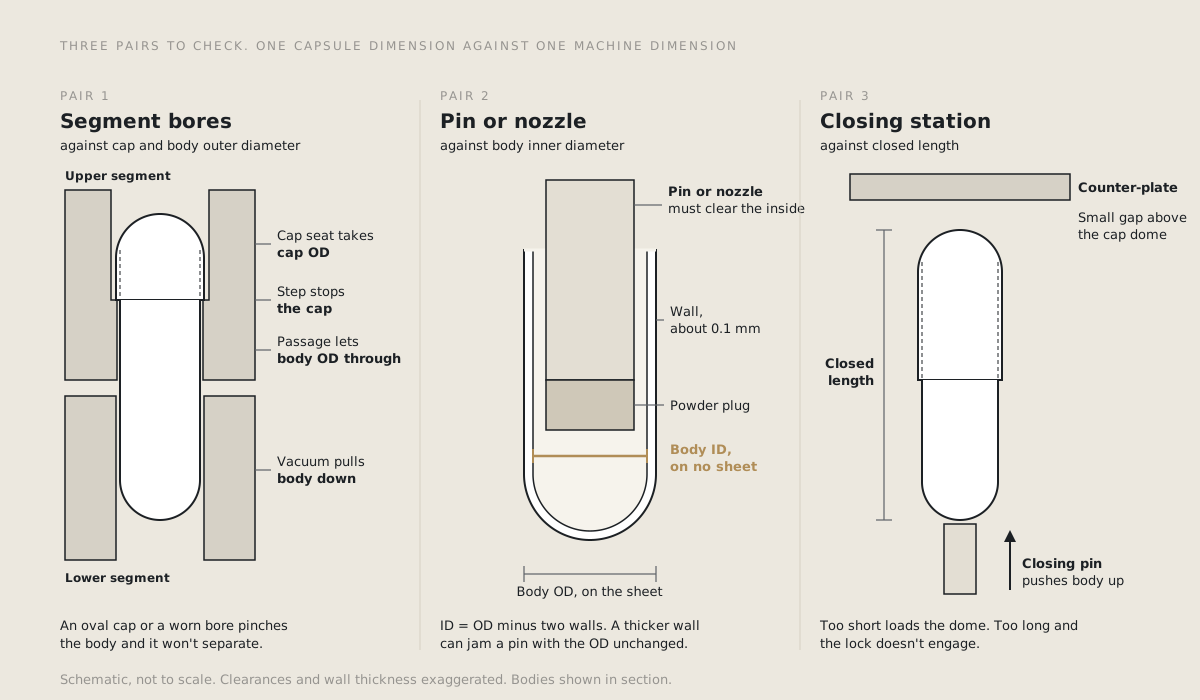
Three pairs, and each pair is one capsule dimension against one machine dimension.
First, the segment bores against the outer diameters. The upper segment's upper bore is the cap seat and has to accept the cap's outer diameter with a little clearance. The upper segment's lower bore is the body passage, and it has to pass the body's outer diameter and stop the cap's, which is the step that makes separation work. The lower segment's bore accepts the body. On a rectifier the slot does the same job in the other direction, catching the cap and passing the body. The capsule dimensions that matter are cap OD and body OD, Table 1, and the tolerance on them, Table 3. If a cap is at the top of its tolerance and the bore is worn oval, the cap constricts on entry and grips the body, and the capsule won't separate. The maker's technical note describes that failure. If the cap "is too large in diameter... it may be constricted, thereby putting a pinch on the body."
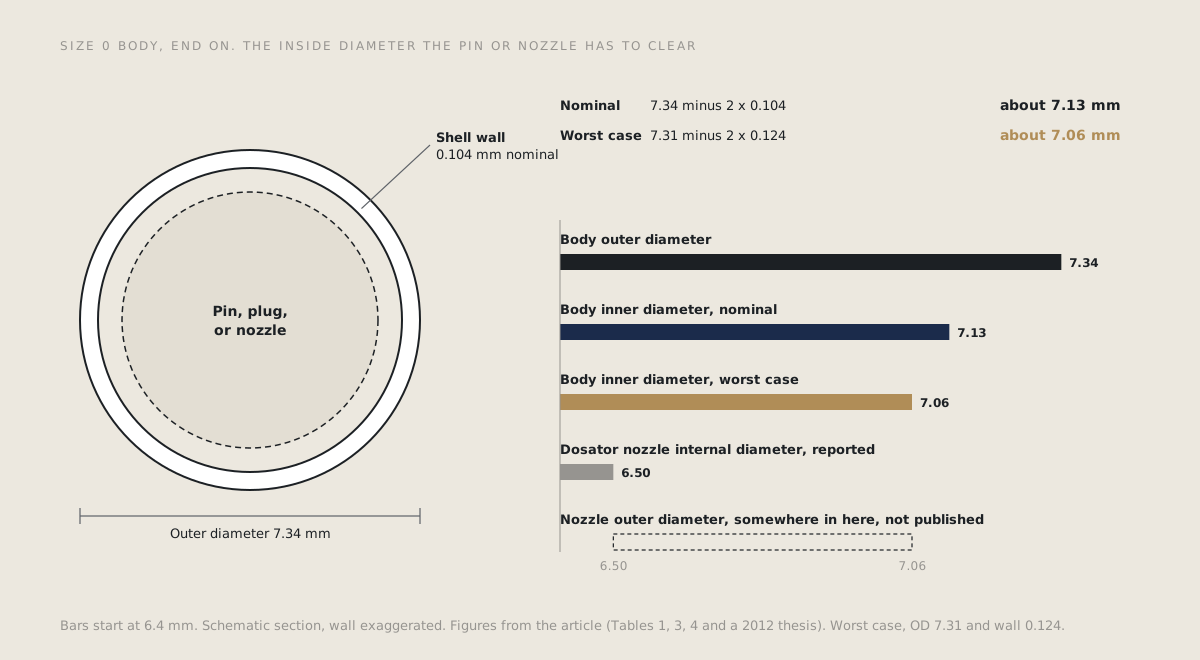
Second, the pin or nozzle against the body's inner diameter. On a tamping machine the plug is formed in the disc bore and pushed into the body by the transfer pin, so the disc bore and the pin have to be smaller than the body's inside. On a dosator machine the nozzle itself enters the body, so the nozzle's outer diameter has to clear the body's inside. The body's inner diameter isn't on any specification sheet. You get it from the outer diameter minus two wall thicknesses, and the wall thickness is the number the fewest makers publish (Table 4). For a size 0 body at 7.34 mm OD with a 0.104 mm wall, the inner diameter is about 7.13 mm. Take the tolerances at their worst, an OD of 7.31 mm and a wall of 0.124 mm, and the inner diameter is about 7.06 mm. That's the number the plug, the pin, or the nozzle has to fit inside with room to spare. A dosator machine maker's nozzle table, as reported in a 2012 engineering thesis, gives internal diameters of 6.5 mm for size 0 and 7.3 mm for size 00, so the nozzle's outer diameter sits somewhere between the internal figure and the body's inner diameter, and the maker doesn't publish it. This is the pair the wall thickness affects directly, and it's why a thicker-walled capsule from a new maker can jam a machine that ran the old one, with the outer diameter unchanged. The 1990s patent that made HPMC capsules run on high-speed machines is a case study in this (the article on how capsules are made covers how an HPMC capsule is made differently). The early cellulose capsules shrank less on the mould pin than gelatin, came out oversize, and "jammed" the fillers until the pins were undersized by "approximately 0.002-0.006 inch (0.05-0.15 mm)."
Third, the closing station against the closed length. The closing pins push the body up into the cap until the lock ring engages, and the depth is set to the maker's closed length (Table 2). Set it short and the cap dome takes the load, which is where dents and splits come from. Set it long and the lock doesn't engage and the capsule opens in the bottle. The counter-plate above the cap is set with a small gap. The same technical manager's setup figure is "0.003 to 0.005 inches above the dome of the cap" with the pins then adjusted upward to reach the closed length. On a plate filler the same thing is the locking plate stroke and the spacer under it. Two related length settings sit upstream. The separation pins under the body dome are set to "a gap of 1/16" to 1/8" (1.5mm to 3mm)," and the rectifier's fingers are positioned to the cap's cut line.
One more pair that isn't a dimension. Pre-lock force against vacuum. It's covered above and it's the first setting to revisit with a new maker.
How much play should there be?
Thousandths of an inch, and the number itself isn't published by anyone. The clearest statement we found from a capsule maker's technical staff is that "the clearance between capsule walls and tooling is mere thousandths of an inch." None of the machine makers we checked (German, Italian, Indian, Korean, or Chinese) publishes a segment bore diameter, a tamping pin diameter, a dosing disc bore, or the clearance between any of those and the capsule. Nor do the aftermarket tooling makers. The machine patents describe the geometry in words, a bore "adapted to the diameter of the capsule bottom part," a lower bore "selected, such that the lower part is not aspirated through it," and give no figure. The bore and pin dimensions are drawings held by the machine maker and the tooling shop, and the tooling shops offer to reverse-engineer from a sample part rather than publish.
What is published is around the edges, and it's enough to reason with.
Diameter tolerance on the capsule is ±0.03 to ±0.06 mm depending on the maker (Table 3), and the spread between makers' nominal diameters is 0.03 to 0.07 mm (Table 1). So the worst case between one maker's size 0 body and another's is about 0.1 mm, and the bore has to accept both without letting either rattle.
Ovality is the tolerance nobody prints, and the one figure we found is in a 1987 patent from a capsule maker. Standard caps measured about 0.127 to 0.132 mm out of round, and a grooved cap design brought that down to about 0.062 to 0.089 mm. So a cap can be out of round by more than its diameter tolerance, which is why the makers say not to measure diameter with calipers (below) and why an oval cap in a round bore is the usual reason a capsule "won't separate" or "won't seat."
Alignment between the upper and lower segments has one published tolerance. A US tooling maker says that even with the alignment pins seated, segments can sit up to 0.003 in (0.076 mm) out of line, because the pin holes are cut "at least 0.001" larger than alignment pins, and lower segment bores are slightly larger than upper segment bores." The maker's universal alignment pins claim 0.0005 in. Misalignment of that order is enough to telescope a capsule at the closing station, and one machine vendor's troubleshooting guide names it as the cause. "If the upper and lower segments of the closing station aren't perfectly aligned, the cap can slide to one side (telescoped) instead of seating fully."
Dosator pin to nozzle clearance has one published figure, 0.025 mm on the diameter, from a research dosator built to a machine maker's dimensions. The same thesis cites a 1981 study showing the clearance matters to fill weight both ways. Too small and air can't escape the nozzle, too large and powder is left on the piston face.
And then there's the capsule moving on its own. A gelatin capsule's dimensions change by about 0.5% for every 1% change in moisture content, in the 13 to 16% water band the makers specify. That's a textbook figure. On a size 0 body at 7.34 mm, a swing across the whole band is 1.5%, or about 0.11 mm on the diameter, which is more than the maker's diameter tolerance and about the same as the ovality figure above. The makers know this, which is why one of them quotes its tolerances "at 14% moisture." A capsule that measured inside tolerance in the maker's lab at 14% and sat in a 30% RH room for a shift is a different diameter by the time it reaches the segment. Room humidity moves the capsule more than the maker's tolerance does, and the storage article covers the storage conditions for empty capsules.
So the practical answer. The play was designed in by the machine maker for a capsule at the nominal diameter, at the maker's stated moisture, and round. Your job is to keep all three true. Buy to a sheet with a stated tolerance and moisture, keep the room where the capsule maker's window says, and gauge the bores so they're still round. If all three hold, a size 0 from any maker in Table 1 goes through the same tooling.

How do I measure a capsule properly?
With a ring gauge for the diameter, a length gauge or go/no-go for the lengths, and a wall thickness gauge at a stated point, on a sample of twenty, at a known temperature and humidity. Not with calipers, and the makers say so in as many words. One large maker's sheet says "outside diameters should not be measured by vernier caliper." The Chinese group standard says the same and adds micrometers to the list. "Micrometers and Vernier calipers shall not be used."
The reason is that a capsule is a thin, compliant tube about 0.1 mm thick that isn't round and isn't a cylinder. A caliper jaw flattens it, so the reading depends on how hard you squeeze. The body is tapered along its length by 0.1 to 0.3 mm per centimeter, so the reading also depends on where you measure. And the cap can be 0.06 to 0.13 mm out of round, so the reading depends on the angle. The ring gauge, or "orifice plate," loads the capsule the way the segment bore does. The Japanese maker's manual describes its own method as passing "caps and bodies through calibrated bushes under specified conditions that simulate those of filling machines," which is the same idea. The Chinese standard's instruction is to "gently push samples through the orifice." If it goes through, it fits a bore that size.
The rest of the method, from the same sources. Length with a tool reading to 0.01 mm. Single wall thickness with a gauge reading to 0.001 mm, measured 1 mm from the cut edge on the cap and 1 mm inside the lock ring on the body. Twenty capsules, averaged, because the makers' tolerances are stated "on average of 20." At 20 to 25°C and 45 to 55% RH, or at whatever moisture the maker's sheet states, because of the 0.5% rule above. And record the room conditions with the figures, or the figures don't mean anything next month.
Closed length after filling is the one operators check most, and the tool is a slotted go/no-go gauge with slots at the maker's closed length. Two capsule sellers make one. Neither publishes the slot dimensions, so the target is the closed length from your maker's sheet and its tolerance (Tables 2 and 3). A filled capsule that drops through the "over-closed" slot has taken load on the dome.
How do I check my tooling for wear?
With plug gauges in the bores and ring gauges on the pins, on a schedule, because the powders wear the steel. The capsule maker's technical note again. "Many of the ingredients used to fill capsules are abrasive in nature and, over time, will wear out critical dimensions within the tooling," and "even small scratches and dents to bores affect the proper flow of capsules in tooling." Its recommendation for the tool is a plug gauge, which "may be ordered by size through common supply stores."
The German machine maker sells the same thing as a kit. Its aftermarket catalog lists a tooling wear gauge set per capsule size, 000 to 5, each with a go/no-go pin for the upper segment's upper bore, the upper segment's lower bore, the lower segment's upper bore, and the dosing disc bore, plus a ring gauge for the tamping pin tip. The catalog says measuring wear "is a very important procedure" that "will help you to determine when your tooling is worn to the point where it needs replacement." The wear limits are on the instruction sheet in the kit and aren't published online, which is the same story as the bore dimensions.
Beyond the gauges, three checks. Segment alignment, with the alignment pins, which should "simply drop into any of the holes in the segment and fall until the pin contacts the cap passage surface," in the tooling maker's words. Pin-to-disc alignment, because a pin that touches the disc wall makes "metal-to-metal contact, and damage to both parts," and a worn guide ring shows up as "excessive side-to-side pin movement" and then as weight variation. And bore cleanliness, since "dirty segment bores" are on the capsule maker's list of separation causes alongside damage and misalignment. One Chinese vendor states a dosing disc bore tolerance of "±0.02 mm" and no OEM we found confirms or contradicts that figure, so treat it as a vendor's number.
If your machine has been through a few sets of abrasive product and a separation or telescoping problem appears with a new capsule lot, gauge the bores before blaming the lot. The capsule is the easier thing to change and the more common thing to blame, and the troubleshooting article has the ranked causes for each symptom, including why capsules telescope or don't close to lock.
Do HPMC capsules run on the same tooling as gelatin?
Yes, on the published word of the two largest makers, and with three differences in behavior you'll notice at the machine. One large maker's HPMC FAQ says its capsules "have the same dimensional characteristics as" its gelatin line and "run on same filling machines as all standard capsules." The Japanese maker says its HPMC capsules "have the required dimensions and strength enabling filling and packaging on automatic high-speed machines." None of the German, Italian, Indian, or Korean machine makers we checked says HPMC needs different change parts, and several list "HPMC" or "vegicaps" among the capsule types their standard machines run. Tables 1 and 2 bear this out. Where a maker publishes both materials, the diameters are the same to the hundredth.
The three differences. First, static. The Japanese maker measured the charge its HPMC capsules pick up at 0.05 relative to 1.00 for gelatin, so HPMC feeds and drops more cleanly in a dry room. Second, the humidity window. HPMC holds 4 to 7% water against gelatin's 13 to 16%, and its dimensions track room humidity less, so a dry winter suite that makes gelatin brittle and small leaves HPMC alone. One maker gives its HPMC range as 10 to 70% RH "versus gelatin's standard 35-65%." The gelatin against HPMC article covers the moisture content of each shell and why it matters in detail. Third, and the one with no published number, the feel of the pre-lock and the force to separate. No maker publishes a separation force comparison between the two materials, and the technical manager's advice on "lighter pre-lock force capsules" as a fix for non-separation doesn't name a material. Expect to reset the vacuum when you change material as you would when you change maker.
Two cautions from the literature. The standard pharmaceutics reference on capsules says HPMC capsules "may differ somewhat among suppliers" because the makers use different gelling systems, and "consequently, these capsules may not be readily interchangeable between suppliers." That's more true of HPMC than of gelatin, and it's a reason to run a sample box rather than assume. And the early HPMC capsules of the 1990s did jam machines, for the wall thickness reason above, until the pins were undersized. That problem is history at the established makers and the reason the patent exists, but it's also the reason one used-equipment dealer lists an upper segment "custom machined for HPMC/Veg Capsules" for a common tamping machine. Someone, somewhere, had an HPMC capsule that needed its own bore.
Capsules.com's HPMC is predominantly the gelling-agent-free type and our gelatin is bovine, and both come with the maker's dimension sheet.

Do elongated sizes need different change parts?
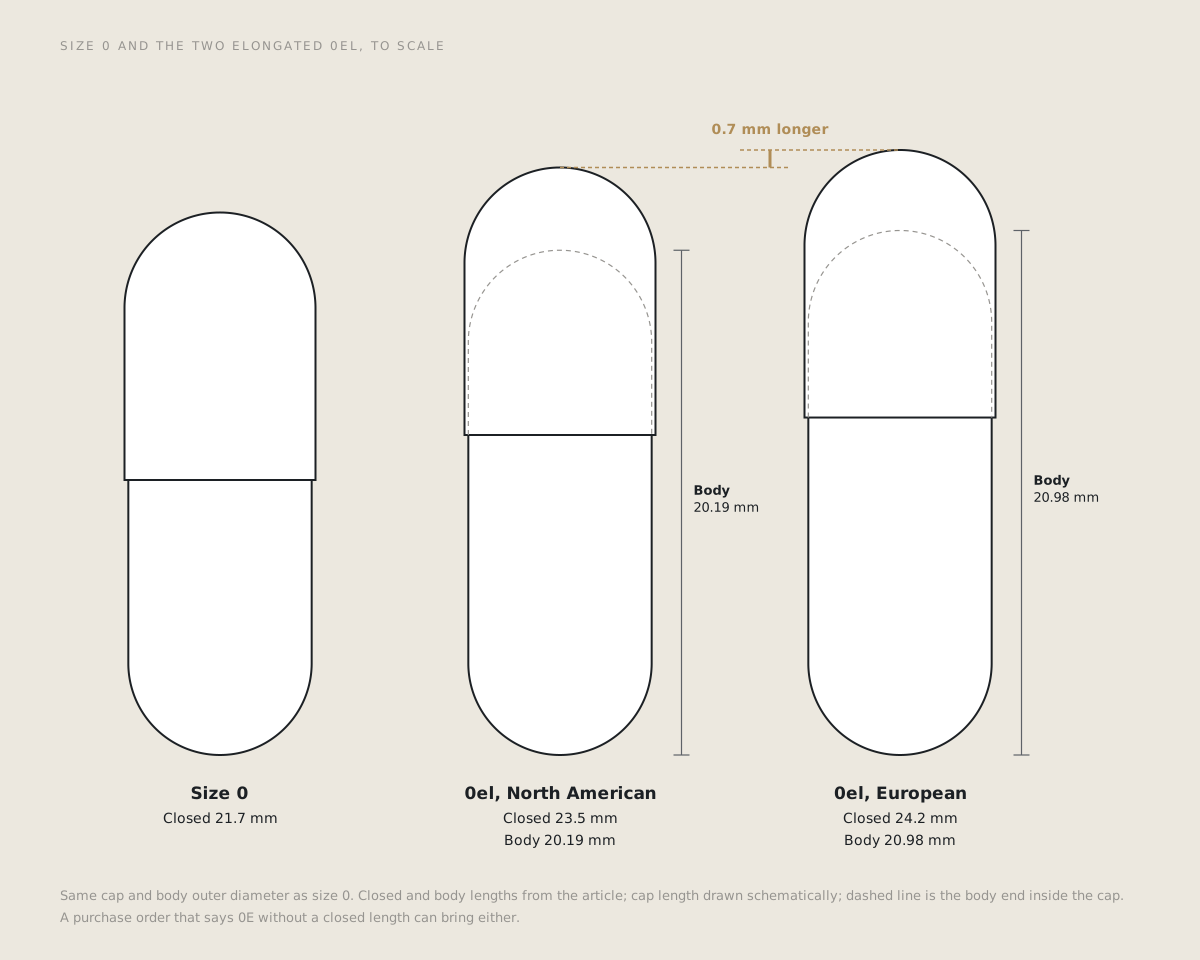
Some of them, and the first thing to settle is which elongated size you mean, because there are two different "0el" in circulation. The North American 0el closes at 23.5 mm with a 20.19 mm body. The European 0el closes at 24.2 mm with a 20.98 mm body. The large European maker prints both on the same sheet, one marked "Europe only." The Japanese maker's 0E and the Indian maker's "0el+" match the European one. The Korean maker's 0EL and the North American maker's 0E match the North American one. The Indian maker also lists a "0xel" at 24.8 mm. A purchase order that says "0E" without a closed length can bring either, so the closed length belongs in your request for quotation for empty capsules.
The diameters don't change. Each maker's elongated size in the tables shares its parent size's cap and body OD to the hundredth, so the diameter-critical parts (segments, disc bores, pins, nozzles) serve both. The length changes by 0.9 to 2 mm on the body, and that's where the parts and settings change. Bore depth in the segments, the rectifier slot and finger travel, the separation pin gap, and the closing stroke. Machine makers don't publish a list of which parts differ, but the aftermarket shows what exists. One Italian machine has its own 0el rectifier assembly and 0el transfer pin mount. The semi-automatic ring fillers from one large maker have a separate "Size 00EL Capsule Filling Ring" with its own part number. The US plate filler maker lists "00el-2el" among its change part sizes and shares one tamper between "000 & 00el." So on an automatic, budget for a partial set, and ask the machine maker which parts by part number rather than assuming the size 0 set will do.
The over-encapsulation sizes (the "DB" or "safety capsule" sizes A to E, with a cap that covers the body) are their own tooling sets, and the machine makers list them separately for that reason. The clinical trials article covers when you need a double-blind capsule and when a standard opaque one will do.
What dosing disc thickness goes with each size?
A range, because a disc is a size plus a fill depth, and the same size runs on discs from about 6.5 mm to 24 mm depending on the powder. The disc's bore diameter goes with the capsule size. Its thickness sets the plug height, and with the powder's density that sets the fill weight, which is why the dealers list discs as "size plus a fill dimension" and why one trade article recommends "three disks per capsule size, the thickest, thinnest and a mid-size."
Table 6. Dosing disc thickness by size, as published. One Chinese machine maker's "standard max" per size, and the thicknesses actually listed for sale by the used-equipment dealers for one common German tamping machine family. These are what exists, not what your powder needs. The fill weight article works through the arithmetic from density to plug height, and the least and the most a tamping-pin machine can put in a capsule.
| Size | One maker's "standard max" disc | Thicknesses listed for sale, common German tamping machine | Same, larger-frame US clone |
|---|---|---|---|
| 000 | not published | not listed | 18.7, 25 mm |
| 00 | 23.8 mm | 15, 18, 18.7, 20, 20.5, 21, 22 mm | 26 mm |
| 0 | 23.8 mm | 10, 18, 19.2, 19.8, 20, 20.2, 21, 21.8, 24 mm | 18, 20 mm |
| 1 | 20 mm | 10.3, 10.5, 12.5, 13.2, 14.5, 15, 16, 16.5, 17, 17.5, 18.9, 19.4, 21.7, 24 mm | not listed |
| 2 | 17.5 mm | 13.6, 14.5, 15, 15.6, 16, 16.2, 16.5, 16.6, 17, 17.2, 17.5 mm | not listed |
| 3 | 16.5 mm | not listed | 15 mm |
| 4 | 14.5 mm | 6.5, 7, 7.5, 8, 8.5, 9, 10, 12 mm | not listed |
| 5 | 10.5 mm | not listed | not listed |
Swipe across to see every column.
The pins are set to the disc. The usual rule, from the same trade article, is that station one enters about three quarters of the disc thickness, station two about half, station three a quarter, station four a few millimeters, and station five "just touching the top of the formed slug." A tooling maker's article gives tamping force at 30 to 75 N and equal-step pin heights, and says to adjust station five "below the top of the dosing disk by no more than 1mm" to add weight.
What does each machine family accept?
The table below is what the machine makers say on their own pages and brochures, copied as printed, with the dosing principle, because the compatibility questions differ between a tamping machine (the plug is formed in a disc and pushed in) and a dosator machine (a nozzle enters the body). Machine makers are named, since these are their published claims about their own products. Capsule makers on this page are not, because Capsules.com names the maker of a capsule after purchase.
Table 7. Sizes accepted and dosing principle by machine family. Verbatim from the makers' technical data where given.
| Family | Dosing principle | Sizes accepted, as published | Changeover claim |
|---|---|---|---|
| Syntegon (ex Bosch) GKF 60, 720, 1400, 1500, 2000, 2500, 2600, Capsylon | Tamping pin and dosing disc; dosator, pellet, tablet, and liquid stations as options | "For all common capsule sizes"; aftermarket sets exist in 000 to 5 | Dosing module change "in less than five minutes"; no capsule-size figure |
| IMA Zanasi 6, 12, 25, 40, Plus | Dosator | "000-5, supro A-E, DB, DBAA" | "Quick size changeover" |
| IMA Adapta 100, 200 | Dosator | "5-00EL (000*), DB E-A (AA*)" | not stated |
| IMA Practica 100, 200 | Dosator | "5-00EL, 000, DB" | not stated |
| IMA Imatic 100, 150 | Dosator, continuous | "000-5-Supro A-E, DB, DB.AA, vegicaps" | "Easy size changeover" |
| MG2 Planeta, FlexaLAB, Futura | Dosator, continuous; disc on some | FlexaLAB "from 000 to 5 tamperproof (DB), elongated, HPMC, vegetal & special capsules"; Planeta "from 000 to 5, including tamper-proof" | not stated |
| ACG AF 90T, AF 150T, AFT Lab; AF 40D | Tamping pin ("slug dosing") on T models; dosator on 40D | "000 - 5" | "Quick and easy mechanical changeover" |
| Fette FEC 20, FEC 40 | Tamping pin stations, removable | "000 to 5" | "By far fastest format changeover on the market," no figure |
| Harro Höfliger Modu-C LS, CS, MS, HS | Modular trolleys, dosator, tamping, or drum | Not published on the pages reached; a used LS listed with parts for 0, 1, 2, 3 | Dosing trolley swaps |
| Sejong SF-40N and family | Tamping pin | "#00~#4 / #000, #5 (Option)" | not stated |
| Dott. Bonapace In-Cap | Tamping and dosator, both | "000-00el-00-0el-0-1el-1-2el-2-3-4-5 and all DBCaps" | Dosator kit "6 parts," "< 5min (no tools required)" |
| Romaco Macofar CD 40, CD 60 | Dosator | "00 - 0 - 1 - 2 - 3 - 4 - 5" (no 000) | "Minimum format parts" |
| NJP series and Chinese equivalents (NJP-400 to 3800) | Tamping pin; dosator variants offered | "000 to 5" at most sellers; "00#~5# and safety capsule A~E" at one; some models "limited to #00-#5" | "Change mould <15 minutes" at several sellers |
| Semi-automatic ring fillers (CGN-208 family, DTJ-C, and the large maker's Cap 8 and Ultra 8) | Auger into a rotating ring | "#000 to #5" with mould sets (CGN-208); "00#-4#" (DTJ-C); 000 to 4 plus 00el and DB rings on the aftermarket for the Ultra 8 | "1-2 hours" (one vendor, for the semi-automatics) |
| US 300-hole plate filler (ProFiller 3700 family) | Manual plate and tamper | "000-5, 00el-2el & AAA-D" on the 3700; "00-4" on the 3800 and X900 | "All Change Parts marked & fit adjustment free" |
| Hobby plate fillers (24 to 400 holes) | Manual plate and tamper | One size per machine or per plate | Not applicable |
Swipe across to see every column.
Two notes. The one maker that lists "vegicaps" as a format is a reminder that some machine makers size their machines for HPMC as a named type even though the dimensions match. And "safety capsule A-E" on a Chinese seller's page is the over-encapsulation DB size range under another name.
Why do capsules from a new supplier crush, split, or not seat on my plate filler?
Because the capsule isn't round, or it's the wrong moisture, or it's a different length than the plate was designed around, in roughly that order of likelihood, and the reviews on the small-machine sites tell the story better than any spec sheet. We read fifty-four threads and review pages where people filling by hand or on a bench-top machine described what went wrong. The industrial operators don't post about capsule brands against their machines in public, so the record is at the small end, where the machine has the least adjustment and the capsule has to be right.
Out of round is the most common specific complaint. "Not round, they are oval... It makes them break when I make them." "Mis shaped mouths that would not work when loading." "About 30 to 35% of them are bent and will not go together." Ovality is the tolerance nobody publishes, and a hand plate has no vacuum and no stepped bore to pull an oval cap round. Separated capsules, sold as loose caps and bodies for the plates that want them that way, feature in most of these complaints, because a cap that isn't held on a body has nothing keeping it round in the bag.
Moisture is the next one, both ways. One plate filler maker's own page says capsules "absorb moisture and expand" and "can jam in The Capsule Machine even if they are 'new' because humidity can go through plastic bags," and that capsules "can also become too dry and thereby get too small," in which case "the tops may fall out." A reviewer describes the dry case. Capsules "too small and keeps falling out of the top of the machine." That's the 0.5% per 1% rule doing its work on a plate with no clearance to spare, and it's a storage problem rather than a maker problem (the storage article covers how to store an opened carton).
Then the box that measured differently. One reviewer of a US capsule seller wrote that size 00 capsules from a local health-food store "were too narrow and did not fit The Capsule Machine," while the seller's own were "wide enough and fit perfectly." Given Table 1, a size 00 body that's "too narrow" for a plate cut for 8.18 mm is more likely to be a dry capsule or a mislabeled one than a maker's different nominal, but the reviewer's experience is real and the fix was the same either way. A different box. The clearest switching story in the sweep is a Trustpilot review from a user filling size 000 by the thousand. "I wanted a change of supplier what a big mistake. Of the 1000 capsules over 300 failed... ordered 1000 from my old supplier i filled 400 today NO failures." That's a 30% failure rate against zero, on the same machine, and the reviewer went back. The lesson for a small filler is the same as for a big one, and it's the hand check before the trial run. Run a hundred by hand before you run the box.
Two smaller patterns. HPMC divides the plate-filler crowd. Some report it "more brittle than gelatin and tend to be more fussy" and that it "does not close or compact as well," and some report "never a problem." That matches the makers' position that the dimensions are the same and the feel is different, on a machine where the operator's thumb is the closing station. And tamper pins come up at the small end where they don't at the large. "Tamper pegs are way too skinny" on a 00 kit, with a workaround of running the 000 tamper, which is the body inner diameter pair from the section above, met by hand.
What should I do before switching capsule supplier on a running machine?
Get a sample box, measure capsules from it against the sheet and against what you're running now, and run it on the machine with the settings written down before and after. The switching article has the full plan across the four gates, the trial protocol, and the change control write-up. The machine-specific part is this.
Ask the new maker for the specification sheet with tolerances and the moisture at which they apply, and put it next to the sheet for the capsule you run today. Compare cap OD, body OD, closed length, and wall thickness if either sheet has it. Diameter differences inside 0.05 mm are noise. A closed length difference of 0.3 mm or more is a closing station reset, and you'd rather know before the trial than during it.
Measure twenty of the sample with a ring gauge and a length gauge, at your room's conditions, and record the room. If the sample doesn't go through the ring gauge for its size, stop there and talk to the maker. If the closed length after a hand close is off the sheet, the sheet is wrong or the lock is different, and either way the closing station needs to know.
Gauge your bores before the trial, so a worn segment doesn't get blamed on the new capsule.
Run the trial with the vacuum at the low end, the closing depth at the new sheet's closed length, and the separation pin gap checked. Count rejects by type at the rectifier, the separation station, and the closing station, because each one points at a different pair from the section above. Rectifier rejects are length or ovality. Non-separation is pre-lock force or cap diameter. Splits and dents at closing are closed length or alignment. The troubleshooting article's quick reference table of filling faults has the ranked causes for each.
Write the settings down. The vacuum, the closing depth, the disc and pin settings, the room conditions, and the reject rate by type, on the old capsule and on the new. That record is the change control, and it's what the quality manager signs. It's also what you'll want in six months when the third lot arrives and someone asks whether it ran like the first.
A Capsules.com sample is one box of any standard size at the single-box price, paid up front and credited against your first order of the same product, and the sheet comes with it.
Machine fit checker
Pick your machine type and capsule size, enter what you measured if you've measured it, and the checker shows the published envelope for that size across the makers in Table 1, whether your capsule sits inside it, the body's inner diameter that the pin or nozzle has to clear, how far the closed length is from what your machine is set to, and the list of parts to gauge on your type of machine before the trial. Nothing you enter leaves the page. The prompt pack below does the same job in your AI assistant, with the reference data attached and room to build the trial protocol and the change record. Get the AI prompt pack.
What is an AI prompt pack?
An AI prompt pack is a small set of files you load into the AI assistant you already use. The assistant then asks you the right questions, works through them with you using our reference data, and shows its working as it goes. We publish one with each article. We did the prompt engineering so you don't have to. Each prompt has been engineered so it asks the right questions in the right order, carries the reference data it needs, and says plainly what it doesn't know.
Inside the Capsule Machine Fit AI Prompt Pack is a prompt file that turns your assistant (Claude, ChatGPT, Gemini, Grok) into a machine fit reviewer for empty capsules, a workbook it fills in as you go, and the reference tables from this page. It walks you from your machine and size to the published envelope, the body inner diameter your tooling has to clear, the length settings that change with a new maker, a twenty-capsule measurement log, a trial run protocol with rejects counted by station, and the change record for your quality system.
Why a pack and not just a table? Because the answer depends on your machine's dosing principle, your room, and the capsule you run today, and a table can't ask which closed length your closing station is set to. It's the conversation we'd have with you on a call, packaged so you can have it at the machine with the sample box open.
Use the form below to request this resource. Newsletter updates are a separate, optional choice.
Get the Capsule Machine Fit AI Prompt Pack
Request the Capsule Machine Fit AI Prompt Pack
Leave your details to request this resource.
If you'd rather talk it through, reply to any email from us or write to us through the contact page. A person who has stood at an encapsulator with a box of the wrong capsules will get back to you. If you want a sample box, ask.
Related.
- Switching capsule supplier without stopping the line
- Capsule filling faults and troubleshooting
- Capsule sizes, volumes, and fill weights
- Capsule fill weight from bulk and tapped density, and what tamping adds
- Gelatin vs HPMC capsules. Which to use, and why
- Capsule moisture, storage, and shelf life
Sources.
- Capsule maker specification sheets. Capsugel (Lonza) Coni-Snap brochure 2011, "Properties and specifications" (mirror at mc100.ru; Medisca 2021 reprint); Capsugel white paper BAS 416, Vcaps Plus (pharmaexcipients.com copy); Lonza Vcaps Plus FAQ, capsugel.com. ACG Technical Manual, Hard Gelatin Capsule Shells, Dimensions (acgcapsule.weebly.com mirror) and ACG "Standard sizes of two-piece capsules," FDA docket FDA-2013-N-1434-0006. Qualicaps Technical Manuals, Quali-G and Quali-V, section 3.2 (falcaoteles.pt copies) and Quali-V brochure, qualicaps.com. Suheung EMBO CAPS Specification, suheung.com. CapsCanada K-Caps size chart, kcaps.com, and lyfegroup.com/capsule-sizes; Farmacapsulas K-CAPS table, February 2024. Erawat Pharma technical specifications, erawat.com. Sunil Healthcare specifications, sunilhealthcare.com. HealthCaps India brochure, June 2023. Torpac capsule size chart 2000 (pennvet.com mirror). Reseller reprints of the same sheets were checked for the copy chain.
- Standards and guidance. Indian Pharmacopoeia general chapter 5.8.1, Dimensions of Hard Gelatin Capsule Shells, https://www.ipc.gov.in/images/news/581-4636657156.pdf. T/CNPPA 3008-2020, Vacant Capsules Size and Appearance Quality, cnppa.org. FDA MAPP 5016.6 (capsule shell supplier change classification), https://www.fda.gov/media/99625/download.
- Patents. US5698155 and EP0781541 (HPMC capsule manufacture; Capsugel dimension, wall thickness, and mould pin tables; pin undersizing 0.05 to 0.15 mm; https://patents.google.com/patent/US5698155). EP0246804 (Lilly, cap ovality figures). US3664495 (Parke-Davis, pre-lock geometry). PL114266 (Capsugel, tapered rim). US6367228 and US8621825 (Bosch, stepped segment bores). US20170216147 (Bosch, separation). US4721230 (Lilly, rectification). US4394933 (Ackley, orientation). US4864876 (Warner-Lambert, dosing disc instrumentation). US11452673 and US12233031 (ACG, tamping and closing). US12213949 (Harro Höfliger). All via patents.google.com.
- Literature. Aulton's Pharmaceutics, chapter on hard capsules (B. E. Jones), wall thickness and the 0.5% per 1% moisture rule. Augsburger and Hoag (eds.), Pharmaceutical Dosage Forms, Capsules, CRC 2018, chapters on shell manufacture and filling machines (excerpts at basicmedicalkey.com). Angulo Pinzón, Modelling of dosator filling and discharge, PhD thesis, University of Greenwich, 2012, Table 2.2 (Harro Höfliger dosator dimensions) and the pin-to-nozzle clearance; Woodhead and Newton, J Pharm Pharmacol 1981, 33 Suppl 21P. Parker et al. (Qualicaps), ONdrugDelivery, November 2021, wall thickness measurement. Podczeck and Jones, Pharmaceutical Capsules, 2nd ed., 2004 (table of contents only; full text not consulted). Stegemann et al., empty capsule dimensions and weight as critical quality attributes, AAPS PharmSciTech 2014, https://pmc.ncbi.nlm.nih.gov/articles/PMC4037476/.
- Machine makers and tooling. Syntegon GKF Selection, Performance, and Capsylon pages, GKF 720 and 2600 brochures, and the Bosch aftermarket catalog (tooling wear gauge sets), syntegon.com and pdfcoffee.com. IMA Zanasi, Adapta, Practica, Imatic pages and the Zanasi brochure October 2023, imagroup.com. MG2 and MG America Planeta and FlexaLAB pages (MG2 Planeta, MG2 FlexaLAB, MG America Planeta, MG America FlexaLAB). ACG AF 90T, AF 150T, AFT Lab pages and the Pam AF-90T datasheet (formpak.com). Fette Compacting capsule filling page; Manufacturing Chemist on the FEC 40. Harro Höfliger magazine 11-2020 and 13-2022. Sejong SF-40N specification via Key International. Dott. Bonapace In-Cap SE page. Romaco CD series page and the Macofar CD catalog (medicalexpo). Torpac ProFiller 3700/3800/X900 brochure (Fagron copy). Natoli Engineering, Proper capsule segment alignment (2022) and encapsulation parts pages; Jon Carlisle, European Pharmaceutical Manufacturer, December 2022, and Tablets & Capsules, tamping. Steve Lee (CapsCanada), Eliminating mechanical defects in capsule closing, SupplySide, January 2010; Capsule separation, 5 steps, blog.lyfegroup.com, March 2022; rectification and separation posts, blog.lyfegroup.com. PharmParts (Federal Equipment), Indy Crossroads Equipment, LabX, SSLLC listings for change parts, discs, and prices. Fillitech, Trustar, SaintyTec, JinLu, Ruida, AIPAK, Finalwe, SED Pharma, and Anxine vendor pages (Chinese machine sellers; treated as vendor statements). CGN208-D3 user manual (Toolots). Herb Affair, Blated, LEADLIFE, Capsule Connection, Aviva Health product pages (plate fillers).
- Reviews and forums. Capsuline product reviews (Yotpo) and Trustpilot; Herb Affair product reviews (Judge.me); Reddit r/Nootropics, r/unclebens, and related threads 2012 to 2025; Capsule Connection FAQ and desiccant page; LinkedIn, Role of pre-locks in capsules (Hallmark pin bars), August 2023.
*Capsules.com supplies empty hard capsules in gelatin and HPMC to manufacturers, brands, pharmacies, and research teams. Capsules Direct Ltd, company number 17362490, 26 Rowood House, Bicester OX26 4PP, United Kingdom. UK 020 3905 1989 · US (816) 445-0042 · capsules.com. *