
Quality and documentation
What a certificate of analysis and a specification contain, and how to check one against the other
Read an empty capsule specification and certificate of analysis side by side, and work through the checks to make before accepting a lot.
Written by Dany, Capsules.com
On this page
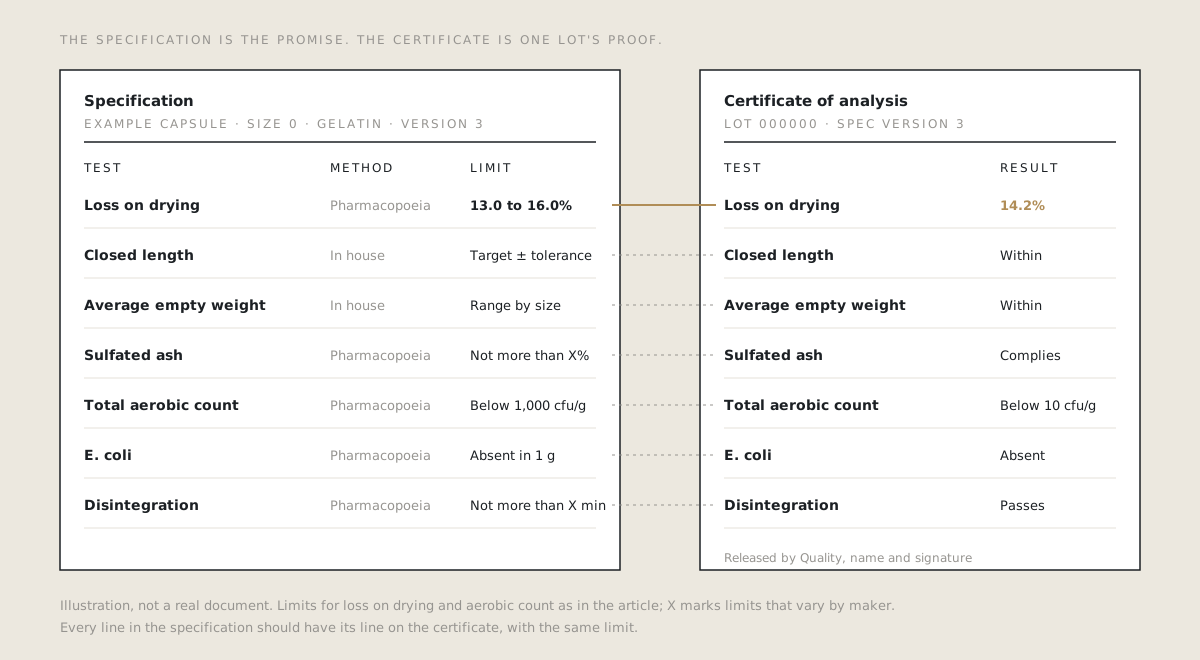
Every lot of capsules should arrive with two documents behind it. The specification is the promise. It says what every lot of that capsule will be, and the limits it has to fall inside. The certificate of analysis (COA) is the proof for one lot. It says what that lot measured when it was tested. Neither is much use on its own. A COA only means something when you hold it next to the specification it claims to meet.
Most people file both and never read them. That's a pity, because a five-minute check when a new lot arrives catches problems that would otherwise turn up as faults on the filling line. This page goes through both documents line by line, in plain language, for gelatin and HPMC capsules. It says what each line means, what a normal result looks like, and which lines matter on the machine.
If you'd rather check a COA with your own AI assistant, the Capsule COA Checker AI Prompt Pack at the foot of the page asks for the specification and the COA and tells you what's missing, what's out of limit, and what to ask.
- Specification or COA, what's the difference? And the other documents a supplier should send.
- What a specification contains. Identity, dimensions, chemistry, microbiology, defects, and storage.
- What a certificate of analysis contains. The header, the results table, and the sign-off.
- How to check a COA against the specification. Eight checks, and the red flags.
- Which lines matter on the filling line. The lines behind the faults in the troubleshooting guide.
- What a COA can't tell you. And what to check yourself.
- What to ask your capsule supplier. Six questions before the next order.
- The free AI prompt pack. The check sheet as a PDF, and the pack that reads a COA with you.
What's the difference between a specification and a certificate of analysis?
The specification is written once for a product and applies to every lot. The COA is issued for one lot and reports that lot's results against the specification. If the specification is a list of questions with the acceptable answers, the COA is one lot's answers.
The specification. One document per product, sometimes one per material covering every size. It lists each test, the method used, and the limit. It has a version number and a date, and it changes only through the supplier's change control. You should have a copy before your first order, and you should be told before it changes.
The certificate of analysis. One document per lot. It carries the lot number, the dates, the result of each test, and a signature from the person who released the lot. It should reference the specification it was tested against, by number and version.
A supplier usually sends other documents as well. They answer different questions, and none of them replaces the COA.
Table 1. The documents a capsule supplier sends, and what each one answers.
| Document | How often | What it answers |
|---|---|---|
| Specification | Once per product, reissued on change | What every lot will be, and the limits |
| Certificate of analysis (COA) | Every lot | What this lot measured |
| Technical data sheet (TDS) | Once per product | Sizes, dimensions, and handling, for setting up. Often looser than the specification |
| Safety data sheet (SDS) | Once per product | Handling and storage safety. Short for empty capsules |
| Statements | Once, renewed as they expire | Allergens, GMO status, animal origin and BSE/TSE for gelatin, colorants, dietary suitability, religious certification where held |
| Certificate of conformance | Sometimes, per lot or per shipment | That the lot meets the specification, without the results. Not a substitute for a COA |
Swipe across to see every column.
Statements and certificates have dates. I'd keep a list of when each one expires, because an out-of-date statement is one of the first things an auditor finds.
What does a capsule specification contain?
Six groups of lines. What the capsule is, its size and weight, its chemistry, its microbiology, how it performs, and the defects allowed. Makers lay them out differently, but a complete specification covers all six. If a group is missing, ask for it.
1. Identity. Material (gelatin or HPMC, and the gelatin source), size, cap and body color, opacity, any printing, and the pharmacopoeia or food standard the capsule is made to. It should also name the colorants and whether titanium dioxide is used.
2. Dimensions and weight. Cap length, body length, closed (joined) length, outside diameter of cap and body, and average empty weight. Each has a target and a tolerance. Some makers also give wall thickness and body volume. These are the lines your machine cares about most.
3. Chemistry.
- Identification. Confirms the shell is the material it says it is.
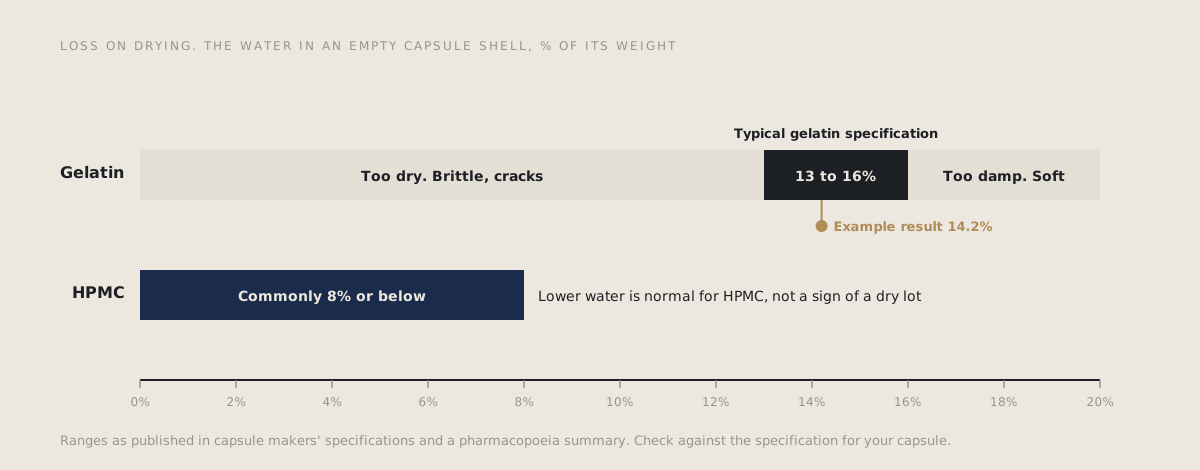
- Loss on drying (LOD). The water in the shell, as a percentage of its weight. For gelatin it's usually 13 to 16%. HPMC holds much less, and specifications commonly cap it at 8% or below.
- Sulfated ash (or residue on ignition). What's left after the shell is burned. It shows the level of mineral content, including opacifiers and pigments.
- Sulfur dioxide. Gelatin only. A residue from gelatin processing, limited in parts per million.
- Elemental impurities or heavy metals. Lead, arsenic, cadmium, mercury, and others, usually against a recognized limit for medicines or supplements.
- Lubricant. The release agent used on the dipping pins, limited to a small percentage.
4. Microbiology. Total aerobic count, total yeast and mold count, and the absence of specific organisms. A typical set of limits is below 1,000 cfu/g for aerobic count, below 100 cfu/g for yeast and mold, and E. coli, Staphylococcus aureus, and Pseudomonas aeruginosa absent in 1 g, with Salmonella absent in 10 g.
5. Performance. Disintegration time, the time it takes the shell to break up in water at body temperature. Gelatin capsules typically pass well within 15 minutes. Some specifications add dissolution for HPMC, or disintegration in acid.
6. Visual defects. The defects the maker inspects for, sorted into critical, major, and minor, with an acceptable quality level (AQL) for each. The AQL is the defect rate the sampling plan is built to accept. Critical defects are the ones that stop a capsule working, like a hole or a missing body. Major ones cause trouble on the machine, like a double cap or a short body. Minor ones are cosmetic, like a small spot.
The last lines are storage conditions, packaging, and shelf life. Capsule makers publish storage at 15 to 25 °C (59 to 77 °F) and 35 to 65% RH. The moisture and storage article covers why.
Table 2. Specification lines at a glance, and what each one tells you.
| Line | Typical limit | What it tells you |
|---|---|---|
| Closed length | Target ± a few tenths of a mm, by size | Whether the capsule will lock and seat on your change parts |
| Outside diameter | Target ± a few hundredths of a mm | Whether it will drop into the segment bores and separate cleanly |
| Average empty weight | A range, by size | Wall thickness, indirectly. Also what to subtract when you check fill weight |
| Loss on drying, gelatin | 13 to 16% | Whether the shell will be flexible or brittle |
| Loss on drying, HPMC | Commonly 8% or below | Normal for the material, not a sign of a dry lot |
| Sulfated ash | A maximum % | Mineral and pigment content |
| Sulfur dioxide (gelatin) | A maximum in ppm | Gelatin processing residue |
| Elemental impurities | Maximums in ppm | Safety for medicines and supplements |
| Microbiology | Below 1,000 cfu/g aerobic, below 100 cfu/g yeast and mold, named organisms absent | Hygiene of manufacture |
| Disintegration | A maximum time in minutes | Whether the shell releases the fill |
| Visual defects | An AQL per class | How many defects the lot can carry and still pass |
Swipe across to see every column.
What does a certificate of analysis contain?
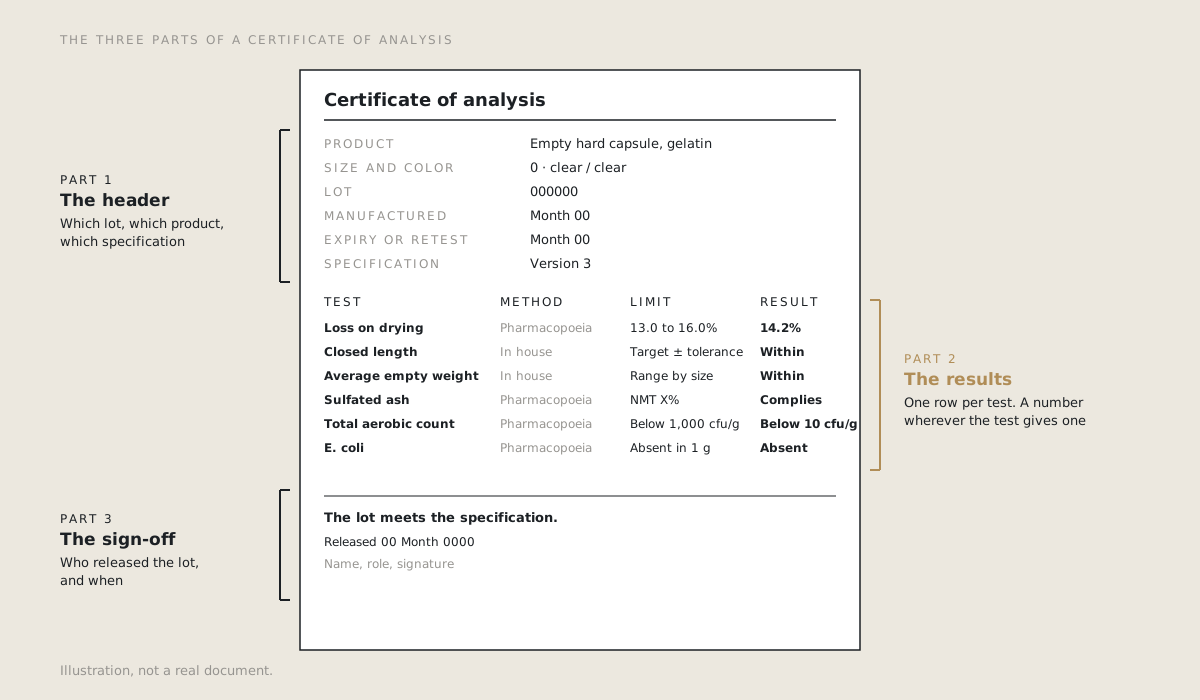
Three parts. A header that identifies the lot, a results table that reports each test against its limit, and a sign-off that releases it.
The header. Product name, material, size, cap and body color, lot number, date of manufacture, and expiry or retest date. It should also name the specification and its version, and the quantity in the lot if the maker reports it.
The results table. One row per test, with four columns. The test, the method, the limit from the specification, and the result. A good COA reports a number wherever the test gives one. Loss on drying reads 14.2%, not "conforms". "Conforms" or "complies" is normal for tests that pass or fail, like identification or the absence of Salmonella.
The sign-off. A conclusion that the lot meets the specification, the date of release, and the name, role, and signature of the person who released it, usually in quality.
Whose COA is it?
How do I check a COA against the specification?
Put the two side by side and work down eight checks. It takes about five minutes a lot, and it's worth doing before the lot goes anywhere near the machine.
- The lot number matches the carton label. Every carton, not just the first one opened.
- The product matches your order. Material, size, and both colors.
- The specification version matches the one you approved. If it's a newer version, ask what changed.
- Every test in the specification is on the COA. A test left off isn't a pass.
- The limits on the COA are the limits in the specification. Not wider.
- Every result is inside its limit, and numeric where the test gives a number.
- The dates make sense. Tested after manufacture, released before shipping, and an expiry or retest date that covers the time you'll hold the stock.
- It's signed and dated by a named person.
Red flags. These don't prove anything is wrong, but I'd ask about each one.
- Results that are identical from lot to lot. Real measurements vary a little.
- "Conforms" against tests that give a number, like loss on drying or weight.
- A result sitting right on the limit, lot after lot.
- No method column, or no specification reference.
- A COA dated before the lot was made, or long after it shipped.
- A lot number on the COA that isn't on the cartons.
Can I rely on the supplier's COA instead of testing?
Often, yes, once you've shown the supplier's COAs can be trusted. In the US, the supplement manufacturing rule lets you rely on a supplier's COA for components other than dietary ingredients, which includes capsules, if you first qualify the supplier by confirming their results with your own tests, the COA shows the method, the limits, and the actual results, you document how you qualified them, and you re-confirm periodically. Other markets and medicines have their own rules, so check with your quality lead.
That's the other reason numeric results matter. You can't confirm a supplier's "conforms" with your own test. You can confirm 14.2%.
Which specification lines matter on the filling line?
The dimensions, the weight, the loss on drying, and the visual defects. Microbiology and disintegration matter to your product and your regulator, but they don't change how a capsule runs. When a fault starts with a new lot, these are the lines to pull out and compare with the last lot that ran well.
Table 3. Faults from the troubleshooting guide, and the line to check.
| Fault on the line | Line to check | What to look for |
|---|---|---|
| Cracking or brittle gelatin shells | Loss on drying | A result at the bottom of the range, or below it |
| Soft shells, dented caps | Loss on drying | A result at the top of the range |
| Separating in the hopper | Closed length, diameters | A shift from the last good lot |
| Telescoping or not locking | Closed length, cap and body length | Results near either end of the tolerance |
| Splitting at separation | Average weight | A light lot, which can mean thin walls |
| New supplier's capsules jam | All dimensions | Compare with the old supplier's specification, not only the COA |
| Double caps, short bodies, pinholes | Visual defects and AQL | Whether these are major or critical, and the AQL for each |
Swipe across to see every column.
The troubleshooting guide has each fault in full, and what to send the supplier if it is the capsule.
What can't a COA tell you?
What happened to the lot after it was tested. A COA reports a sample taken at the factory. It doesn't know how the cartons were stored in transit or in your warehouse, and moisture moves after testing.
- It's a sample, not every capsule. Dimensions and defects are checked on a sample plan. Ask whether the maker also inspects every capsule by camera.
- Moisture on the day of test. A gelatin lot that left the factory at 14% can arrive drier after a hot, dry shipment, or softer after a damp one.
- Some tests aren't run on every lot. Elemental impurities, for example, are often tested periodically and reported as "complies". That's normal, but the COA should say so.
- Transit damage. Crushed cartons, split inner bags, and heat damage all happen after release.
So I'd do three quick checks on arrival as well. Look at the cartons and the inner bags. Count separated or damaged capsules in a sample from an unopened carton. And if you have a moisture balance, check loss on drying on a gelatin lot against its COA.
What should I ask my capsule supplier about specifications and COAs?
Whether you'll get the numbers, and whether you'll be told when anything changes. These six questions are worth asking before the next order, whoever you buy from.
- Can I have the current specification, with its version number, before I order?
- Will I be told before the specification, the material, or the manufacturing site changes? This is change control, and it's the question most people forget.
- Does every lot come with a COA, with numeric results?
- Which tests are run on every lot, and which periodically?
- Which methods do you use? A pharmacopoeia method is the answer you want.
- Which statements do you hold, and when do they expire? Allergens, GMO status, BSE/TSE for gelatin, colorants, and any religious or dietary certification.
A supplier who sends all of that without being chased is one I'd trust with a line. The supplier approval article goes further into the documentation side.
Get the Capsule COA Checker AI Prompt Pack
Request the Capsule COA Checker AI Prompt Pack
Leave your details to request this resource.